 Back
7 Kinetic Molecular Theory of Gases and Gas Laws
Study Guide - Smart Notes
 Tailored notes based on your materials, expanded with key definitions, examples, and context.
Kinetic Molecular Theory of Gases
Introduction to Kinetic Molecular Theory (KMT)
The Kinetic Molecular Theory (KMT) provides a microscopic explanation for the macroscopic properties of gases. It describes the behavior of ideal gases by considering their molecular composition and motion.
Key Point 1: Gases consist of a large number of tiny particles (atoms or molecules) in constant, random, straight-line motion.
Key Point 2: The volume of the individual gas particles is negligible compared to the total volume of the gas.
Key Point 3: Gas particles undergo elastic collisions with each other and the walls of their container, conserving total energy.
Key Point 4: There are no intermolecular forces between gas particles except during collisions.
Key Point 5: The average kinetic energy of gas particles is proportional to the absolute temperature of the gas.

Additional info: These postulates explain why gases expand to fill their containers and why they are easily compressible.
Explaining Gas Laws with KMT
The KMT provides a molecular-level explanation for the empirical gas laws:
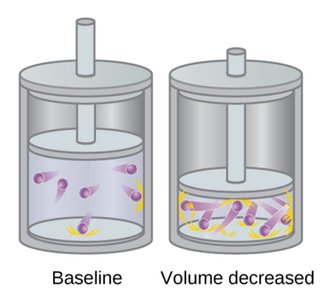
Boyle’s Law (P ∝ 1/V at constant T, n): Decreasing the volume increases the frequency of collisions with the container walls, raising the pressure.
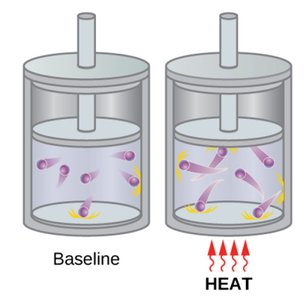
Charles’ Law (V ∝ T at constant P, n): Increasing temperature increases the kinetic energy and speed of molecules, requiring a larger volume to maintain constant pressure.
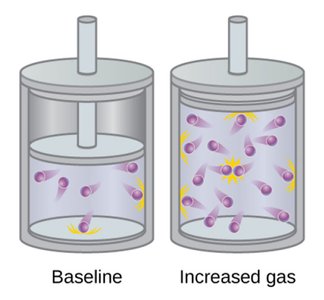
Avogadro’s Law (V ∝ n at constant T, P): Increasing the number of molecules increases the number of collisions, so the volume must increase to keep pressure constant.
Amonton’s Law (P ∝ T at constant V, n): At constant volume, increasing temperature increases the kinetic energy and collision frequency, raising the pressure.
Dalton’s Law of Partial Pressures: The total pressure exerted by a mixture of gases is the sum of the partial pressures of each individual gas, as each acts independently.
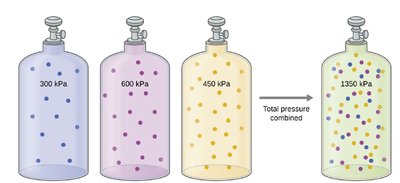
Gas Collection Over Water
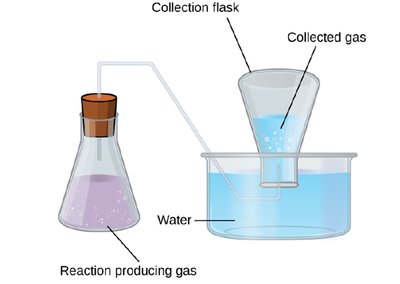
When collecting a gas over water, the total pressure is the sum of the gas pressure and the vapor pressure of water. The vapor pressure depends on temperature and must be subtracted from the atmospheric pressure to find the pressure of the collected gas.
t, °C | kPa | mmHg |
|---|---|---|
15.0 | 1.706 | 12.79 |
17.0 | 1.938 | 14.54 |
19.0 | 2.198 | 16.49 |
21.0 | 2.448 | 18.66 |
23.0 | 2.811 | 21.08 |
25.0 | 3.170 | 23.78 |
30.0 | 4.247 | 31.86 |
50.0 | 12.35 | 92.65 |
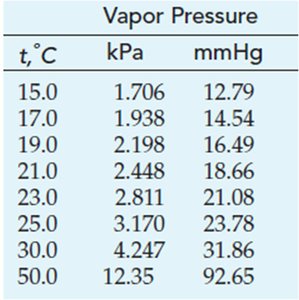
Example: If 81.2 mL of O2 is collected over water at 23°C and 100.1 kPa, the pressure of O2 is found by subtracting the vapor pressure of water (2.811 kPa at 23°C) from the atmospheric pressure.
Additional info: The number of moles can then be calculated using the ideal gas law: .
Molecular Speed and Kinetic Energy
Distribution of Molecular Speeds
Not all molecules in a gas move at the same speed. The distribution of speeds is described by the Maxwell-Boltzmann distribution, which shows the fraction of molecules at each speed.
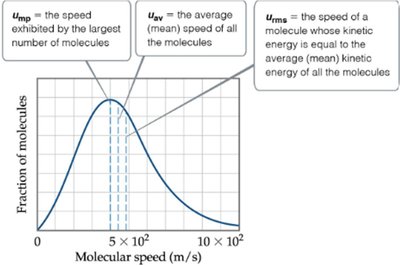
ump: Most probable speed (peak of the curve)
uav: Average speed
urms: Root-mean-square speed, related to average kinetic energy
The root-mean-square speed is given by:
where R is the gas constant, T is temperature in Kelvin, and M is molar mass in kg/mol.
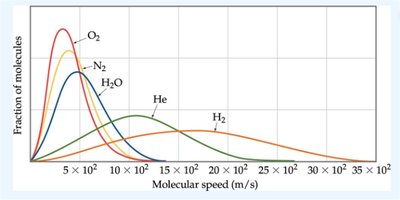
Example: Lighter gases (e.g., H2) have higher average speeds than heavier gases (e.g., O2) at the same temperature.
Kinetic Energy and Temperature
The average kinetic energy of a gas molecule is directly proportional to the absolute temperature:
where is the Boltzmann constant and is temperature in Kelvin.
Example: At a given temperature, all gases have the same average kinetic energy per molecule, regardless of their mass.
Diffusion, Effusion, and Mean Free Path
Diffusion and Effusion
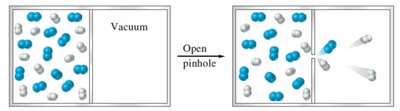
Diffusion is the mixing of gas molecules by random motion. Effusion is the escape of gas molecules through a small hole into a vacuum.

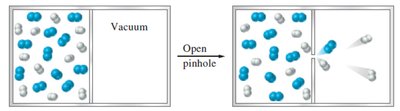
Graham’s law of effusion states:
where M is the molar mass of the gas. Lighter gases effuse and diffuse faster than heavier gases.
Mean Free Path
The mean free path is the average distance a molecule travels between collisions. It is affected by pressure and temperature.
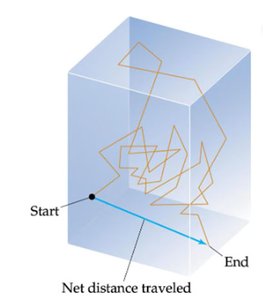
Additional info: At higher altitudes (lower pressure), the mean free path increases.
Heat Capacity and Degrees of Freedom
Degrees of Freedom
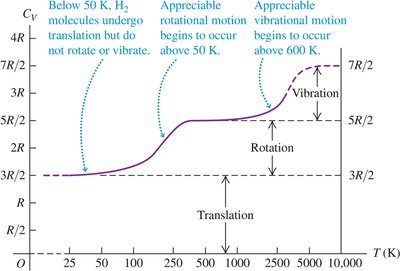
Degrees of freedom refer to the independent ways in which a molecule can store energy (translation, rotation, vibration).
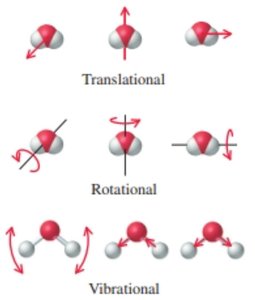
Monatomic gases: 3 translational degrees of freedom
Diatomic gases: 3 translational + 2 rotational (at room temperature); vibrational modes become significant at higher temperatures
Equipartition of Energy and Heat Capacity
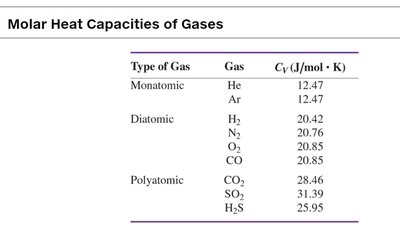
The principle of equipartition of energy states that each degree of freedom contributes equally to the total energy. For a molecule with d degrees of freedom, the molar heat capacity at constant volume is:
where R is the gas constant.
Type of Gas | Gas | Cv (J/mol·K) |
|---|---|---|
Monatomic | He | 12.47 |
Monatomic | Ar | 12.47 |
Diatomic | H2 | 20.42 |
Diatomic | N2 | 20.76 |
Diatomic | O2 | 20.85 |
Diatomic | CO | 20.85 |
Polyatomic | CO2 | 28.46 |
Polyatomic | SO2 | 31.39 |
Polyatomic | H2S | 25.95 |
Additional info: Quantum mechanics determines which degrees of freedom are active at a given temperature.
Summary Table: Gas Laws and KMT Explanations
Gas Law | Mathematical Form | KMT Explanation |
|---|---|---|
Boyle's Law | Decreasing volume increases collision frequency, raising pressure. | |
Charles' Law | Increasing temperature increases kinetic energy, requiring larger volume to maintain pressure. | |
Avogadro's Law | More molecules increase collisions; volume must increase to keep pressure constant. | |
Amonton's Law | Higher temperature increases kinetic energy and collision frequency, raising pressure. | |
Dalton's Law | Each gas acts independently; total pressure is the sum of partial pressures. |
