 Back
BackLaboratory Techniques, Measurement, and Error Analysis in General Chemistry
Study Guide - Smart Notes
 Tailored notes based on your materials, expanded with key definitions, examples, and context.
Laboratory Equipment and Techniques
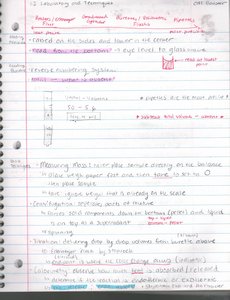
Common Laboratory Glassware
Laboratory glassware is essential for measuring, mixing, and transferring chemicals accurately. Each type of glassware has specific uses and limitations.
Beaker: Used for mixing, stirring, and heating chemicals. Not highly accurate for measuring volumes.
Erlenmeyer Flask: Used for mixing by swirling and heating. Not highly accurate for volume measurement.
Graduated Cylinder: Used for measuring liquid volumes with moderate accuracy.
Volumetric Flask: Used for preparing solutions of precise volumes. Highly accurate.
Buret: Used for titration, delivering precise volumes of liquid.
Pipet: Used for transferring exact volumes of liquid.
Dropper: Used for adding liquids dropwise.
Other Equipment
Balance: Used for measuring mass. Highly accurate, long, and graduated.
Spatula and Scoopula: Used for transferring solid chemicals.
Measurement Techniques
Reading Volumes and Masses
Proper measurement techniques are crucial for obtaining accurate and reliable data in the laboratory.
Reading Volumes: Always read the meniscus at eye level for glassware such as graduated cylinders and burets.
Measuring Mass: Use a balance. Never place chemicals directly on the balance; use a container or weighing paper.
Zeroing the Balance: Always tare the balance before measuring.
Significant Figures
Significant figures reflect the precision of a measurement. The number of significant digits depends on the instrument used.
Rules for Significant Figures:
Nonzero digits are always significant.
Zeros between nonzero digits are significant.
Leading zeros are not significant.
Trailing zeros in a decimal number are significant.
Example: 0.00250 has three significant figures.
Accuracy and Precision
Definitions and Comparison
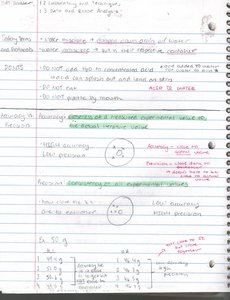
Accuracy and precision are important concepts in measurement. They describe how close measurements are to the true value and to each other.
Accuracy: How close a measurement is to the accepted or true value.
Precision: How close repeated measurements are to each other.
Comparison Table:
Term | Description |
|---|---|
Accuracy | Closeness to true value |
Precision | Closeness of repeated measurements |
Data and Error Analysis
Types of Errors
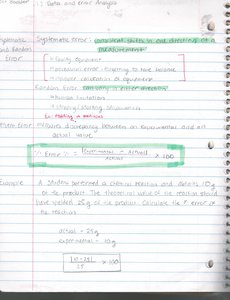
Errors in measurement can be classified as systematic or random. Understanding these helps improve experimental reliability.
Systematic Error: Consistent, repeatable error due to faulty equipment or technique. Affects accuracy.
Random Error: Unpredictable variations. Affects precision.
Percent Error Calculation
Percent error quantifies the difference between experimental and actual values.
Formula:
Example: If the actual mass is 25 g and the measured mass is 23 g:
Summary Table: Laboratory Glassware and Their Uses
Glassware | Use | Accuracy |
|---|---|---|
Beaker | Mixing, heating | Low |
Erlenmeyer Flask | Mixing, heating | Low |
Graduated Cylinder | Measuring volume | Moderate |
Volumetric Flask | Preparing solutions | High |
Buret | Titration | High |
Pipet | Transferring volume | High |
Additional info:
Laboratory safety is essential: Always wear goggles, gloves, and follow proper procedures.
Proper waste disposal and handling of chemicals are critical for safety and environmental protection.
