 Back
Lewis Structures and VSEPR Theory: Chemical Bonding and Lattice Energy
Study Guide - Smart Notes
 Tailored notes based on your materials, expanded with key definitions, examples, and context.
Lewis Structures and VSEPR Theory
Types of Chemical Bonds
Chemical bonds are the forces that hold atoms together in compounds. The three most important types of chemical bonds are:
Ionic Bonds: Formed by the transfer of electrons from one atom (typically a metal) to another (typically a nonmetal), resulting in the formation of oppositely charged ions.
Covalent Bonds: Formed when two atoms (usually nonmetals) share one or more pairs of electrons.
Metallic Bonds: Involve the pooling of valence electrons among a lattice of metal atoms, creating a 'sea of electrons' that accounts for metallic properties.
Representing Valence Electrons: Lewis Symbols
Lewis symbols are a simple way to represent the valence electrons of an element. Each dot around the chemical symbol represents one valence electron. For example, the Lewis symbols for the elements lithium through neon show the progressive filling of the valence shell.
Example: The Lewis symbol for carbon (C) has four dots, representing its four valence electrons.
Ionic Bonding
Formation of Ionic Bonds
Ionic bonding involves the transfer of electrons from a metal to a nonmetal, resulting in the formation of cations and anions. These oppositely charged ions are held together by strong electrostatic forces.
Example: In potassium chloride (KCl), potassium (K) donates one electron to chlorine (Cl), forming K+ and Cl- ions.
Lattice Energy
Lattice energy is the energy released when gaseous ions combine to form an ionic solid. It is a measure of the strength of the ionic bonds in a crystal lattice.
Lattice energy increases with higher ionic charges and decreases with larger ionic radii.
The formula for lattice energy (based on Coulomb's Law) is:
Where U is the lattice energy, Q1 and Q2 are the charges of the ions, r is the distance between ion centers, and k is a proportionality constant.
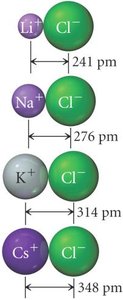
Trends in Lattice Energies: Ion Size
Lattice energy decreases as the ionic radius increases. Larger ions cannot approach each other as closely, resulting in weaker electrostatic attraction and lower lattice energy.
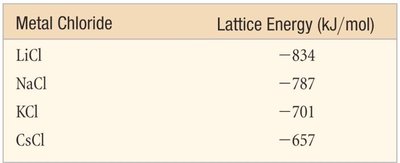
As you move down a group in the periodic table, ionic radii increase and lattice energy decreases.
Metal Chloride | Lattice Energy (kJ/mol) |
|---|---|
LiCl | -834 |
NaCl | -787 |
KCl | -701 |
CsCl | -657 |
Trends in Lattice Energies: Ion Charge
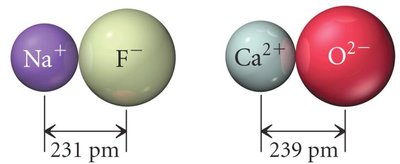
Lattice energy increases dramatically with increasing ionic charge. Even if the bond distance is longer, higher charges result in much stronger attractions and higher lattice energies.
For example, CaO (with Ca2+ and O2-) has a much higher lattice energy than NaF (with Na+ and F-).
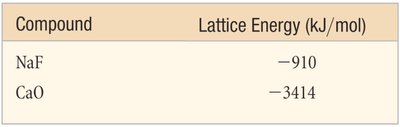
Compound | Lattice Energy (kJ/mol) |
|---|---|
NaF | -910 |
CaO | -3414 |
Example Problem: Which will have a higher melting point, NaCl or MgO? Answer: MgO will have a higher melting point because it has higher ionic charges (Mg2+ and O2-), resulting in a much higher lattice energy compared to NaCl (Na+ and Cl-).
Covalent Bonding
Single, Double, and Triple Bonds
Covalent bonds involve the sharing of electron pairs between atoms. The number of shared pairs determines the bond type:
Single Bond: One pair of electrons shared (e.g., H2, Cl2).
Double Bond: Two pairs of electrons shared (e.g., O2).
Triple Bond: Three pairs of electrons shared (e.g., N2).
Multiple bonds (double and triple) are shorter and stronger than single bonds.
Additional info: The strength and length of covalent bonds depend on the number of shared electron pairs and the atoms involved. Lewis structures are used to represent covalent bonding and predict molecular shapes using VSEPR theory.
