 Back
BackLewis Structures: Drawing and Interpreting Covalent Compounds
Study Guide - Smart Notes
 Tailored notes based on your materials, expanded with key definitions, examples, and context.
Lewis Structures
Introduction to Lewis Structures
Lewis structures are two-dimensional representations of covalent compounds (especially nonmetals) that show how atoms are bonded together and how valence electrons are distributed. These diagrams help visualize the arrangement of electrons in molecules and ions, which is essential for understanding molecular structure and reactivity.
Octet Rule: Most atoms (except hydrogen) tend to form bonds until they are surrounded by eight valence electrons.
Hydrogen Exception: Hydrogen only requires two electrons to achieve a stable configuration.
Bonding: A single line (–) represents a covalent bond (a shared pair of electrons).
Lone Pairs: Dots (:) represent non-bonding pairs of electrons, also called lone pairs.
Key Terms
Valence Electrons: Electrons in the outermost shell of an atom, involved in bonding.
Covalent Bond: A chemical bond formed by the sharing of electron pairs between atoms.
Lone Pair: A pair of valence electrons not involved in bonding.
Rules for Drawing Lewis Structures
Follow these steps to construct accurate Lewis structures for molecules and polyatomic ions:
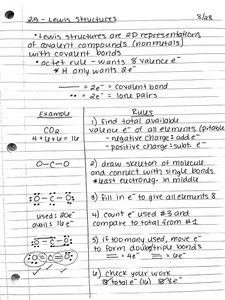
Find the total number of available valence electrons.
Add electrons for each atom in the molecule.
Add one electron for each negative charge (anion), subtract one for each positive charge (cation).
Draw the skeletal structure of the molecule.
Connect atoms with single bonds (usually the least electronegative atom is central, except hydrogen).
Distribute remaining electrons as lone pairs to complete octets.
If electrons remain, place them on the central atom.
If octets are incomplete, form double or triple bonds as needed.
Check your work.
Ensure all atoms (except hydrogen) have an octet.
Count total electrons to confirm accuracy.
Example: Drawing the Lewis Structure for CO2
Step 1: Count valence electrons: C (4) + 2 × O (6) = 16 electrons.
Step 2: Draw skeletal structure: O–C–O.
Step 3: Place lone pairs on outer atoms, then central atom if electrons remain.
Step 4: Form double bonds to satisfy octet rule for all atoms.
Example Structure:
O=C=O
Additional Examples and Resonance Structures
Lewis Structures for Other Molecules
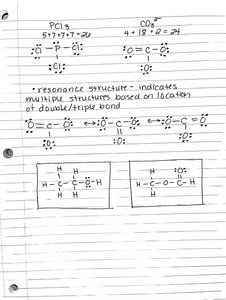
PCl3: Phosphorus trichloride has 26 valence electrons (P: 5, Cl: 7 × 3 = 21). The structure shows P at the center with three single bonds to Cl atoms, and lone pairs on each Cl and P.
CO32− (Carbonate ion): 24 valence electrons (C: 4, O: 6 × 3 = 18, plus 2 for the charge). The structure involves resonance, with one double bond and two single bonds distributed among the three oxygens.
Resonance Structures
Resonance structures are multiple valid Lewis structures for a molecule or ion that differ only in the placement of electrons (not atoms). They indicate delocalization of electrons, especially in polyatomic ions like CO32−. The actual structure is a hybrid of all resonance forms.
Example: The carbonate ion (CO32−) has three resonance structures, each with a double bond between carbon and a different oxygen atom.
Practice Structures
Practice drawing Lewis structures for simple organic molecules, such as ethane (C2H6) and ethanol (C2H5OH), to reinforce understanding of bonding and lone pairs.
Summary Table: Steps for Drawing Lewis Structures
Step | Description |
|---|---|
1 | Count total valence electrons |
2 | Draw skeletal structure with single bonds |
3 | Distribute remaining electrons as lone pairs |
4 | Form double/triple bonds if needed to complete octets |
5 | Check octet rule and total electron count |
Additional info:
Lewis structures are foundational for predicting molecular geometry, polarity, and reactivity, which are explored further in topics such as VSEPR theory and molecular orbital theory.
