 Back
Lewis Structures, Resonance, and Formal Charge in Molecular Compounds
Study Guide - Smart Notes
 Tailored notes based on your materials, expanded with key definitions, examples, and context.
Lewis Structures of Molecular Compounds and Polyatomic Ions
Introduction to Lewis Structures
Lewis structures are diagrams that represent the bonding between atoms in a molecule and the lone pairs of electrons that may exist. They are essential for understanding the arrangement of atoms and electrons in molecules and polyatomic ions.
Lewis structures show how valence electrons are distributed among atoms in a molecule.
They help predict molecular shape, reactivity, and properties.
For polyatomic ions, the total number of valence electrons is adjusted by adding or subtracting electrons according to the ion's charge.
Resonance and Formal Charge
Resonance Structures
Some molecules can be represented by more than one valid Lewis structure. These alternative structures are called resonance structures.
Resonance structures differ only in the arrangement of electrons, not the arrangement of atoms.
The actual structure of the molecule is an average of all possible resonance structures, known as the resonance hybrid.
Resonance hybrids are often depicted with dashed lines to indicate delocalized electrons.
Example: Ozone (O3) can be represented by two resonance structures, each with a double bond between a different pair of oxygen atoms.
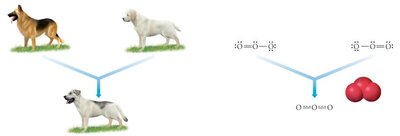
The image above illustrates the concept of resonance: just as a hybrid dog is a blend of two breeds, the resonance hybrid is a blend of two Lewis structures for O3.
Formal Charge
Formal charge is a bookkeeping tool used to determine the most likely Lewis structure for a molecule. It is the hypothetical charge an atom would have if all bonding electrons were shared equally.
Formal charge helps identify the most stable Lewis structure (the one with the smallest formal charges and/or negative charges on the most electronegative atoms).
The formula for calculating formal charge is:
Example calculations:
For hydrogen in HF:
For fluorine in HF:
Key Points:
Resonance structures are used when more than one valid Lewis structure can be drawn for a molecule.
The resonance hybrid represents the true structure, which is an average of all resonance forms.
Formal charge calculations help determine the most stable Lewis structure.
