 Back
Light, Spectra, and the Bohr Model of Hydrogen: Foundations of Atomic Structure
Study Guide - Smart Notes
 Tailored notes based on your materials, expanded with key definitions, examples, and context.
Light, Spectra, and the Bohr Model of Hydrogen
Atomic Structure and the Periodic Table
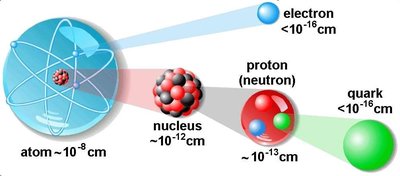
The structure of the atom is fundamental to understanding chemical behavior. Atoms consist of a dense nucleus containing protons and neutrons, surrounded by electrons that occupy regions of space at relatively large distances from the nucleus. The arrangement of electrons determines how atoms interact and form compounds.
Atoms are the basic units of matter, composed of a nucleus (protons and neutrons) and electrons.
Electrons are much smaller than protons and neutrons and are found in regions called orbitals.
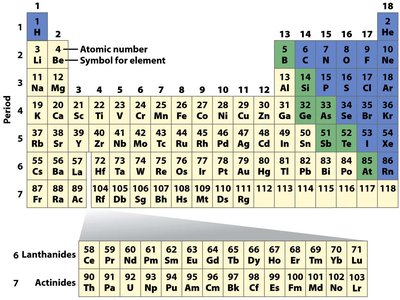
The periodic table organizes elements by increasing atomic number and similar chemical properties.
Electromagnetic Radiation and Atomic Spectra
Electromagnetic radiation is energy transmitted through space as oscillating electric and magnetic fields. The interaction of atoms with electromagnetic radiation reveals the arrangement and energies of electrons in atoms.
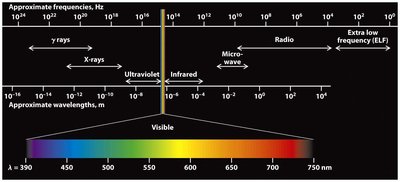
Electromagnetic spectrum is the range of all types of electromagnetic radiation, from gamma rays to radio waves.
Visible light is a small portion of the spectrum, with wavelengths from about 400 nm (violet) to 750 nm (red).
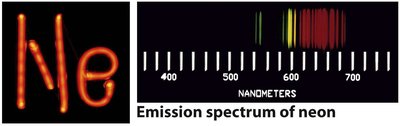
Each element emits a unique emission spectrum when heated, which can be observed as distinct lines of color.
The absorption spectrum of an element is also unique and consists of dark lines where light has been absorbed.





Wave Properties of Light
Light exhibits wave-like behavior, which is characterized by several key properties:
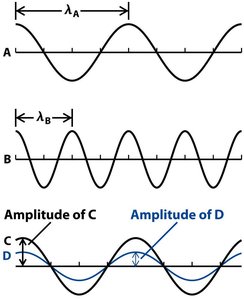
Wavelength (\( \lambda \)): The distance between successive crests or troughs of a wave.
Amplitude: The height of the wave crest or depth of the trough from the center line.
Frequency (\( f \)): The number of wave cycles that pass a given point per unit time (measured in Hz).
The relationship between wavelength, frequency, and the speed of light (\( c \)) is given by:
Electromagnetic Waves
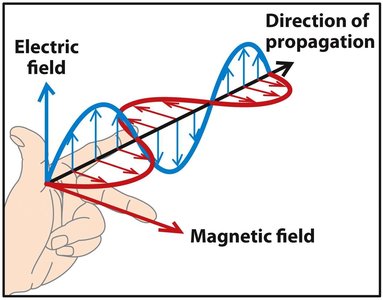
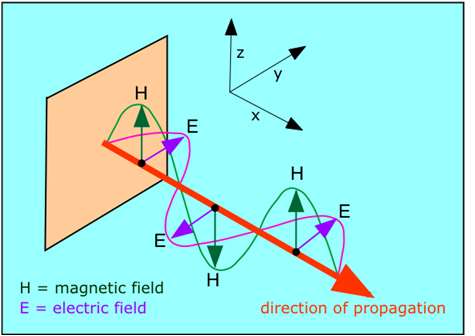
Electromagnetic waves consist of oscillating electric and magnetic fields that propagate through space. The direction of propagation is perpendicular to both the electric and magnetic field vectors.
All electromagnetic waves travel at the speed of light in a vacuum (\( c = 3.00 \times 10^8 \) m/s).
The energy of a photon is related to its frequency by Planck's equation:
Where \( h \) is Planck's constant (\( 6.626 \times 10^{-34} \) J·s).
Types of Waves
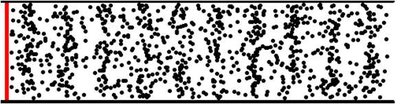
Waves can be classified as transverse or longitudinal:
Transverse waves: Oscillations are perpendicular to the direction of wave propagation (e.g., light waves).
Longitudinal waves: Oscillations are parallel to the direction of wave propagation (e.g., sound waves).
Wave Phenomena: Refraction, Diffraction, and Interference
Waves exhibit several important behaviors when interacting with matter:
Refraction: The bending of waves as they pass from one medium to another.
Diffraction: The spreading of waves around obstacles or through slits.
Interference: The combination of two or more waves, resulting in constructive (amplified) or destructive (diminished) interference.
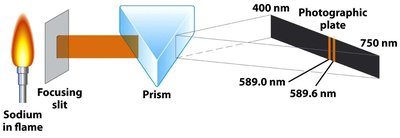
Atomic Spectra and Quantization of Energy
When atoms absorb or emit energy, they do so in discrete amounts called quanta. This leads to the observation of line spectra, where only specific wavelengths are present.
Emission spectra are produced when electrons in an atom drop from higher to lower energy levels, emitting photons of specific energies.
Absorption spectra occur when electrons absorb photons and move to higher energy levels.
The energy difference between levels determines the wavelength of light absorbed or emitted:
The Bohr Model of the Hydrogen Atom
The Bohr model explains the discrete energy levels of electrons in hydrogen. Electrons orbit the nucleus in specific, quantized orbits without radiating energy. Transitions between these orbits involve the absorption or emission of photons with energy equal to the difference between the levels.
Energy levels are labeled by the principal quantum number \( n \).
The energy of an electron in the nth orbit of hydrogen is:
The wavelength of emitted or absorbed light during a transition is given by the Rydberg formula:
Where \( n_2 > n_1 \) and both are integers.
The Photoelectric Effect
The photoelectric effect demonstrates that light can behave as particles (photons). When light of sufficient frequency strikes a metal surface, electrons are ejected. The minimum energy required to remove an electron is called the work function (\( \Phi \)).
The energy of the photon must be at least equal to the work function:
If \( h f < \Phi \), no electrons are emitted.
Summary Table: Key Equations and Concepts
Concept | Equation | Description |
|---|---|---|
Speed of light | Relates speed, frequency, and wavelength | |
Photon energy | Energy of a photon | |
Bohr energy levels (H atom) | Energy of nth level in hydrogen | |
Rydberg formula | Wavelength of spectral lines | |
Photoelectric effect | Minimum energy to eject electron |
Key Terms
Photon: A quantum of electromagnetic radiation.
Quantum: The smallest discrete amount of a physical property.
Ground state: The lowest energy state of an atom.
Excited state: Any energy state above the ground state.
Electron transition: Movement of an electron between energy levels.
Additional info: These notes cover foundational concepts in atomic structure, electromagnetic radiation, and the quantum mechanical model of the atom, which are essential for understanding chemical bonding and reactivity in later chapters.
