 Back
BackLimiting Reactant, Theoretical Yield, and Percent Yield: Stoichiometry in Chemical Reactions
Study Guide - Smart Notes
 Tailored notes based on your materials, expanded with key definitions, examples, and context.
Limiting Reactant, Theoretical Yield, and Percent Yield
Limiting Reactant Concept
The concept of the limiting reactant is fundamental in stoichiometry, which is the quantitative study of reactants and products in chemical reactions. The limiting reactant is the substance that is completely consumed first, thus determining the maximum amount of product that can be formed.
Limiting Reactant (LR): The reactant that is entirely consumed when a reaction goes to completion.
Excess Reactant (ER): The reactant that remains after the limiting reactant is used up.
Theoretical Yield: The maximum amount of product that can be formed from the limiting reactant.
Example: Consider assembling cars. Each car requires 4 tires and 1 steering wheel. If you have 40 tires and 15 steering wheels, the number of cars you can build is limited by the component you have in the smallest proportion relative to the requirements.
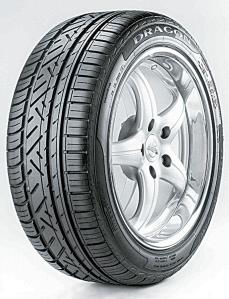

Calculation:
40 tires / 4 tires per car = 10 cars
15 steering wheels / 1 steering wheel per car = 15 cars
Limiting reactant: Tires (can only make 10 cars)
Stoichiometry Relationships in Chemical Reactions
Stoichiometry allows us to predict the amounts of products and reactants involved in a chemical reaction. The balanced chemical equation provides the ratio in which substances react and are produced.
General form: aA + bB → cC + dD
Reactants are consumed in fixed ratios; the limiting reactant determines the theoretical yield.
Limiting and Excess Reactants: Combustion of Methane
For the combustion of methane:
Balanced equation:
Stoichiometric ratios: 1 mol CH4 : 2 mol O2 : 1 mol CO2 : 2 mol H2O
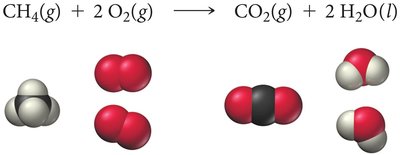
If you have 5 molecules of CH4 and 8 molecules of O2, which is the limiting reactant?
5 CH4 can react with 10 O2 (need 2 O2 per CH4), but only 8 O2 are available.
8 O2 can react with 4 CH4 (need 2 O2 per CH4).
Limiting reactant: O2 (can only make 4 CO2)
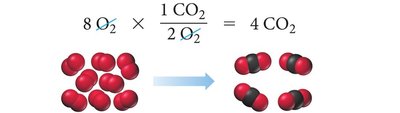
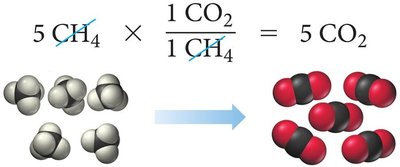
Limiting Reactant Calculations: Ammonia Synthesis
For the reaction , given 3.00 mol N2 and 3.00 mol H2, calculate the moles of NH3 produced.
3.00 mol N2 × = 6.00 mol NH3
3.00 mol H2 × = 2.00 mol NH3
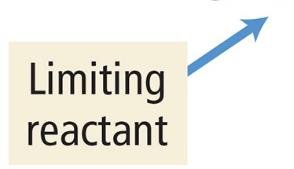
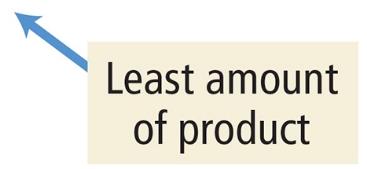
Limiting reactant: H2 (produces less NH3)
Limiting Reactant Calculations: Silicon Nitride Synthesis
For the reaction , given 1.20 mol Si and 1.00 mol N2, calculate the moles of Si3N4 produced.
1.20 mol Si × = 0.400 mol Si3N4
1.00 mol N2 × = 0.500 mol Si3N4
Limiting reactant: Si (produces less Si3N4)


Theoretical Yield and Percent Yield
Theoretical Yield
The theoretical yield is the calculated maximum amount of product that can be obtained from a chemical reaction, based on the limiting reactant and the stoichiometry of the balanced equation.
Calculated from the balanced chemical equation.
Represents the ideal amount of product if the reaction goes to completion without losses.
Actual Yield
The actual yield is the amount of product actually obtained from a reaction, which is usually less than the theoretical yield due to various practical factors.
Measured experimentally.
Can be affected by incomplete reactions, side reactions, or loss of product during recovery.
Percent Yield
Percent yield quantifies the efficiency of a reaction by comparing the actual yield to the theoretical yield.
Formula:
Percent yield is always ≤ 100%.
Example Calculation
Suppose 64.0 g of methanol (CH3OH) is the theoretical yield, but only 56.0 g is obtained in the lab.
Percent yield:
Percent Yield Example: Benzene and Bromine
For the reaction , 8.00 g benzene reacts with excess bromine to yield 12.85 g bromobenzene.
Molar mass of C6H6: 78.114 g/mol
Molar mass of C6H5Br: 157.010 g/mol
Moles of C6H6:
Theoretical yield of C6H5Br:
Percent yield:
Limiting Reactant, Theoretical Yield, and Percent Yield from Initial Masses
Example: Sodium Chloride Synthesis
For the reaction , given 53.2 g Na and 65.8 g Cl2, determine the limiting reactant, theoretical yield, and percent yield if the actual yield is 86.4 g NaCl.
Molar mass of Na: 22.99 g/mol
Molar mass of Cl2: 70.9 g/mol
Molar mass of NaCl: 58.44 g/mol
53.2 g Na → mol Na
65.8 g Cl2 → mol Cl2
Na is limiting reactant (produces less NaCl)
Theoretical yield: 108 g NaCl
Percent yield:
Example: Copper Production
For the reaction , given 114.5 g Cu2O and 11.5 g C, determine the limiting reactant, theoretical yield, and percent yield if the actual yield is 87.4 g Cu.
Molar mass of Cu2O: 143.10 g/mol
Molar mass of C: 12.01 g/mol
Molar mass of Cu: 63.55 g/mol
114.5 g Cu2O → mol Cu2O
11.5 g C → mol C
Cu2O is limiting reactant (produces less Cu)
Theoretical yield: 101.7 g Cu
Percent yield:

Practice Problems: Hydrofluoric Acid and Silicates
Reaction of Sodium Silicate with Hydrofluoric Acid
Hydrofluoric acid (HF) reacts with sodium silicate (Na2SiO3) as follows:
a. Moles of HF needed for 0.300 mol Na2SiO3: mol HF
b. Grams of NaF formed from 0.500 mol HF (excess Na2SiO3): g NaF
c. Grams of Na2SiO3 that can react with 0.800 g HF: g Na2SiO3
Summary Table: Limiting Reactant, Theoretical Yield, and Percent Yield
Term | Definition | Calculation | Example |
|---|---|---|---|
Limiting Reactant | Reactant that is completely consumed first | Compare moles or mass of reactants based on stoichiometry | O2 in CH4 combustion |
Theoretical Yield | Maximum possible product from limiting reactant | Use limiting reactant and balanced equation | 108 g NaCl from Na and Cl2 |
Actual Yield | Measured product from experiment | Lab measurement | 86.4 g NaCl obtained |
Percent Yield | Efficiency of reaction | 80% for NaCl synthesis |
Additional info: The notes include practical examples and stepwise calculations to reinforce the concepts of limiting reactant, theoretical yield, and percent yield, which are essential for mastering stoichiometry in general chemistry.
