 Back
week 2
Study Guide - Smart Notes
 Tailored notes based on your materials, expanded with key definitions, examples, and context.
Row Reduction and Echelon Forms
Definitions and Properties
Row reduction is a fundamental process in linear algebra used to solve systems of linear equations and analyze matrices. The echelon form (REF) and reduced row echelon form (RREF) are two important types of matrix forms that facilitate these operations.
Nonzero row/column: Contains at least one nonzero entry.
Leading entry: The leftmost nonzero entry in a row.
REF Properties:
All nonzero rows are above any rows of all zeros.
Each leading entry of a row is in a column to the right of the leading entry of the row above it.
All entries below a leading entry are zeros.
RREF Properties:
The leading entry in each nonzero row is 1.
Each leading 1 is the only nonzero entry in its column.
Are REF and RREF unique? Any nonzero matrix may be row reduced into more than one REF, but the RREF is unique for each matrix.

Pivot Positions and Columns
A pivot position in a matrix is a location corresponding to a leading 1 in the RREF. A pivot column contains a pivot position.
The Row Reduction Algorithm
The row reduction algorithm transforms a matrix into REF and then RREF using elementary row operations. The process consists of five steps:
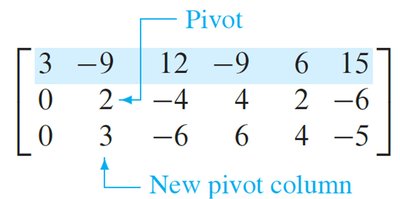
Step 1: Begin with the leftmost nonzero column. This is a pivot column. The pivot position is at the top.

Step 2: Select a nonzero entry in the pivot column as a pivot. If necessary, interchange rows to move this entry into the pivot position.

Step 3: Use row replacement operations to create zeros in all positions below the pivot.

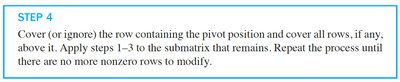
Step 4: Cover the row containing the pivot position and all rows above it. Apply steps 1–3 to the submatrix that remains. Repeat until no more nonzero rows remain.
Step 5: Beginning with the rightmost pivot and working upward and to the left, create zeros above each pivot. If a pivot is not 1, make it 1 by scaling.

Example: Row Reduction
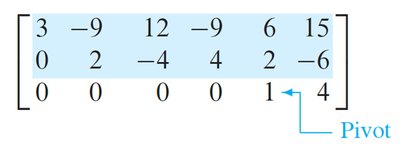
Consider the matrix:
After row reduction, the matrix becomes:
Solutions of Linear Systems
General Solution and Free Variables
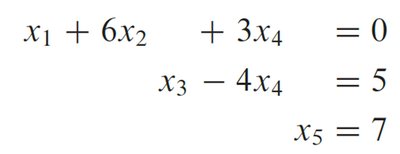
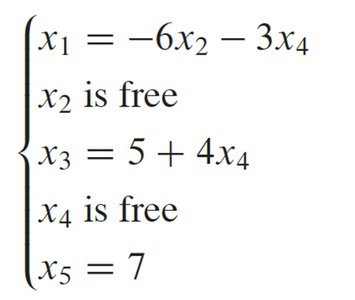
Applying the row reduction algorithm to the augmented matrix of a linear system provides an explicit description of the solution set. Variables corresponding to pivot columns are called basic variables, while others are free variables.
For example, the system:
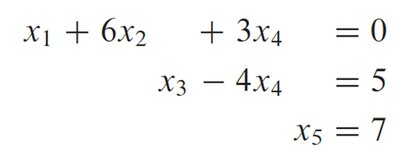
Can be rewritten as:
Existence and Uniqueness Theorem
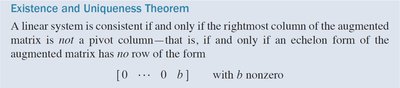
A linear system is consistent if and only if the rightmost column of the augmented matrix is not a pivot column. That is, an echelon form of the augmented matrix has no row of the form with nonzero.
If a linear system is consistent, the solution set contains either:
A unique solution (no free variables)
Infinitely many solutions (at least one free variable)
Vector Equations and Linear Combinations
Vectors as Points
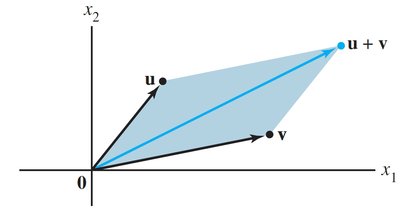
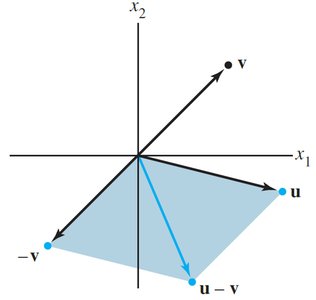
Vectors can be represented as points in space. In , each vector corresponds to a point in the plane, and in , to a point in three-dimensional space.

Vector Addition and Scalar Multiplication
Given vectors and in , their sum is obtained by adding corresponding entries. Scalar multiplication involves multiplying each entry by a real number (scalar).
Example: If and , then , , and .
Algebraic Properties of
Vector addition and scalar multiplication in satisfy several algebraic properties:
Commutativity:
Associativity:
Identity:
Inverse:
Distributivity:
Scalar distributivity:
Associativity of scalar multiplication:
Identity for scalar multiplication:
Linear Combination and Span
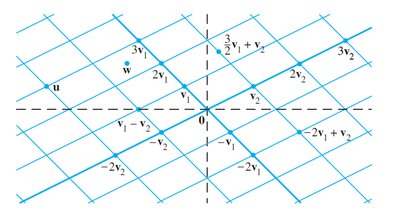
A linear combination of vectors in with scalars is . The span of a set of vectors is the set of all possible linear combinations of those vectors.
Example: Linear Combination
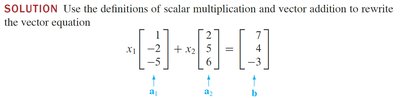
Let , , and . To determine if can be written as a linear combination of and , solve for and :
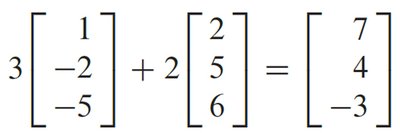
Row reducing the augmented matrix yields , , so is a linear combination: .
Practice Problems
Solving Linear Systems
Find the general solution of the linear system whose augmented matrix is:
Find the general solution of the system:
Suppose a coefficient matrix for a system of equations has 4 pivots. Is the system consistent? If so, how many solutions are there?
*Additional info: The above problems reinforce concepts of row reduction, solution sets, and linear combinations. The study notes are expanded with academic context for clarity and completeness.*
