 Back
week 4
Study Guide - Smart Notes
 Tailored notes based on your materials, expanded with key definitions, examples, and context.
Linear Independence
Definition and Criteria
Linear independence is a fundamental concept in linear algebra, describing whether a set of vectors can be expressed as linear combinations of each other. An indexed set of vectors {v1, ..., vp} in Rn is said to be linearly independent if the vector equation
has only the trivial solution (all ). If there exist weights , not all zero, such that
then the set is linearly dependent.


Matrix Representation and Solution
To determine linear independence, we often set up a matrix equation and analyze its solution set. For example:

This can be written as an augmented matrix:
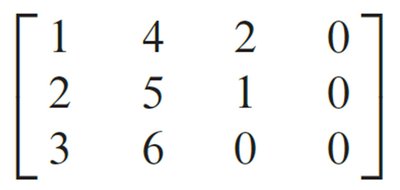
Row reduction reveals the nature of the solution:
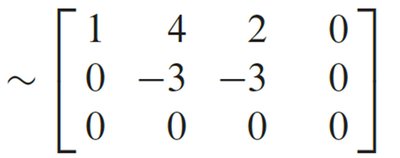
If there are free variables, nontrivial solutions exist, indicating linear dependence.
Linear Independence of Matrix Columns
The columns of a matrix A are linearly independent if and only if the equation has only the trivial solution.

Row reduction of the augmented matrix can confirm this.
Sets of One and Two Vectors
A set containing only one vector is linearly independent if and only if the vector is not the zero vector. For two vectors, the set is linearly dependent if at least one is a multiple of the other.
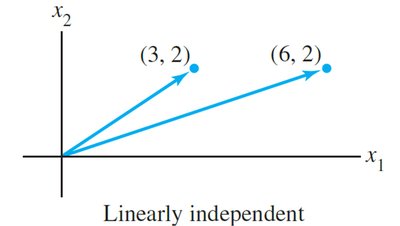
Geometrically, two vectors are linearly dependent if they lie on the same line through the origin.
Characterization of Linearly Dependent Sets
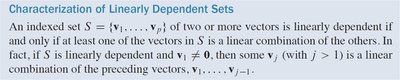
An indexed set S = {v1, ..., vp} of two or more vectors is linearly dependent if and only if at least one vector in S is a linear combination of the others.

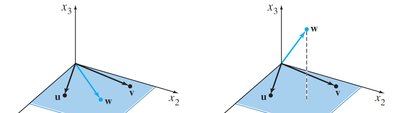
Geometric Interpretation in R3
If two vectors u and v are linearly independent in R3, then the set {u, v, w} is linearly dependent if and only if w lies in the plane spanned by u and v.

Theorem 8: Automatic Linear Dependence
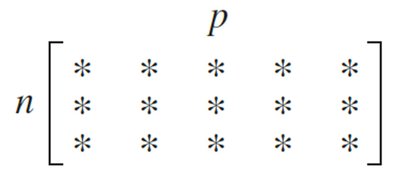
If a set contains more vectors than there are entries in each vector, then the set is linearly dependent. That is, any set {v1, ..., vp} in Rn is linearly dependent if p > n.


Theorem 9: Zero Vector in a Set
If a set S = {v1, ..., vp} in Rn contains the zero vector, then the set is linearly dependent.

Introduction to Linear Transformations
Definition and Notation
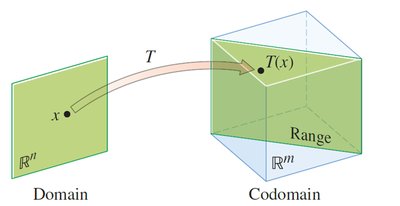
A linear transformation (or function or mapping) T from Rn to Rm is a rule that assigns to each vector x in Rn a vector T(x) in Rm. The set Rn is called the domain of T, and Rm is called the codomain. The set of all images T(x) is called the range of T.
Matrix Transformations
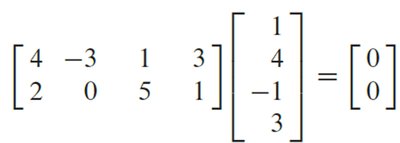
For each x in Rn, T(x) is computed as Ax, where A is an m x n matrix. The range of T is the set of all linear combinations of the columns of A.
Properties of Linear Transformations
A transformation T is linear if:
for all u, v in the domain
for all scalars c and all u in the domain
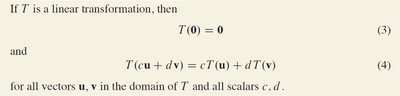
If T is a linear transformation, then:
for all vectors u, v and scalars c, d

Examples of Linear Transformations
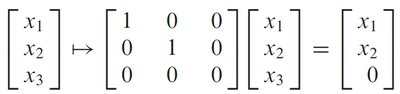
Projection Transformation: If , then projects points in R3 onto the -plane.
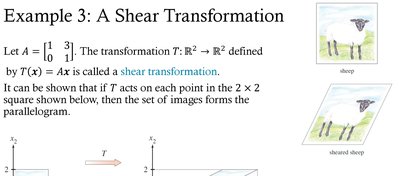
Shear Transformation: If , then is a shear transformation, mapping a square to a parallelogram.
Contraction and Dilation
Given a scalar , define by . is called a contraction when and a dilation when . Such transformations are linear.
Practice Problems
Practice problems often involve determining linear independence, finding images under transformations, and analyzing the properties of matrix equations.
Summary Table: Linear Independence Criteria
Set Type | Criterion for Independence |
|---|---|
Single Vector | Vector is not zero |
Two Vectors | Neither is a multiple of the other |
More Vectors than Entries | Set is always dependent |
Set Contains Zero Vector | Set is dependent |
Matrix Columns | has only trivial solution |
