 Back
BackChemistry Chatper 11
Study Guide - Smart Notes
 Tailored notes based on your materials, expanded with key definitions, examples, and context.
Liquids and Intermolecular Forces
States of Matter and Intermolecular Attractions
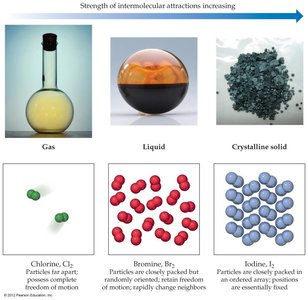
The physical state of a substance—gas, liquid, or solid—is determined by the balance between the kinetic energy of its particles and the strength of the intermolecular forces acting between them. As the strength of intermolecular attractions increases, substances transition from gases to liquids to solids.
Gases: Particles are far apart and move freely, with negligible intermolecular attractions.
Liquids: Particles are closer together, allowing for fluidity but with significant intermolecular attractions.
Solids: Particles are closely packed in a fixed arrangement, with strong intermolecular attractions.
Intramolecular vs. Intermolecular Forces
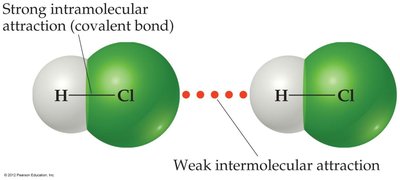
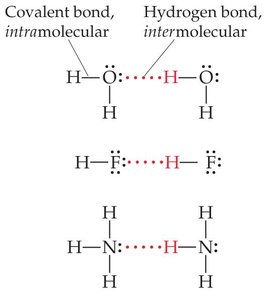
Intramolecular forces (such as covalent bonds) hold atoms together within a molecule, while intermolecular forces are the attractions between molecules. Intermolecular forces are generally much weaker than intramolecular forces but are crucial in determining physical properties like boiling and melting points.
Types of Intermolecular Forces
There are three main types of intermolecular forces between neutral molecules:
Dispersion (London) Forces
Dipole-Dipole Attractions
Hydrogen Bonding
All intermolecular interactions are electrostatic in nature, involving attractions between positive and negative regions of molecules.
Dispersion Forces
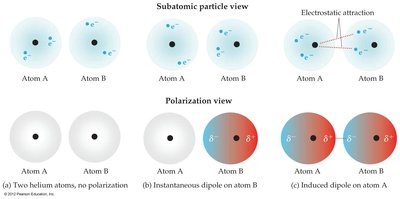
Dispersion forces arise from temporary fluctuations in electron distribution, creating instantaneous dipoles that induce dipoles in neighboring atoms or molecules. These forces are present in all substances but are the only intermolecular force in nonpolar molecules.
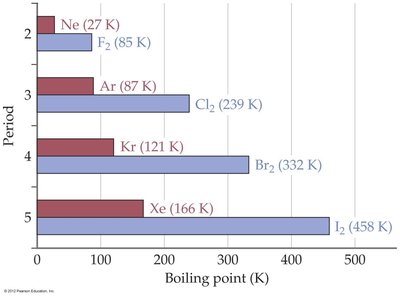
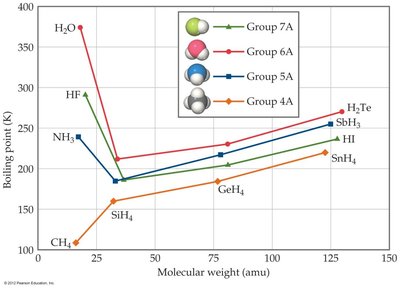
Strength increases with molecular weight and polarizability.
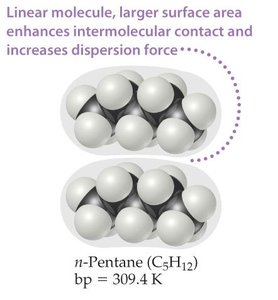
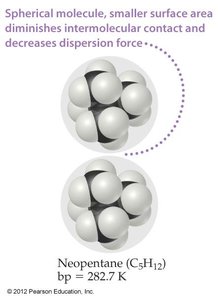
Molecular shape affects the magnitude of dispersion forces; elongated molecules have stronger dispersion forces due to greater surface area contact.
Dipole-Dipole Forces
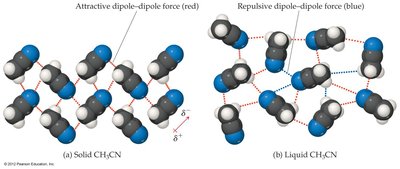
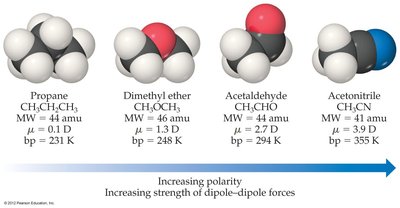
Dipole-dipole forces occur between polar molecules, where the positive end of one molecule is attracted to the negative end of another. The strength of these forces increases with the polarity of the molecules.
For molecules of similar size and mass, higher polarity leads to stronger dipole-dipole attractions and higher boiling points.
Hydrogen Bonding
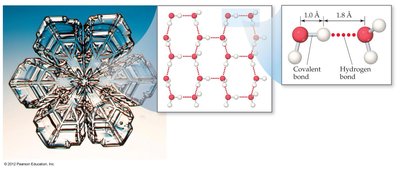
Hydrogen bonding is a special, strong type of dipole-dipole interaction that occurs when hydrogen is bonded to highly electronegative atoms (N, O, or F). The hydrogen atom interacts with a lone pair of electrons on another electronegative atom in a neighboring molecule.
Hydrogen bonding leads to unusually high boiling points for compounds like H2O, HF, and NH3.
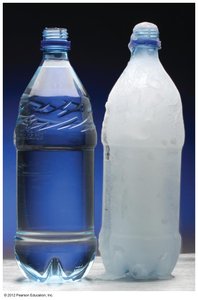
Hydrogen bonds are responsible for many unique properties of water, including its expansion upon freezing.

Ion-Dipole Forces
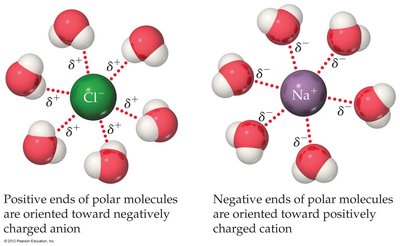
Ion-dipole forces exist between an ion and a polar molecule. These forces are especially important in solutions of ionic compounds in polar solvents, such as NaCl dissolved in water.
Cations are attracted to the negative end of a dipole, and anions to the positive end.
Comparing Intermolecular Forces
The relative strengths of intermolecular forces are as follows:
Dispersion forces: 2–10 kJ/mol (present in all molecules)
Dipole-dipole forces: 2–10 kJ/mol (in polar molecules)
Hydrogen bonding: 5–25 kJ/mol (when H is bonded to N, O, or F)
Ion-dipole forces: ~15 kJ/mol (in solutions with ions and polar molecules)
Covalent/ionic bonds: 100s of kJ/mol (much stronger than intermolecular forces)
Vapor Pressure and Phase Changes
Vapor Pressure
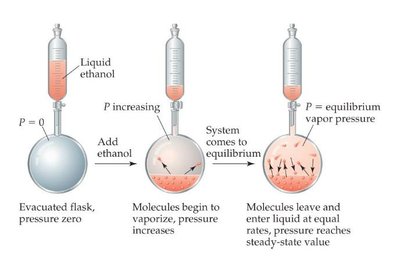
The vapor pressure of a liquid is the pressure exerted by its vapor when the liquid and vapor are in dynamic equilibrium. At equilibrium, the rates of evaporation and condensation are equal.
Liquids with high vapor pressure are called volatile.
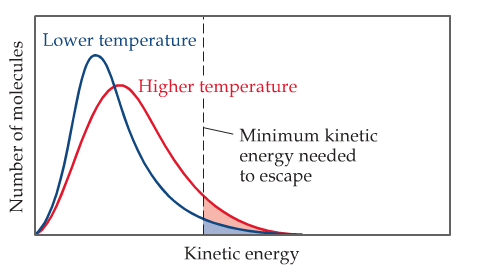
Vapor pressure increases with temperature, as more molecules have enough kinetic energy to escape into the gas phase.
Weaker intermolecular forces result in higher vapor pressures at a given temperature.
Boiling Point and Volatility
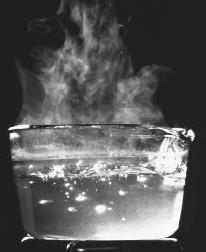
A liquid boils when its vapor pressure equals the external pressure acting on its surface. The boiling point decreases at higher altitudes where atmospheric pressure is lower.
Phase Changes
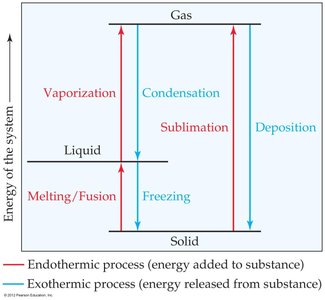
Substances can change between solid, liquid, and gas phases through phase changes such as melting, freezing, vaporization, condensation, sublimation, and deposition. These changes involve energy transfer:
Endothermic processes: Melting, vaporization, sublimation (energy absorbed)
Exothermic processes: Freezing, condensation, deposition (energy released)
Critical Temperature and Pressure
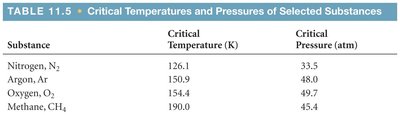
The critical temperature is the highest temperature at which a liquid phase can exist. The critical pressure is the pressure required to liquefy a gas at its critical temperature. Above the critical temperature, a substance cannot be liquefied regardless of pressure.
Substance | Critical Temperature (K) | Critical Pressure (atm) |
|---|---|---|
Nitrogen, N2 | 126.1 | 33.5 |
Argon, Ar | 150.9 | 48.0 |
Oxygen, O2 | 154.4 | 49.7 |
Methane, CH4 | 190.0 | 45.4 |
Phase Diagrams
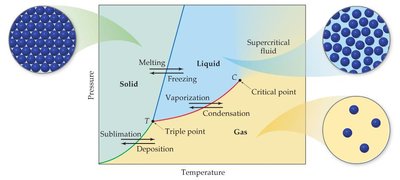
A phase diagram graphically summarizes the conditions of temperature and pressure under which the different phases of a substance exist and the equilibria between them. Key features include the triple point (where all three phases coexist) and the critical point (end of the liquid-gas boundary).
Key Points for Interpreting Phase Diagrams
The melting curve separates solid and liquid regions.
The vaporization curve separates liquid and gas regions.
The sublimation curve separates solid and gas regions.
The triple point is where all three phases are in equilibrium.
The critical point marks the end of the liquid-gas boundary.
