 Back
BackLiquids, Solids, and Intermolecular Forces: A Comprehensive Study Guide
Study Guide - Smart Notes
 Tailored notes based on your materials, expanded with key definitions, examples, and context.
Liquids and Solutions
States of Matter and Intermolecular Forces
The fundamental difference between the states of matter—gas, liquid, and solid—lies in the strength of the intermolecular forces that hold particles together. These forces determine the physical properties and behaviors of substances in different phases.
Solids and liquids are referred to as the condensed phases due to their closely packed particles.
Stronger intermolecular forces bring molecules closer together, resulting in solids and liquids, while weaker forces allow for the gaseous state.
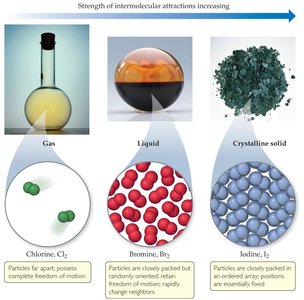
Characteristic Properties of the States of Matter
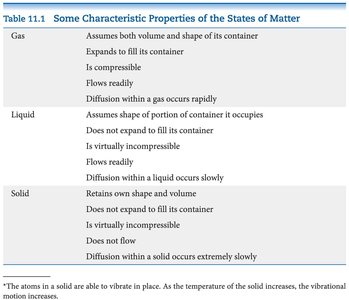
Each state of matter exhibits distinct physical properties based on particle arrangement and movement.
State | Properties |
|---|---|
Gas | Assumes both volume and shape of its container, compressible, flows readily, rapid diffusion. |
Liquid | Assumes shape of container, virtually incompressible, flows readily, slow diffusion. |
Solid | Retains own shape and volume, virtually incompressible, does not flow, extremely slow diffusion. |
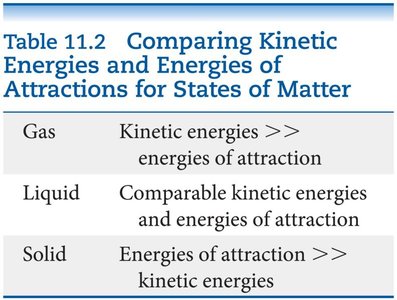
Kinetic Energies vs. Energies of Attraction
The balance between kinetic energy and intermolecular attractions determines the state of matter:
State | Relationship |
|---|---|
Gas | Kinetic energies >> energies of attraction |
Liquid | Comparable kinetic energies and energies of attraction |
Solid | Energies of attraction >> kinetic energies |
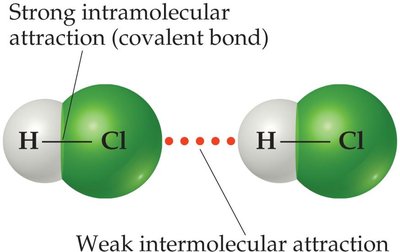
Intermolecular Forces
Types of Intermolecular Forces
Intermolecular forces are weaker than the intramolecular (covalent or ionic) bonds within molecules but are crucial in determining physical properties such as boiling and melting points, viscosity, and surface tension.
Dispersion forces (London dispersion forces): Present in all atoms and molecules due to temporary dipoles.
Dipole–dipole forces: Occur between polar molecules with permanent dipoles.
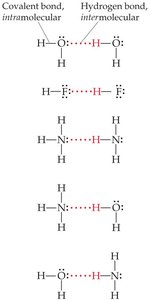
Hydrogen bonding: A special, strong dipole–dipole interaction when H is bonded to N, O, or F.
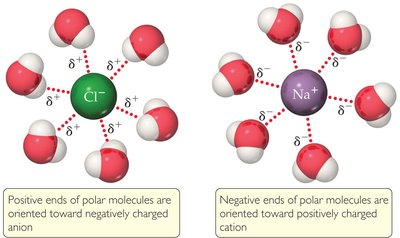
Ion–dipole forces: Occur between ions and polar molecules, important in solutions of ionic compounds.
Dispersion Forces (London Forces)
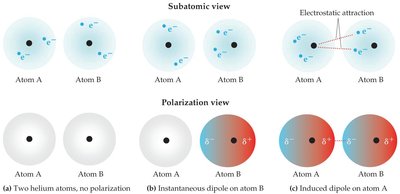
Dispersion forces arise from instantaneous dipoles created by the movement of electrons. The ease with which an electron cloud can be distorted is called polarizability.
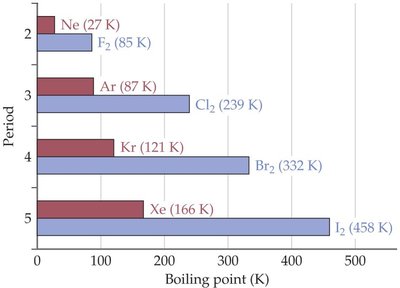
All molecules experience dispersion forces, but their strength increases with the number of electrons and molecular size.
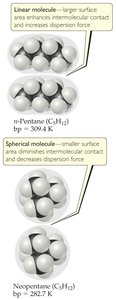
Molecular shape affects dispersion: elongated molecules have stronger dispersion forces than compact ones.
Factors Influencing Dispersion Forces
Number of electrons (more electrons = stronger dispersion force)
Size/molecular weight (larger = stronger force)
Shape (more surface area = stronger force)
Dipole–Dipole Interactions
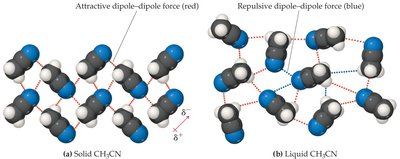
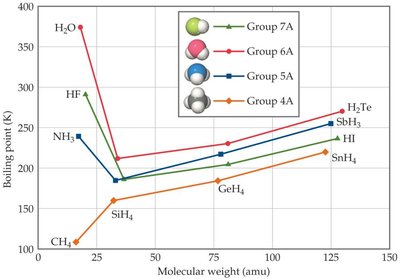
Polar molecules have regions of partial positive (δ+) and negative (δ−) charge, leading to attractions between oppositely charged ends of different molecules. For molecules of similar size, increased polarity leads to higher boiling points.
Hydrogen Bonding
Hydrogen bonds are especially strong dipole–dipole interactions that occur when hydrogen is bonded to highly electronegative atoms (N, O, F). These bonds are responsible for many unique properties of water and other compounds.
Hydrogen bonds are much stronger than typical dipole–dipole interactions.
They play a critical role in biological molecules like DNA and proteins.
Ion–Dipole Interactions
Ion–dipole forces are significant in solutions where ionic compounds dissolve in polar solvents. The strength of these interactions explains why salts dissolve in water.
Summary of Intermolecular Forces
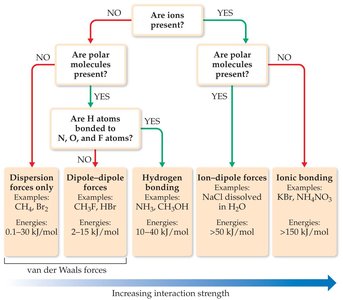
The following chart summarizes the types and relative strengths of intermolecular forces:
Physical Properties Affected by Intermolecular Forces
Viscosity
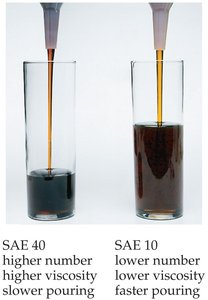
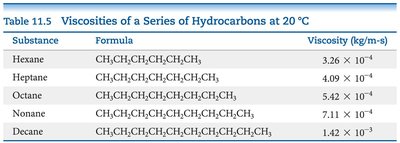
Viscosity is the resistance of a liquid to flow. It increases with stronger intermolecular forces and decreases with higher temperature.
Longer or more complex molecules generally have higher viscosity.
Surface Tension
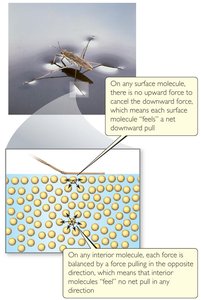
Surface tension is the energy required to increase the surface area of a liquid. It results from the net inward force experienced by surface molecules.
Cohesion and Adhesion
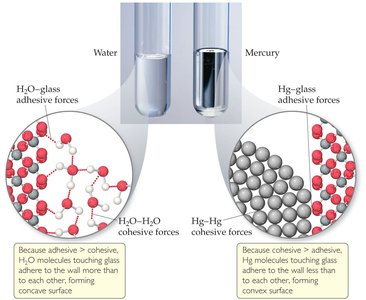
Cohesive forces bind similar molecules together, while adhesive forces bind molecules to different substances. These forces are important in phenomena such as capillary action.
Phase Changes
Types of Phase Changes
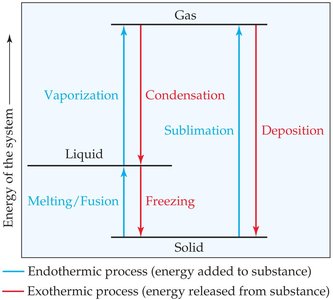
Phase changes involve the conversion between solid, liquid, and gas states. Energy is either absorbed (endothermic) or released (exothermic) during these transitions.
Melting/Fusion: Solid to liquid
Freezing: Liquid to solid
Vaporization: Liquid to gas
Condensation: Gas to liquid
Sublimation: Solid to gas
Deposition: Gas to solid
Heats of Phase Change
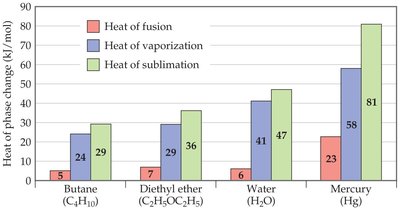
The energy required for phase changes is quantified as:
Heat of fusion (\( \Delta H_{fus} \)): Solid to liquid
Heat of vaporization (\( \Delta H_{vap} \)): Liquid to gas
Heat of sublimation (\( \Delta H_{sub} \)): Solid to gas
These values are related by:
Heating Curves
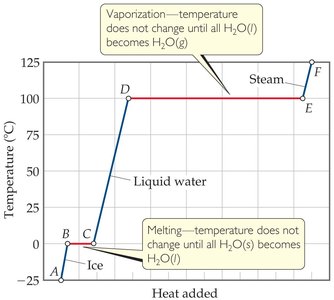
A heating curve plots temperature versus heat added. During phase changes, temperature remains constant as energy is used to change the phase rather than increase temperature.
Vapor Pressure and Boiling Point
Vapor Pressure
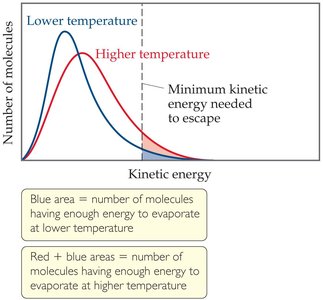
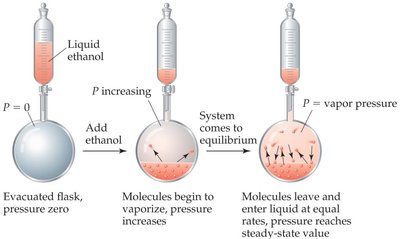
At any temperature, some molecules in a liquid have enough energy to escape into the gas phase, creating vapor pressure. As temperature increases, more molecules can escape, raising the vapor pressure.
Boiling Point
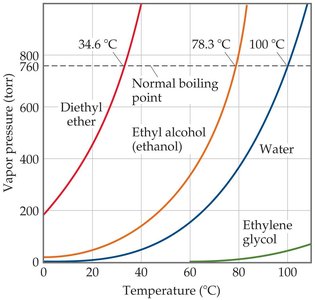
The boiling point is the temperature at which the vapor pressure of a liquid equals atmospheric pressure. The normal boiling point is defined at 1 atm (760 torr).
Clausius–Clapeyron Equation
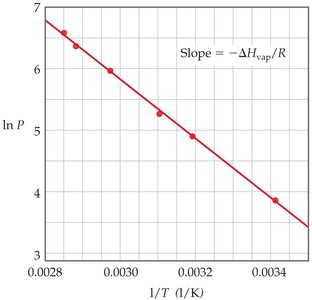
The relationship between vapor pressure and temperature is given by the Clausius–Clapeyron equation:
where is vapor pressure, is the enthalpy of vaporization, is the gas constant, is temperature in Kelvin, and is a constant.
Phase Diagrams
Understanding Phase Diagrams
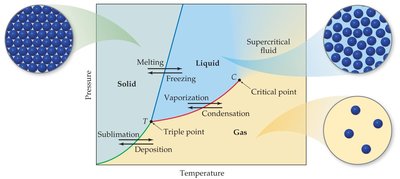
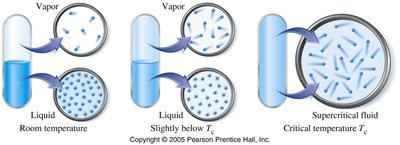
A phase diagram is a graph of pressure versus temperature showing the conditions under which a substance exists as solid, liquid, or gas. Key features include the triple point (where all three phases coexist) and the critical point (beyond which the liquid and gas phases are indistinguishable).
Special Features of Water and Carbon Dioxide
Water: The solid–liquid line has a negative slope, meaning increased pressure lowers the melting point.
CO2: Cannot exist as a liquid below 5.11 atm; sublimes at normal pressures.
Liquid Crystals
Types of Liquid Crystals
Some substances form liquid crystals, an intermediate state with properties of both solids and liquids. Types include:
Nematic: Molecules ordered in one dimension.
Smectic: Molecules ordered in two dimensions (layers).
Cholesteric: Nematic-like layers at angles to each other.
Colligative Properties of Solutions
Definition and Types
Colligative properties depend only on the number of solute particles, not their identity. These include:
Vapor-pressure lowering
Boiling-point elevation
Freezing-point depression
Osmotic pressure
Vapor-Pressure Lowering and Raoult’s Law
Adding a nonvolatile solute to a solvent lowers the solvent’s vapor pressure. Raoult’s Law quantifies this:
where is the mole fraction of solvent and is the vapor pressure of the pure solvent.
Boiling-Point Elevation and Freezing-Point Depression
Solutions boil at higher temperatures and freeze at lower temperatures than pure solvents. The changes are proportional to the solution’s molality ():
where and are the boiling-point elevation and freezing-point depression constants, respectively.
Osmosis and Osmotic Pressure
Osmosis is the movement of solvent through a semipermeable membrane from low to high solute concentration. The pressure required to stop this flow is the osmotic pressure ():
where is molarity, is the gas constant, and is temperature in Kelvin.
Biological Applications: Osmosis in Cells
Red blood cells in hypertonic solutions lose water and shrink (crenation), while in hypotonic solutions they gain water and may burst (hemolysis).
Practice Problems and Applications
Practice problems in the original material reinforce the application of these concepts, such as calculating vapor pressure lowering, boiling-point elevation, freezing-point depression, and osmotic pressure for various solutions.
