Back
Liquids, Solids, and Intermolecular Forces: Chapter 12 Study Guide
Study Guide - Smart Notes
 Tailored notes based on your materials, expanded with key definitions, examples, and context.
Liquids, Solids, and Intermolecular Forces
Overview of States of Matter
The physical state of a substance—solid, liquid, or gas—is determined by the balance between intermolecular forces and thermal energy. Intermolecular forces are the attractions between molecules, while thermal energy is the energy of molecular motion.
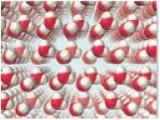
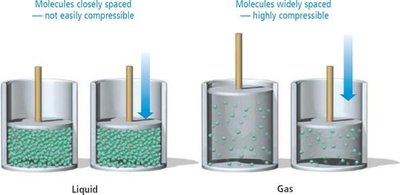
Solid: Particles are closely packed and fixed in position, resulting in a definite shape and volume. Solids are incompressible and do not flow.
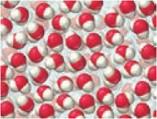
Liquid: Particles are closely packed but can move past each other, giving liquids an indefinite shape but definite volume. Liquids are incompressible and can flow.
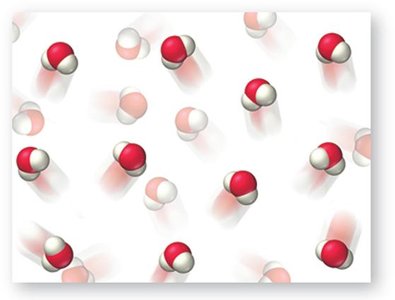
Gas: Particles are far apart and move freely, resulting in indefinite shape and volume. Gases are compressible and expand to fill their container.
State | Density | Shape | Volume | Intermolecular Forces |
|---|---|---|---|---|
Solid | High | Definite | Definite | Strong |
Liquid | High | Indefinite | Definite | Moderate |
Gas | Low | Indefinite | Indefinite | Weak |
Properties of Solids
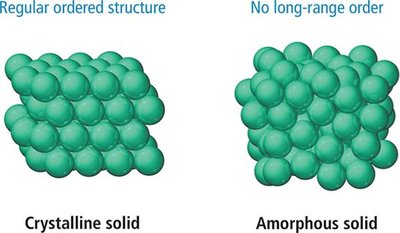
Solids can be classified as crystalline or amorphous based on the arrangement of their particles.
Crystalline solids: Particles are arranged in a regular, repeating pattern (e.g., salt, diamond).
Amorphous solids: Particles lack long-range order (e.g., glass, plastic).
Phase Changes
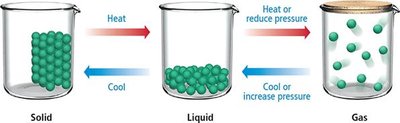
Phase changes occur when energy is added or removed, altering the kinetic energy and freedom of particles.
Melting (fusion): Solid to liquid
Boiling (vaporization): Liquid to gas
Condensation: Gas to liquid
Freezing: Liquid to solid
Sublimation: Solid to gas
Deposition: Gas to solid
Intermolecular Forces
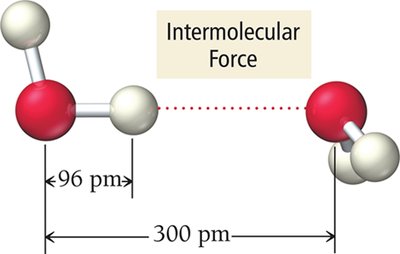
Intermolecular forces are the attractions between molecules and are responsible for the physical properties of substances.
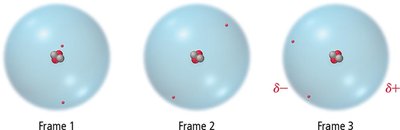
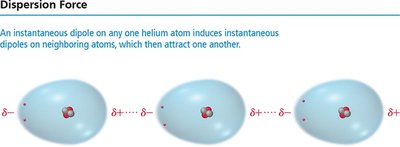
Dispersion forces (London forces): Present in all molecules and atoms; arise from temporary dipoles due to electron movement.
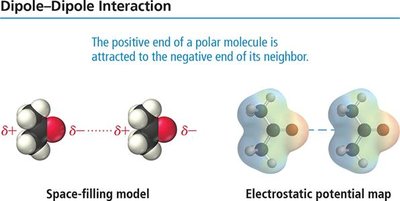
Dipole–dipole forces: Occur in polar molecules due to permanent dipoles.
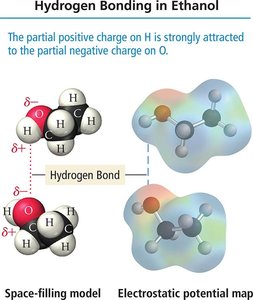
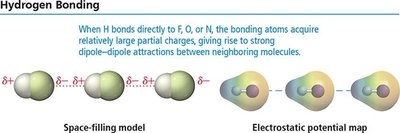
Hydrogen bonding: A special, strong dipole–dipole interaction when H is bonded to N, O, or F.
Ion–dipole forces: Occur between ions and polar molecules, important in solutions.
Dispersion Forces
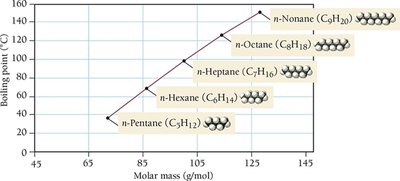
Dispersion forces increase with molar mass and molecular size, as larger electron clouds are more easily polarized.
All molecules experience dispersion forces.
Boiling points increase with stronger dispersion forces.
Effect of Molecular Shape and Size
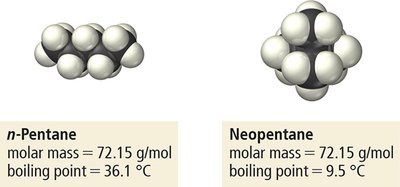
Boiling points are affected by both molar mass and molecular shape. Straight-chain molecules have higher boiling points than branched ones due to greater surface contact.
Dipole–Dipole Forces
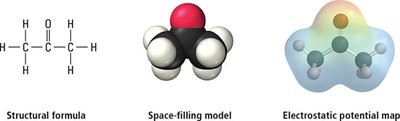
Polar molecules have permanent dipoles, which increase boiling and melting points compared to nonpolar molecules of similar size.
Hydrogen Bonding
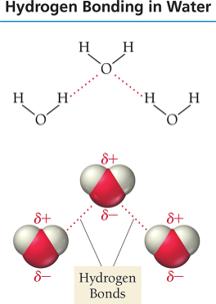
Hydrogen bonds are especially strong when H is bonded to N, O, or F. These bonds significantly raise boiling and melting points.
Hydrogen bonds are not as strong as covalent bonds but are the strongest intermolecular force in pure substances.
Ion–Dipole Forces
Ion–dipole forces occur in mixtures of ionic compounds and polar molecules, and are crucial for dissolving salts in water.
Surface Tension
Surface tension is the energy required to increase the surface area of a liquid. It results from cohesive forces among molecules at the surface.
Stronger intermolecular forces lead to higher surface tension.
Increasing temperature decreases surface tension.
Viscosity
Viscosity is the resistance of a liquid to flow. It increases with stronger intermolecular forces and decreases with higher temperature.
More spherical molecules have lower viscosity.
Capillary Action and Meniscus
Capillary action is the ability of a liquid to flow up a narrow tube against gravity, due to cohesive and adhesive forces. The meniscus is the curve at the liquid's surface in a tube, determined by the balance of these forces.
Vaporization and Condensation
Vaporization is the process by which molecules escape from the liquid phase to the gas phase. Condensation is the reverse process. The rate of vaporization increases with temperature, surface area, and decreases with stronger intermolecular forces.
Dynamic Equilibrium and Vapor Pressure
In a closed container, vaporization and condensation reach a dynamic equilibrium. The vapor pressure is the pressure exerted by the vapor when equilibrium is established. Higher vapor pressure indicates greater volatility.
Boiling Point and Clausius–Clapeyron Equation
The boiling point is the temperature at which the vapor pressure equals external pressure. The Clausius–Clapeyron equation relates vapor pressure and temperature:
Two-point form:
Supercritical Fluids and Critical Point
At the critical temperature and pressure, the distinction between liquid and gas disappears, forming a supercritical fluid with properties of both.
Sublimation and Deposition
Sublimation is the transition from solid to gas without passing through the liquid phase. Deposition is the reverse process.
Heating Curves and Energetics
Heating curves show temperature changes as a substance is heated, including plateaus at phase changes. Melting and vaporization are endothermic; freezing and condensation are exothermic.
Heat of fusion (): energy required to melt one mole of solid.
Heat of vaporization (): energy required to vaporize one mole of liquid.
Phase Diagrams
Phase diagrams map the state of a substance at various temperatures and pressures. The triple point is where all three phases coexist. The critical point marks the end of the liquid-gas boundary.
Water: An Extraordinary Substance
Water is unique due to its strong hydrogen bonding, high boiling point, high specific heat, and ability to expand upon freezing. It is an excellent solvent for ionic and polar substances.