 Back
Liquids, Solids & Intermolecular Forces: Comprehensive Study Notes
Study Guide - Smart Notes
 Tailored notes based on your materials, expanded with key definitions, examples, and context.
Liquids, Solids & Intermolecular Forces
Molecular Polarity
Molecular polarity is a fundamental concept in chemistry that describes the distribution of electrical charge across a molecule. Polarity arises from the unequal sharing of electrons between atoms due to differences in electronegativity. The shape of the molecule, determined by its Lewis structure and electron group arrangement, plays a crucial role in whether a molecule is polar or nonpolar.
Bond Polarity: Occurs when atoms in a bond have different electronegativities, resulting in partial charges.
Molecular Polarity: The overall polarity of a molecule, determined by both bond polarity and molecular shape.
Nonpolar Molecule: Hydrocarbons and molecules with perfect shapes (symmetrical, no lone pairs on the central atom) are nonpolar.
Polar Molecule: Molecules that lack perfect symmetry or have lone pairs on the central atom are polar.
Examples: Carbon tetrachloride (CCl4) is nonpolar due to its symmetrical tetrahedral shape; phosphorus trihydride (PH3) is polar due to lone pairs.
Practice: Determine the polarity of BCl2F, S2Cl2, and other compounds by analyzing their shapes and electron groups.
Intermolecular Forces
Intermolecular forces are the attractive forces that exist between molecules, influencing the physical properties of substances. These forces are generally weaker than intramolecular forces (chemical bonds) but are essential for understanding the behavior of liquids and solids.
Intramolecular Forces: Exist within a molecule, holding atoms together (ionic and covalent bonds).
Intermolecular Forces: Exist between molecules, affecting properties such as boiling point, melting point, and solubility.
Types of Intermolecular Forces:
London Dispersion Forces: Present in all molecules, arise from temporary dipoles.
Dipole-Dipole Forces: Occur between polar molecules.
Hydrogen Bonding: Strong dipole-dipole interaction involving H bonded to N, O, or F.
Ion-Dipole Forces: Occur between ions and polar molecules.
Ionic Forces: Between ions in ionic compounds.
Practice: Identify dominant intermolecular forces in various compounds (e.g., N2, CH3OH, KCl).
Intermolecular Forces & Physical Properties
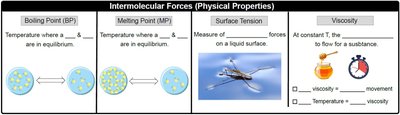
The strength and type of intermolecular forces directly affect measurable physical properties such as boiling point, melting point, surface tension, and viscosity. Stronger intermolecular forces generally lead to higher boiling and melting points, greater surface tension, and higher viscosity.
Boiling Point (BP): Temperature at which liquid and gas phases are in equilibrium.
Melting Point (MP): Temperature at which solid and liquid phases are in equilibrium.
Surface Tension: Measure of cohesive forces at the surface of a liquid.
Viscosity: Resistance to flow; increases with stronger intermolecular forces and decreases with higher temperature.
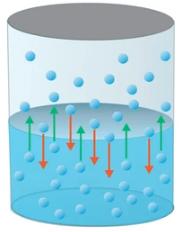
Vapor Pressure: The pressure exerted by a vapor at the surface of a liquid, representing an equilibrium between evaporation and condensation.
Clausius-Clapeyron Equation
The Clausius-Clapeyron equation describes the relationship between the vapor pressure of a liquid and its temperature. It is used to calculate the enthalpy of vaporization and predict vapor pressures at different temperatures.
Linear Form: Used when plotting ln(P) vs 1/T (temperature in Kelvin).
Two-Point Form: Used when two temperatures and/or pressures are given.
Variables: R = 8.314 J/(mol·K), P = vapor pressure, T = temperature in K, ΔHvap = enthalpy of vaporization.
Phase Diagrams
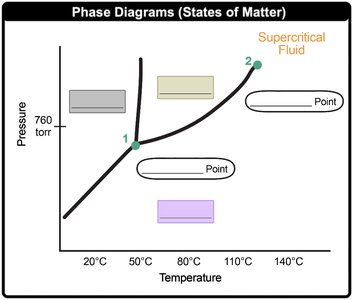
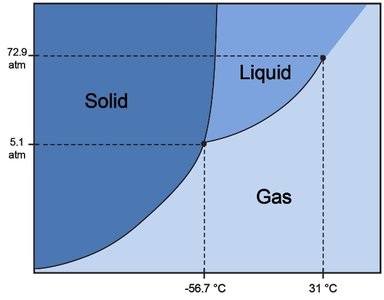
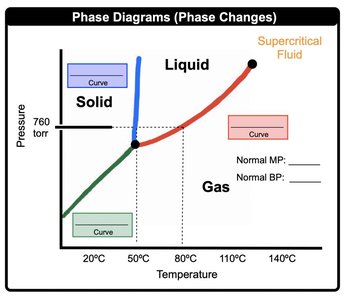
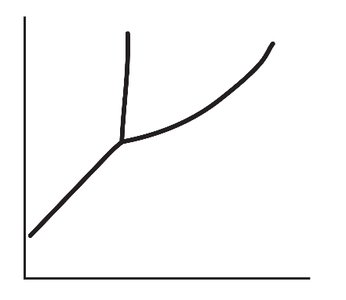
Phase diagrams are graphical representations of the physical states of a substance as a function of pressure and temperature. They show regions of solid, liquid, and gas, as well as critical and triple points.
Triple Point: Unique conditions where all three states are in equilibrium.
Critical Point: The highest temperature and pressure at which liquid and gas phases are distinguishable.
Phase Change Curve: Line segments separating different states of matter.
Normal Pressure: Standard pressure (1 atm or 760 mmHg).
Heating and Cooling Curves
Heating and cooling curves illustrate the amount of heat absorbed or released by a substance during phase changes. These curves show temperature changes and plateaus corresponding to phase transitions.
Heating Curve: Endothermic process (heat absorbed).
Cooling Curve: Exothermic process (heat released).
Key Formulas:
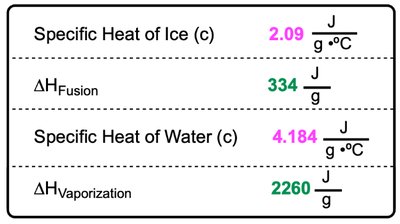
Specific Heat Capacity:
Enthalpy (Phase Change):
Total Energy:
Example: Calculating energy required to convert ice at -5°C to steam at 100°C using specific heats and enthalpies.
Atomic, Ionic, and Molecular Solids
Solids are classified based on their structural arrangement and the nature of their constituent particles. The two main categories are crystalline and amorphous solids.
Crystalline Solid: Highly ordered arrangement of atoms, ions, or molecules.
Amorphous Solid: Disordered arrangement with no regular pattern.
Types of Crystalline Solids:
Ionic Solids: Composed of ions, held together by ionic bonds.
Molecular Solids: Composed of molecules, held together by intermolecular forces.
Covalent Network Solids: Atoms connected by covalent bonds.
Metallic Solids: Metal atoms held together by metallic bonds.
Crystalline Solids and Unit Cells
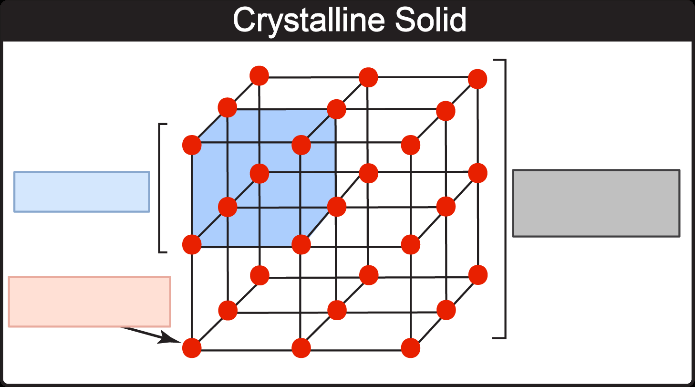
Crystalline solids are made up of repeating units called unit cells, which form a crystal lattice. The unit cell is the smallest repeating structure that defines the entire lattice.
Unit Cell: The basic repeating structure of a crystal lattice.
Crystal Lattice: 3D arrangement of unit cells.
Lattice Point: Position occupied by an atom, ion, or molecule.
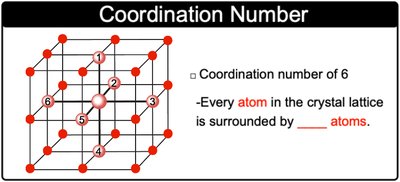
Coordination Number: Number of nearest neighbors surrounding an atom in the lattice.
Packing Efficiency: Percentage of space occupied by particles in the unit cell.
Types of Cubic Unit Cells
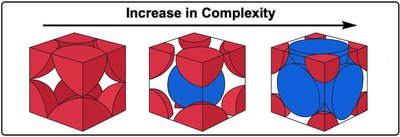
Cubic unit cells are classified into three types based on their arrangement and complexity: simple cubic, body-centered cubic, and face-centered cubic.
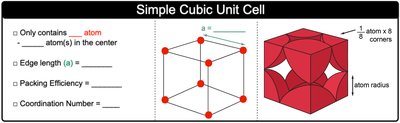
Simple Cubic Unit Cell: Atoms at each corner, coordination number of 6, low packing efficiency.
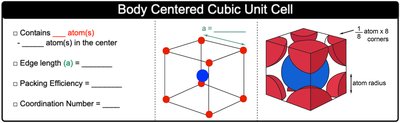
Body-Centered Cubic Unit Cell: Atoms at each corner and one in the center, coordination number of 8, higher packing efficiency.
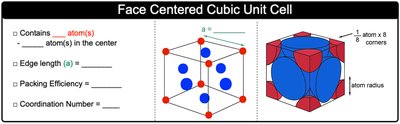
Face-Centered Cubic Unit Cell: Atoms at each corner and on each face, coordination number of 12, highest packing efficiency.
Additional info: These notes expand on brief points from the original material, providing definitions, examples, and formulas for clarity and completeness. All included images directly reinforce the adjacent explanations and are strictly relevant to the topic discussed.
