 Back
BackLiquids, Solids, and Intermolecular Forces: Properties, Phase Changes, and Structures
Study Guide - Smart Notes
 Tailored notes based on your materials, expanded with key definitions, examples, and context.
Liquids: Properties and Phase Changes
Surface Tension
Surface tension is a property of liquids that results from the tendency of liquids to minimize their surface area. This phenomenon is due to intermolecular forces acting at the surface, causing liquids to form spherical drops to minimize potential energy.
Definition: Surface tension is the energy required to increase the surface area of a liquid by a unit amount.
Intermolecular Forces: Stronger intermolecular forces result in higher surface tension.
Temperature Effect: Increasing the temperature raises the kinetic energy of molecules, reducing surface tension.
Example: Water forms nearly spherical droplets due to high surface tension from hydrogen bonding.
Viscosity
Viscosity is a measure of a liquid's resistance to flow, determined by the strength of intermolecular attractions and molecular shape.
Definition: Viscosity quantifies how easily a liquid flows.
Intermolecular Forces: Larger attractions yield higher viscosity.
Molecular Shape: More spherical molecules have lower viscosity.
Temperature Effect: Increasing temperature reduces viscosity.
Capillary Action
Capillary action is the ability of a liquid to flow up a thin tube against gravity, resulting from cohesive and adhesive forces.
Cohesive Forces: Hold liquid molecules together.
Adhesive Forces: Attract liquid molecules to the tube's surface, pulling the liquid upward.
Vaporization and Condensation
Vaporization is the process by which a liquid becomes a gas. As temperature increases, more molecules have enough energy to escape the liquid phase. Condensation is the reverse process, where gas becomes liquid.
Vaporization: Endothermic; rate increases with temperature, surface area, and weaker intermolecular forces.
Condensation: Exothermic; .
Volatile Liquids: Vaporize easily due to weak intermolecular forces.
Heat of Vaporization: Amount of heat required to vaporize one mole of liquid; always positive.
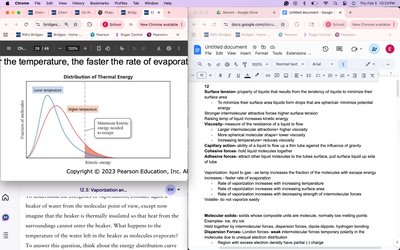
Vapor Pressure and Boiling Point
Vapor pressure is the pressure exerted by a vapor in dynamic equilibrium with its liquid. The boiling point is reached when vapor pressure equals external pressure.
Vapor Pressure: Higher for liquids with weaker intermolecular forces.
Dynamic Equilibrium: Rate of vaporization equals rate of condensation.
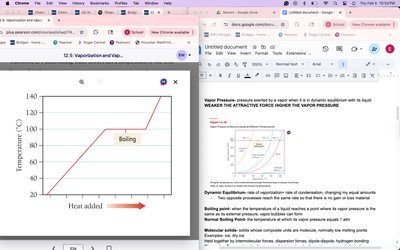
Boiling Point: Temperature at which vapor pressure equals external pressure; normal boiling point is at 1 atm.
Heating Curve: At boiling point, temperature remains constant as liquid converts to vapor.
Equation: (heat calculation)
Solids: Types, Structures, and Properties
Molecular Solids
Molecular solids are composed of molecules held together by intermolecular forces, typically with low melting points.
Examples: Ice (H2O), dry ice (CO2).
Forces: Dispersion (London), dipole-dipole, hydrogen bonding.
Dispersion Forces (London Forces)
Dispersion forces arise from temporary polarity due to unequal electron distribution. All molecules experience these forces.
Strength: Increases with molar mass and electron cloud size.
Molecular Shape: More surface contact increases force.
Boiling Point: Higher with stronger dispersion forces.
Dipole-Dipole Forces
Dipole-dipole forces exist between polar molecules with permanent dipoles.
Bond Polarity: Depends on electronegativity difference and molecular shape.
Miscibility: Polar molecules mix well with other polar substances.
Hydrogen Bonding
Hydrogen bonding is the strongest intermolecular force, occurring when hydrogen is bonded to F, O, or N.
Super Dipole-Dipole: Large partial charges create strong attractions.
Biological Importance: Found in DNA structure.
Ion-Dipole Forces
Ion-dipole forces occur when ionic compounds are mixed with polar compounds, important in solution chemistry.
Solubility
Solubility depends on the attractive forces between solute and solvent. Polar substances dissolve in polar solvents (hydrophilic), while nonpolar substances dissolve in nonpolar solvents (hydrophobic).
Types of Solids
Molecular Solids: Low melting points, held by intermolecular forces.
Ionic Solids: High melting points, held by strong coulombic forces between ions.
Atomic Solids: Composite units are atoms; includes nonbonding, metallic, and network covalent solids.
Ionic Solids
Ionic solids are composed of cations and anions, with high melting points due to strong electrostatic attractions.
Coordination Number: Number of close cation-anion interactions; higher values indicate greater stability.
Rock Salt Structure: NaCl has a 1:1 ratio, with Cl- ions in a face-centered cubic arrangement and Na+ ions in holes between Cl-.
Atomic Solids
Nonbonding Atomic Solids: Held by weak dispersion forces; low melting points.
Metallic Atomic Solids: Held by metallic bonds; variable melting points.
Network Covalent Solids: Held by covalent bonds; high melting points (e.g., diamond, graphite).
Crystalline vs. Amorphous Solids
Crystalline Solids: Highly ordered arrangement (ionic, molecular, covalent network, metals).
Amorphous Solids: Randomly arranged particles; no specific pattern.
Carbon Allotropes
Graphite: Flat sheets of carbon atoms in hexagonal rings; good electrical conductor; slippery due to weak forces between sheets.
Diamond: Tetrahedral geometry; very hard; electrical insulator; thermal conductor.
Fullerenes (C60): Spherical clusters; held by dispersion forces.
Nanotubes: Cylindrical structures; strong and conductive.
Silicates
Network covalent atomic solids containing silicon, oxygen, and various metals.
Band Theory
Band theory explains bonding in atomic solids using molecular orbital theory, describing energy bands and gaps.
Valence Band: Formed from bonding molecular orbitals.
Conduction Band: Formed from antibonding molecular orbitals.
Band Gap: Energy gap between valence and conduction bands; determines conductivity.
Insulators: Large band gap; no conductivity.
Semiconductors: Small band gap; conductivity increases with temperature.
Conductors: No band gap.
Doping: Adding impurities to increase conductivity (n-type: extra electrons; p-type: electron holes).
Polymers
Polymers are long chain-like molecules composed of repeating units called monomers.
Natural Polymers: Found in living organisms (starch, proteins, DNA).
Synthetic Polymers: Made in labs (polyethylene, nylon).
Phase Changes and Energetics
Sublimation and Deposition
Sublimation: Solid to gas (endothermic).
Deposition: Gas to solid (exothermic).
Fusion (Melting) and Freezing
Fusion (melting) occurs when a solid absorbs enough energy to overcome intermolecular forces and becomes a liquid. Freezing is the reverse process.
Melting Point: Temperature at which solid becomes liquid.
Heat of Fusion: Heat required to melt one mole of solid; positive value.
Heat of Fusion vs. Vaporization: Heat of fusion is much less than heat of vaporization.
Crystallization:
Summary Table: Types of Solids and Their Properties
Type of Solid | Composite Units | Forces | Melting Point | Examples |
|---|---|---|---|---|
Molecular | Molecules | Dispersion, dipole-dipole, H-bonding | Low | Ice, dry ice |
Ionic | Ions | Coulombic (ionic) | High | NaCl |
Atomic (Nonbonding) | Atoms | Dispersion | Low | Noble gases |
Atomic (Metallic) | Atoms | Metallic bonds | Variable | Iron, gold |
Atomic (Network Covalent) | Atoms | Covalent bonds | High | Diamond, graphite |
Additional info: Academic context and definitions have been expanded for clarity and completeness. Images included are directly relevant to the explanation of vaporization and boiling point.
