 Back
BackLiquids, Solids, and Intermolecular Forces: Structure, Properties, and Applications
Study Guide - Smart Notes
 Tailored notes based on your materials, expanded with key definitions, examples, and context.
Liquids, Solids, and Gases
States of Matter and Their Properties
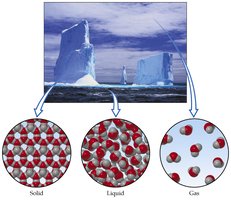
The three primary states of matter—solid, liquid, and gas—differ in the arrangement and movement of their particles, which is governed by the strength of intermolecular forces.
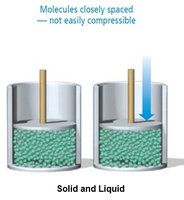
Solids: Particles are tightly packed in a fixed arrangement. Solids are incompressible, retain their shape, and do not flow.
Liquids: Particles are close together but can move past one another. Liquids flow, take the shape of their container, but do not expand or compress easily.
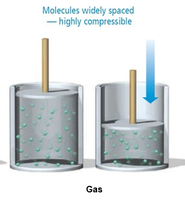
Gases: Particles are far apart and move freely. Gases are compressible, expand to fill their container, and flow easily.
These differences arise from the varying strengths of intermolecular forces in each state.
Intermolecular Forces
Types and Importance
Intermolecular forces are the forces that hold particles (atoms, molecules, ions) together in a substance. They determine key physical properties such as boiling point, melting point, vapor pressure, and physical state. There are four main types:
Dispersion Forces (London Forces)
Dipole–Dipole Forces
Hydrogen Bonding
Ion–Dipole Forces
Dispersion Forces
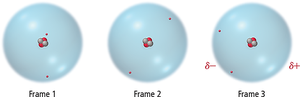
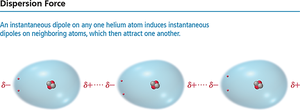
Dispersion forces are weak attractions caused by temporary dipoles that arise from fluctuations in electron distribution. They are present in all atoms and molecules but are especially significant in non-polar substances.
Regions with excess electron density become partially negative (𝛿−), while regions with depleted density become partially positive (𝛿+).
The negative end of one molecule attracts the positive end of another, forming the dispersion force.
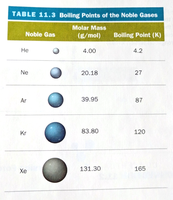
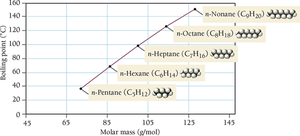
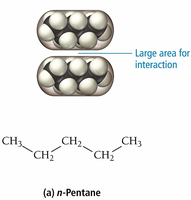
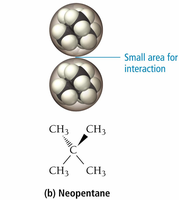
The strength of dispersion forces increases with molecular size (molar mass) and with greater surface-to-surface contact (molecular shape).
Effect of Molecular Size and Shape
Larger molar mass means more electrons and a more polarizable electron cloud, resulting in stronger dispersion forces.
Straight-chain molecules have more surface contact and stronger dispersion forces than branched molecules of similar mass.
Noble Gas | Molar Mass (g/mol) | Boiling Point (K) |
|---|---|---|
He | 4.00 | 4.2 |
Ne | 20.18 | 27 |
Ar | 39.95 | 87 |
Kr | 83.80 | 120 |
Xe | 131.30 | 165 |
Dipole–Dipole Forces
Origin and Examples
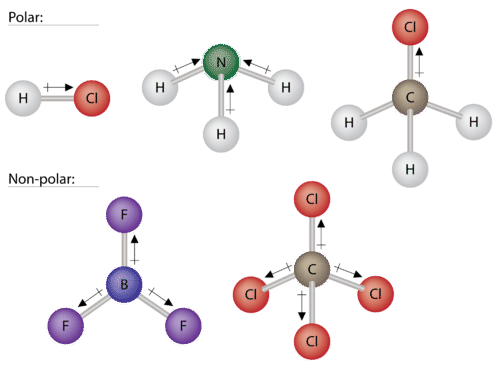
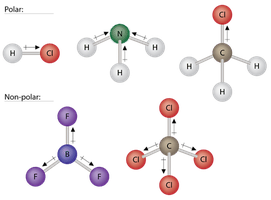
Dipole–dipole forces arise from permanent dipoles in polar molecules, caused by differences in electronegativity between atoms. The more electronegative atom attracts electrons, creating a partial negative charge, while the less electronegative atom becomes partially positive. The negative end of one molecule attracts the positive end of another.
Examples of polar molecules: HCl, NH3, CH3Cl
Nonpolar molecules (e.g., BF3, CCl4) have polar bonds, but their molecular geometry causes the dipoles to cancel out.
Strength and Comparison
Dipole–dipole forces are stronger than dispersion forces.
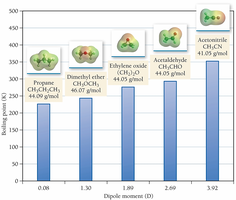
Boiling points increase with dipole moment for molecules of similar size and mass.
Example: Formaldehyde (CH2O) has a higher boiling point than ethane (C2H6).
Acetonitrile (CH3CN) has a higher dipole moment and boiling point than acetaldehyde (CH3CHO).
Hydrogen Bonding
Definition and Importance
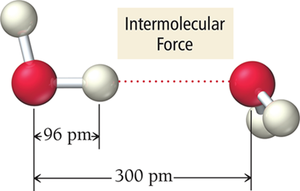
Hydrogen bonding is a special, strong type of dipole–dipole interaction that occurs when hydrogen is bonded to highly electronegative atoms (F, O, or N). The hydrogen atom acquires a strong partial positive charge and is attracted to lone pairs on nearby molecules.
Examples: HF, H2O, NH3
Hydrogen bonds are stronger than regular dipole–dipole or dispersion forces.
Hydrogen bonding leads to higher boiling points, as seen in water (100°C) and ethanol (78.3°C) compared to dimethyl ether (–22.0°C).
Ion–Dipole Forces
Definition and Role
Ion–dipole forces occur when an ionic compound (such as NaCl) is mixed with a polar molecule (such as water). Positive ions attract the negative end of dipoles, and negative ions attract the positive end. This is the strongest type of intermolecular force and is key in dissolving ionic compounds in water.
Summary Table: Intermolecular Forces
Type of Force | Occurs Between | Relative Strength | Example |
|---|---|---|---|
Dispersion | All molecules/atoms | Weakest | He, Cl2, CH4 |
Dipole–Dipole | Polar molecules | Intermediate | HCl, CH3Cl |
Hydrogen Bonding | H with F, O, or N | Strong (in pure substances) | H2O, NH3 |
Ion–Dipole | Ions and polar molecules | Strongest (in mixtures) | NaCl in H2O |
Physical Properties Influenced by Intermolecular Forces
Surface Tension
Surface tension is the tendency of a liquid to minimize its surface area due to cohesive forces. Molecules at the surface experience a net inward pull, creating a 'skin-like' layer. Surface tension increases with stronger intermolecular forces and decreases with temperature.
Viscosity
Viscosity is a liquid's resistance to flow. It increases with stronger intermolecular forces and molar mass, and decreases with temperature. Molecular shape also affects viscosity: elongated or irregular shapes increase viscosity, while compact shapes decrease it.
Capillary Action
Capillary action is the rise of a liquid in a thin tube against gravity, caused by adhesive (liquid–tube) and cohesive (liquid–liquid) forces. It is higher in narrower tubes due to greater surface area contact.
Vaporization and Vapor Pressure
Vaporization and Condensation
Vaporization is the process by which a liquid changes to a gas when thermal energy overcomes intermolecular forces. The reverse process is condensation. In a closed container, vaporization and condensation reach a dynamic equilibrium.
The pressure exerted by vapor molecules in equilibrium with the liquid is called vapor pressure.
The temperature at which vapor pressure equals external pressure is the boiling point.
The heat required to vaporize one mole of a liquid is the enthalpy of vaporization ().
Sublimation and Fusion
Sublimation
Sublimation is the process where molecules of a solid gain enough energy to escape directly into the gas phase (e.g., dry ice, iodine). The reverse process is deposition.
Fusion (Melting)
Fusion, or melting, occurs when a solid is heated and its particles gain enough energy to overcome some intermolecular forces, changing into a liquid. The reverse process is freezing.
Heating Curve of Water
Phases and Energy Changes
The heating curve of water shows temperature changes as heat is added, including phase transitions (melting and boiling). Each segment corresponds to a different phase or phase change, with plateaus representing energy used for phase transitions rather than temperature increase.
Phase Diagrams
Interpretation and Features
A phase diagram is a graph showing the physical state of a substance at various temperatures and pressures. It includes regions for solid, liquid, and gas, lines for phase transitions, and special points:
Triple point: All three phases coexist in equilibrium.
Critical point: The temperature and pressure above which the liquid and gas phases are indistinguishable (supercritical fluid).
Ice is favored at low temperature and high pressure; steam at high temperature and low pressure. Beyond the critical point, water becomes a supercritical fluid, exhibiting properties of both a liquid and a gas.
Water: An Extraordinary Substance
Unique Properties of Water
Water is a liquid at room temperature due to strong hydrogen bonding.
It is a universal solvent, dissolving many ionic and polar substances, and some small nonpolar molecules.
Water has a high specific heat, moderating climate and body temperature.
It expands upon freezing, making ice less dense than liquid water (ice floats).
