 Back
BackLiquids, Solids, and Intermolecular Forces: Structured Study Notes
Study Guide - Smart Notes
 Tailored notes based on your materials, expanded with key definitions, examples, and context.
Liquids, Solids, and Intermolecular Forces
Introduction to States of Matter
The physical state of matter—solid, liquid, or gas—is determined by the balance between intermolecular forces and thermal energy. These forces are responsible for the existence of liquids and solids, and their magnitude relative to thermal energy dictates the state of a substance at a given temperature.
Intermolecular forces are attractive forces between molecules or atoms.
Thermal energy is the energy associated with the random motion of particles.
Stronger intermolecular forces favor solids and liquids; weaker forces favor gases.
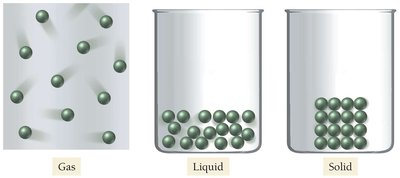
Properties of Gases, Liquids, and Solids
The properties of each state of matter are determined by the arrangement and movement of their constituent particles.
Gases: Low density, indefinite shape and volume, easily compressed, weak intermolecular forces.
Liquids: High density, indefinite shape, definite volume, not easily compressed, moderate intermolecular forces.
Solids: High density, definite shape and volume, not easily compressed, strong intermolecular forces. Solids may be crystalline (ordered) or amorphous (disordered).
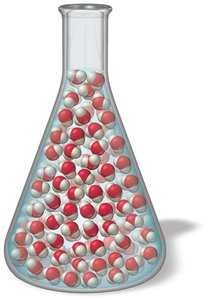
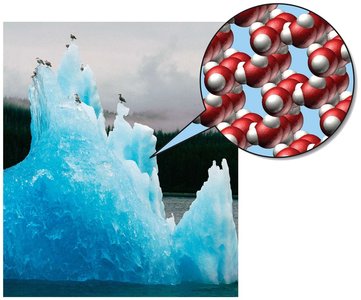
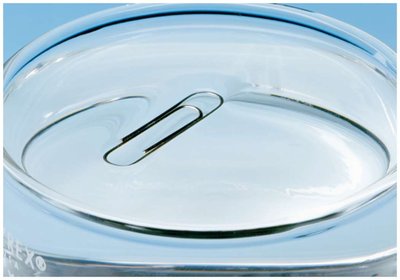
Intermolecular Forces in Action: Surface Tension and Viscosity
Intermolecular forces manifest in various physical properties of liquids, such as surface tension and viscosity.
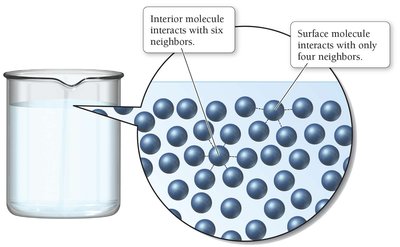
Surface tension: The tendency of liquid surfaces to resist external force, caused by stronger interactions among surface molecules. Example: a paper clip floating on water due to surface tension.
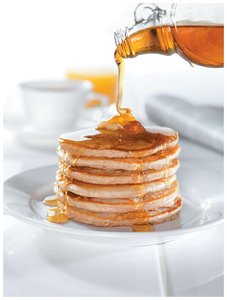
Viscosity: The resistance of a liquid to flow. Liquids with stronger intermolecular forces or longer molecules (e.g., motor oil, maple syrup) are more viscous.
Evaporation, Condensation, and Thermal Energy
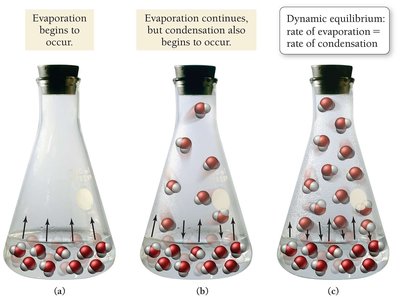
The processes of evaporation and condensation are governed by the kinetic energy of molecules and the strength of intermolecular forces.
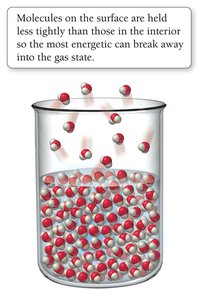
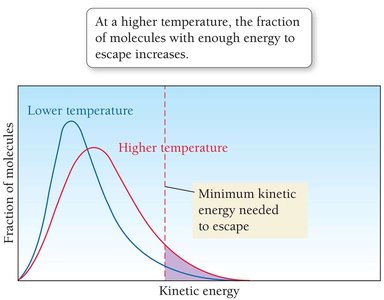
Evaporation: Molecules on the surface with sufficient energy escape into the gas phase. Rate increases with surface area, temperature, and decreases with weaker intermolecular forces.
Condensation: Gas molecules lose energy and return to the liquid phase.
Dynamic equilibrium: When the rates of evaporation and condensation are equal, the vapor pressure remains constant.
Boiling and Heating Curves
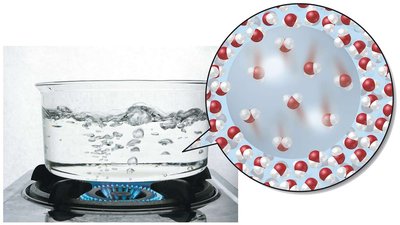
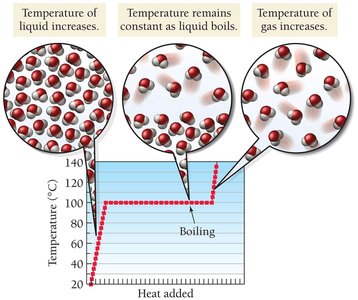
Boiling occurs when vapor pressure equals atmospheric pressure, allowing molecules throughout the liquid to become gaseous. Heating curves illustrate temperature changes during phase transitions.
During boiling, temperature remains constant until all liquid is vaporized.
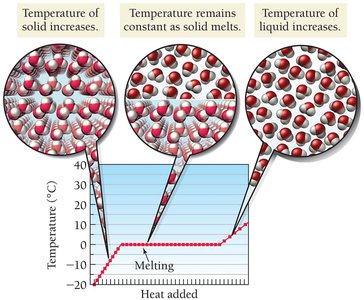
Heating curves show plateaus at phase change points.
Energetics of Evaporation and Condensation
Evaporation is endothermic: heat is absorbed to break intermolecular forces.
Condensation is exothermic: heat is released as molecules form intermolecular bonds.
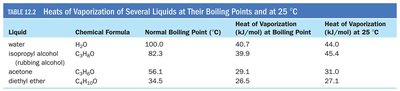
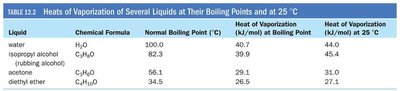
Heat of vaporization (): amount of heat required to vaporize 1 mol of liquid.
Heats of Vaporization Table
Liquid | Chemical Formula | Normal Boiling Point (°C) | Heat of Vaporization (kJ/mol) at Boiling Point | Heat of Vaporization (kJ/mol) at 25 °C |
|---|---|---|---|---|
Water | H2O | 100.0 | 40.7 | 44.0 |
Isopropyl alcohol | C3H8O | 82.3 | 39.9 | 45.4 |
Acetone | C3H6O | 56.1 | 29.1 | 31.0 |
Diethyl ether | C4H10O | 34.5 | 26.5 | 27.1 |
Melting, Freezing, and Heat of Fusion
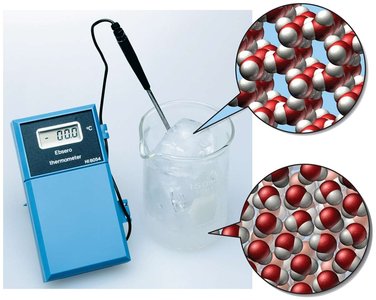
Melting and freezing are phase changes between solid and liquid, governed by the heat of fusion ().
Melting is endothermic: heat is absorbed to overcome intermolecular forces.
Freezing is exothermic: heat is released as molecules form a solid structure.
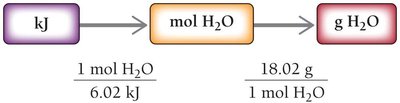
Heat of fusion: amount of heat required to melt 1 mol of solid.
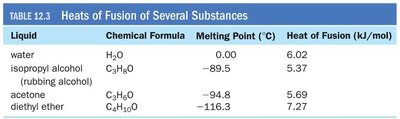
Heats of Fusion Table
Liquid | Chemical Formula | Melting Point (°C) | Heat of Fusion (kJ/mol) |
|---|---|---|---|
Water | H2O | 0.00 | 6.02 |
Isopropyl alcohol | C3H8O | -89.5 | 5.37 |
Acetone | C3H6O | -94.8 | 5.69 |
Diethyl ether | C4H10O | -116.3 | 7.27 |
Sublimation
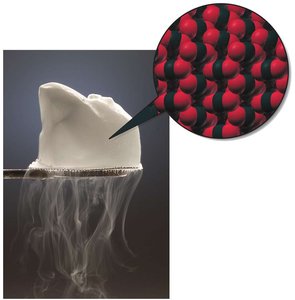
Sublimation is the direct transition from solid to gas without passing through the liquid phase.
Example: Dry ice (solid CO2) sublimes at -78°C.
Regular ice can also slowly sublime at temperatures below 0°C.
Types of Intermolecular Forces
The strength and type of intermolecular forces determine the physical properties of substances.
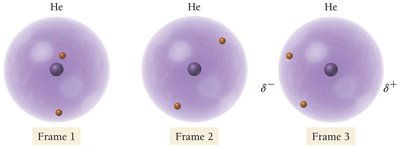
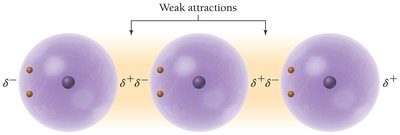
Dispersion forces (London forces): Present in all molecules and atoms, caused by temporary fluctuations in electron distribution.
Dipole–dipole forces: Occur in polar molecules with permanent dipoles.
Hydrogen bonding: Occurs in molecules with hydrogen bonded directly to F, O, or N; a strong form of dipole–dipole interaction.
Effect of Dispersion Forces on Boiling Points
Noble Gas | Molar Mass (g/mol) | Boiling Point (K) |
|---|---|---|
He | 4.00 | 4.2 |
Ne | 20.18 | 27 |
Ar | 39.95 | 87 |
Kr | 83.80 | 120 |
Xe | 131.29 | 165 |
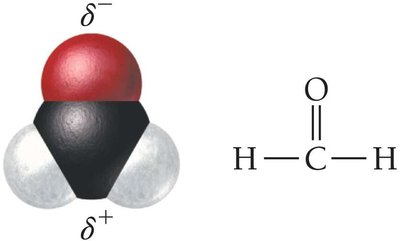
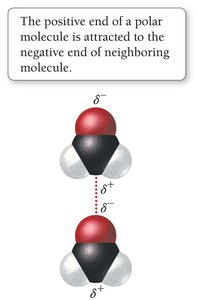
Comparison of Melting and Boiling Points for Polar and Nonpolar Compounds
Name | Formula | Molar Mass (g/mol) | Structure | Boiling Point (°C) | Melting Point (°C) |
|---|---|---|---|---|---|
Formaldehyde | CH2O | 30.0 | O=CH2 | -19.5 | -92 |
Ethane | C2H6 | 30.1 | H3C-CH3 | -88 | -172 |
Hydrogen Bonding
Hydrogen bonding is a particularly strong intermolecular force found in molecules with hydrogen directly bonded to fluorine, oxygen, or nitrogen.
Examples: HF, NH3, H2O, methanol.
Hydrogen bonds significantly increase melting and boiling points.
Types of Crystalline Solids
Crystalline solids are classified based on their composite units and the forces holding them together.
Molecular solids: Composite units are molecules; held together by intermolecular forces. Example: ice, dry ice.
Ionic solids: Composite units are formula units (cations and anions); held together by ionic bonds. Example: NaCl.
Atomic solids: Composite units are atoms; can be covalent atomic solids (diamond), nonbonding atomic solids (solid Xe), or metallic atomic solids (iron).
Water: A Remarkable Molecule
Water exhibits unique properties due to its molecular structure and strong hydrogen bonding.
High boiling point for its molar mass.
Expands upon freezing, making ice less dense than liquid water.
Excellent solvent for polar and ionic compounds.
Essential for life and environmental processes.
Chemistry in the Environment: Water Pollution
Water quality is crucial for health and environmental sustainability.
Biological contaminants (microorganisms) can cause diseases; boiling eliminates most biological contaminants.
Chemical contaminants (organic and inorganic compounds) are not removed by boiling and require other treatment methods.
