 Back
week 6
Study Guide - Smart Notes
 Tailored notes based on your materials, expanded with key definitions, examples, and context.
Matrix Inverses
Definition and Properties of the Inverse
The inverse of a square matrix is a fundamental concept in linear algebra. A matrix A is said to be invertible (or nonsingular) if there exists a matrix C such that:
Key Point 1: The product of A and C in either order yields the identity matrix I.

Example: If A and C are given as:

Then:


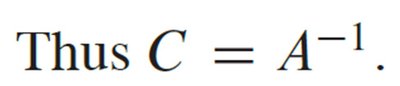
Thus, C = A^{-1}.
Determinant and Invertibility
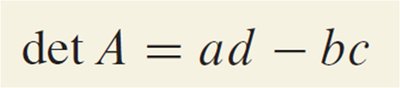
The determinant of a matrix is a scalar value that can be used to determine if a matrix is invertible.
Key Point 2: A matrix is invertible if and only if its determinant is nonzero.
Theorems on Matrix Inverses
Theorem 4: Characterization of Inverse
The existence of a matrix C such that AC = CA = I is the defining property of the inverse.

Theorem 5: Solution of Linear Systems
If A is an invertible n x n matrix, then for each b in Rn, the equation Ax = b has the unique solution:

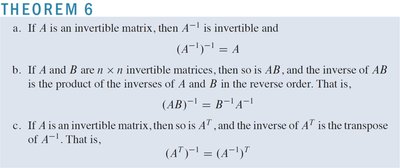
Theorem 6: Properties of Inverses
(a) If A is invertible, then A^{-1} is invertible and .
(b) If A and B are invertible, then AB is invertible and .
(c) If A is invertible, then AT is invertible and .
Elementary Matrices and Row Operations
Definition and Examples
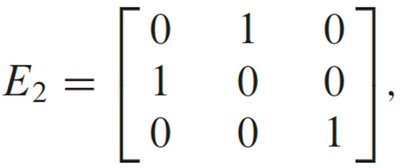
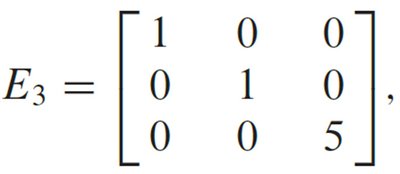
An elementary matrix is obtained by performing a single elementary row operation on the identity matrix. These matrices are used to perform row operations on other matrices.
Key Point 3: Multiplying a matrix A by an elementary matrix E corresponds to performing the same row operation on A.

Examples of elementary matrices:

Invertibility of Elementary Matrices
Each elementary matrix is invertible. The inverse is the elementary matrix of the same type that transforms E back into I.

Algorithm for Finding the Inverse
Row Reduction Method
To find the inverse of a matrix A, augment A with the identity matrix I and row reduce:
Key Point 4: If A is row equivalent to I, then the augmented matrix is row equivalent to .

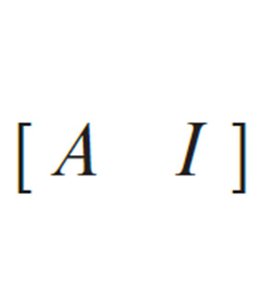
Example of row reduction steps:
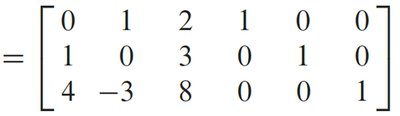
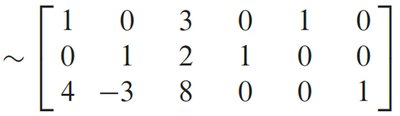
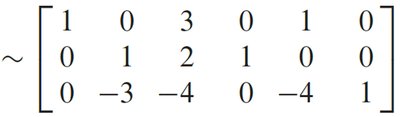
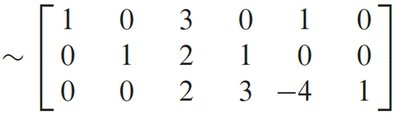
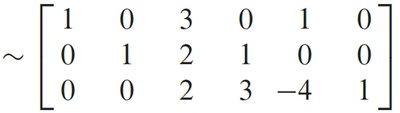
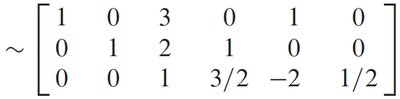
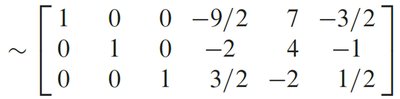
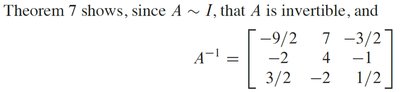

Final result:
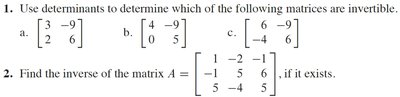
It is good practice to check the answer:

The Invertible Matrix Theorem
Equivalent Statements
The Invertible Matrix Theorem provides a list of equivalent conditions for a square matrix A to be invertible:
A is an invertible matrix.
A is row equivalent to the identity matrix.
A has n pivot positions.
The equation Ax = 0 has only the trivial solution.
The columns of A form a linearly independent set.
The linear transformation x ↦ Ax is one-to-one.
The equation Ax = b has at least one solution for each b in Rn.
The columns of A span Rn.
The linear transformation x ↦ Ax maps Rn onto Rn.
There is an n x n matrix C such that CA = I.
There is an n x n matrix D such that AD = I.
AT is an invertible matrix.

Practice Problems
Determining Invertibility
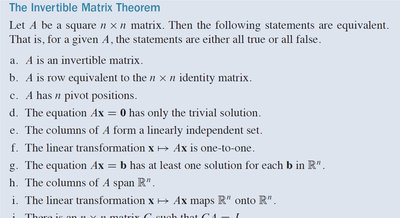
Use determinants to determine which matrices are invertible:
Matrix | Determinant | Invertible? |
|---|---|---|
Yes | ||
Yes | ||
No |
Finding the Inverse
Find the inverse of the matrix , if it exists.

Linear Transformations and Invertibility
Invertible Linear Transformations
A linear transformation T: Rn → Rn is invertible if there exists a function S: Rn → Rn such that:
Key Point 5: and for all in .
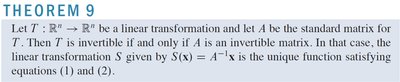
Theorem 9 states that T is invertible if and only if its standard matrix A is invertible, and the inverse transformation is given by .
Summary Table: Properties of Invertible Matrices
Property | Condition |
|---|---|
Invertibility | Determinant ≠ 0 |
Unique Solution to Ax = b | A is invertible |
Row Equivalence | A is row equivalent to I |
Elementary Matrices | Each is invertible |
Inverse of Product | |
Inverse of Transpose |
Additional info: These notes expand on the original slides and examples, providing definitions, theorems, and step-by-step explanations for matrix inverses, determinants, and the Invertible Matrix Theorem. Practice problems and tables are included for exam preparation.
