 Back
Matter and Measurement: Foundations of General Chemistry
Study Guide - Smart Notes
 Tailored notes based on your materials, expanded with key definitions, examples, and context.
Matter and Measurement
Introduction to Chemistry
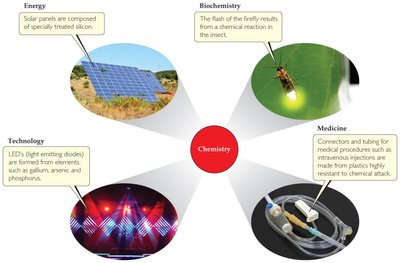
Chemistry is the scientific study of the properties, composition, and behavior of matter. It is central to understanding many fields, including energy, biochemistry, technology, and medicine.
Matter is anything that has mass and occupies space.
Chemistry connects to real-world applications such as solar panels, medical tubing, and LED technology.
Atoms are the fundamental building blocks of matter.
Classification of Matter
Matter can be classified based on its physical state and composition. Understanding these classifications is essential for studying chemical reactions and properties.
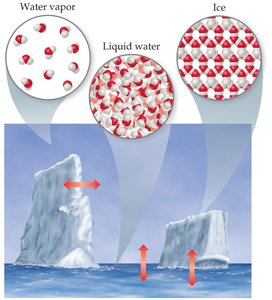
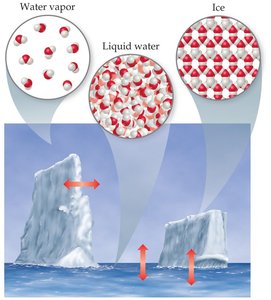
States of Matter: Solid, liquid, and gas. For example, water exists as ice (solid), liquid water, and water vapor (gas).
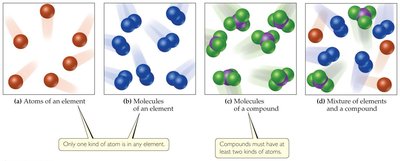
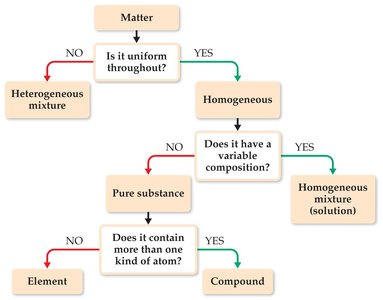
Composition: Matter can be an element, compound, or mixture.
Elements: Substances made of only one kind of atom.
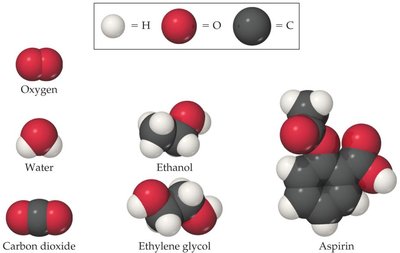
Compounds: Substances composed of two or more different kinds of atoms chemically bonded.
Mixtures: Physical combinations of two or more substances. Mixtures can be homogeneous (uniform, also called solutions) or heterogeneous (non-uniform).
Properties of Matter
Properties of matter are categorized as physical or chemical, and as intensive or extensive.
Physical Properties: Can be observed without changing the substance (e.g., boiling point, density).
Chemical Properties: Can only be observed when a substance undergoes a chemical change (e.g., flammability, reactivity).
Intensive Properties: Independent of the amount of substance (e.g., color, density).
Extensive Properties: Depend on the amount of substance (e.g., mass, volume).
Changes in Matter
Changes in matter are classified as physical or chemical.
Physical Changes: Alter the form or appearance but not the composition (e.g., melting, evaporation).
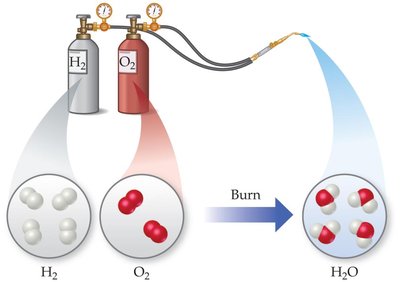
Chemical Changes: Result in the formation of new substances (e.g., combustion, oxidation).
Converting between states of matter (solid, liquid, gas) is a physical change.
Separation of Mixtures
Mixtures can be separated using physical methods based on differences in properties.
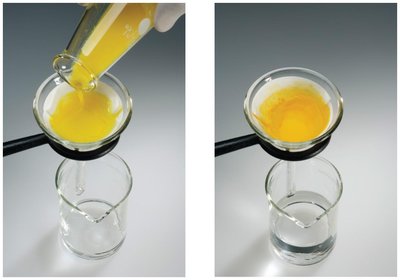
Filtration: Separates solids from liquids.
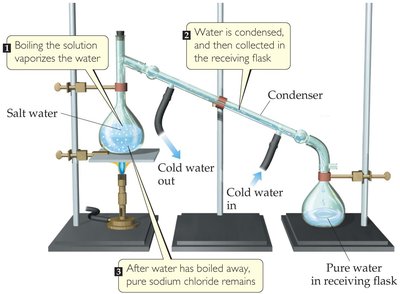
Distillation: Separates components based on differences in boiling points.
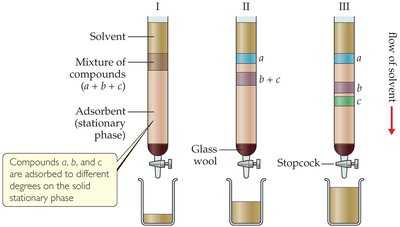
Chromatography: Separates substances based on their ability to adhere to a solid surface.
Measurement in Chemistry
Quantitative measurements are fundamental in chemistry. The International System of Units (SI) is used for consistency.
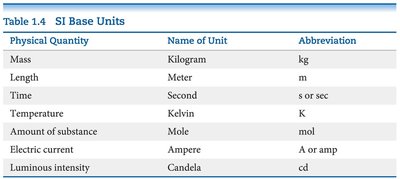
SI Base Units: Each physical quantity has a specific base unit (e.g., kilogram for mass, meter for length).
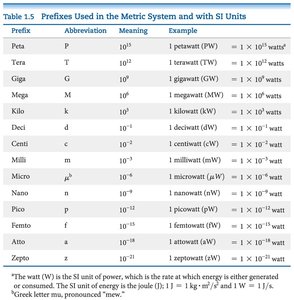
Metric System Prefixes: Prefixes modify base units for practical measurement (e.g., milli-, kilo-, micro-).
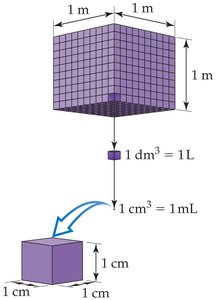
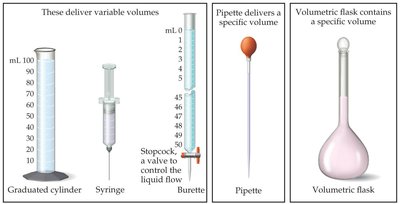
Volume: Derived from length; common units are liter (L) and milliliter (mL).
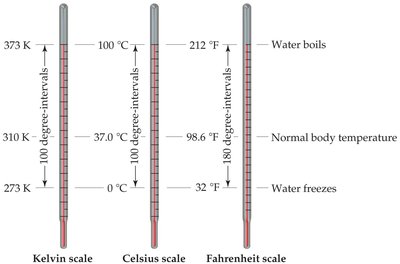
Temperature: Measured in Celsius (°C), Kelvin (K), and Fahrenheit (°F). Kelvin is the SI unit.
Density: Defined as mass per unit volume.
Numbers and Uncertainty in Chemistry
Measurements in chemistry involve uncertainty and require careful attention to significant figures and accuracy.
Exact Numbers: Known by definition or counting (e.g., 12 eggs in a dozen).
Inexact Numbers: Measured values subject to instrument limitations.
Accuracy: Closeness to the true value.
Precision: Closeness of repeated measurements to each other.
Significant Figures: Digits that reflect the precision of a measurement.
Rules for significant figures in calculations:
Addition/Subtraction: Round to the least significant decimal place.
Multiplication/Division: Round to the least number of significant figures.
Dimensional Analysis
Dimensional analysis is a method for converting between units using conversion factors.
Set up ratios to cancel units and convert quantities.
Example: To convert meters to inches, use and .

Summary Table: SI Base Units
Physical Quantity | Name of Unit | Abbreviation |
|---|---|---|
Mass | Kilogram | kg |
Length | Meter | m |
Time | Second | s or sec |
Temperature | Kelvin | K |
Amount of substance | Mole | mol |
Electric current | Ampere | A or amp |
Luminous intensity | Candela | cd |
Summary Table: Metric System Prefixes
Prefix | Abbreviation | Meaning | Example |
|---|---|---|---|
Peta | P | 1015 | 1 petawatt (PW) |
Tera | T | 1012 | 1 terawatt (TW) |
Giga | G | 109 | 1 gigawatt (GW) |
Mega | M | 106 | 1 megawatt (MW) |
Kilo | k | 103 | 1 kilowatt (kW) |
Deci | d | 10-1 | 1 deciwatt (dW) |
Centi | c | 10-2 | 1 centiwatt (cW) |
Milli | m | 10-3 | 1 milliwatt (mW) |
Micro | μ | 10-6 | 1 microwatt (μW) |
Nano | n | 10-9 | 1 nanowatt (nW) |
Pico | p | 10-12 | 1 picowatt (pW) |
Femto | f | 10-15 | 1 femtowatt (fW) |
Atto | a | 10-18 | 1 attowatt (aW) |
Zepto | z | 10-21 | 1 zeptowatt (zW) |
Additional info: Academic context and examples were expanded for clarity and completeness. All images included are directly relevant to the adjacent explanations.
