 Back
BackMatter: Its Properties and Measurement – General Chemistry Chapter 1 Study Notes
Study Guide - Smart Notes
 Tailored notes based on your materials, expanded with key definitions, examples, and context.
Matter: Its Properties and Measurement
Introduction to Chemistry and Matter
Chemistry is the central science, concerned with the composition, structure, properties, and changes of matter. All material objects, whether living or nonliving, are composed of chemicals. Chemistry has been practiced since ancient times, from pottery glazing to fermentation. The elements discussed in chemistry are found both on Earth and throughout the universe.
1-1 The Scientific Method
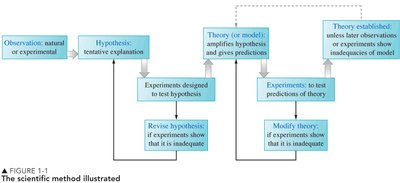
The scientific method is a systematic approach to understanding natural phenomena. It involves observation, hypothesis formation, experimentation, and the development of laws and theories. This method originated in the seventeenth century and remains the foundation of scientific inquiry.
Observation: Careful examination of natural phenomena without initial assumptions.
Natural Law: A concise statement, often mathematical, describing a consistent pattern in nature (e.g., law of radioactive decay).
Hypothesis: A tentative explanation for a natural law, subject to experimental testing.
Theory: A well-tested model that explains natural laws and predicts new phenomena.
Experimentation: Designed to test hypotheses and theories, leading to their refinement or rejection.
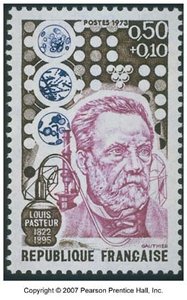
Example: Louis Pasteur, a chemist, developed the germ theory, pasteurization, and the rabies vaccine, demonstrating the application of the scientific method in biology and chemistry.
Many scientific discoveries, such as vulcanized rubber and penicillin, were made by chance, emphasizing the importance of observation and preparedness in science.
1-2 Properties of Matter
Matter is anything that occupies space, has mass, and exhibits inertia. The study of matter involves understanding its composition and properties, which are classified as physical or chemical.
Physical Properties: Characteristics that can be observed without changing the substance's composition (e.g., color, malleability, ductility, melting point).
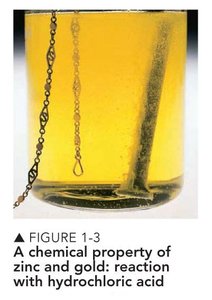
Chemical Properties: Characteristics that describe a substance's ability to undergo chemical changes, resulting in new substances (e.g., flammability, reactivity with acids).

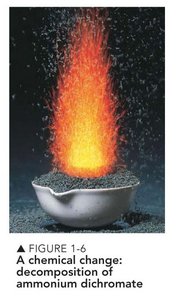
Example: Burning paper is a chemical change, while melting ice is a physical change. Ammonium dichromate decomposes into chromium(III) oxide, nitrogen, and water upon heating—a chemical change.
1-3 Classification of Matter
Matter is composed of atoms, the fundamental units of chemical elements. Elements and compounds are classified as substances, while mixtures can be homogeneous or heterogeneous.
Element: A pure substance made of only one kind of atom (e.g., copper, sulfur).
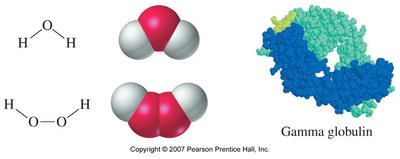
Compound: A substance composed of two or more elements chemically combined in fixed proportions (e.g., water, H2O).
Mixture: A combination of two or more substances that retain their individual properties. Mixtures can be:
Homogeneous (Solution): Uniform composition throughout (e.g., saltwater, air).
Heterogeneous: Non-uniform composition, with distinct regions (e.g., salad dressing, concrete).
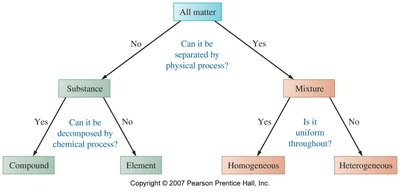
Separation of Mixtures: Physical processes such as filtration, distillation, and chromatography are used to separate mixtures based on differences in physical properties.
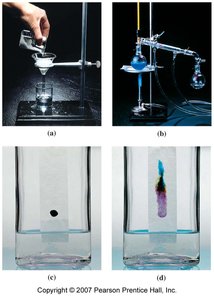
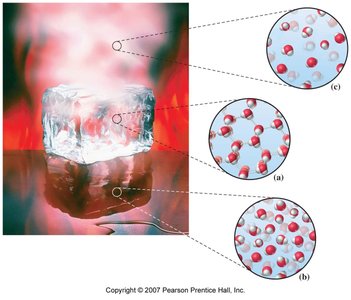
States of Matter: Macroscopic and Microscopic Views
Matter exists in three primary states: solid, liquid, and gas. These states are distinguished by the arrangement and movement of particles at the atomic and molecular levels.
1-4 Measurement of Matter: SI (Metric) Units
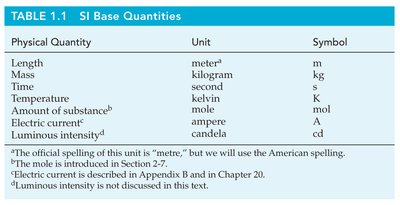
Chemistry is a quantitative science, relying on measurements expressed as the product of a number and a unit. The International System of Units (SI) is the standard for scientific measurements.
Base SI Units: meter (m) for length, kilogram (kg) for mass, second (s) for time, kelvin (K) for temperature, mole (mol) for amount of substance, ampere (A) for electric current, candela (cd) for luminous intensity.
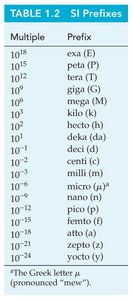
SI Prefixes: Used to express multiples or fractions of units (e.g., kilo-, centi-, milli-).
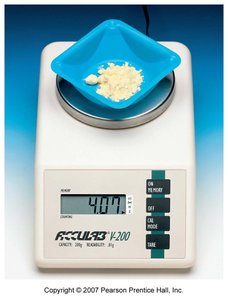
Mass vs. Weight: Mass is the quantity of matter; weight is the force of gravity on an object.
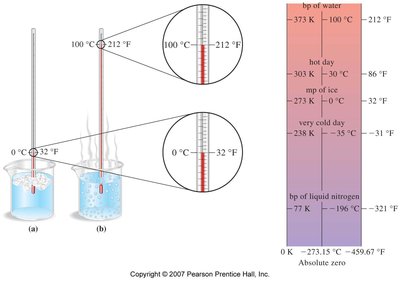
Temperature: Measured in degrees Celsius (°C), Kelvin (K), or Fahrenheit (°F). Fixed points and increments define temperature scales.
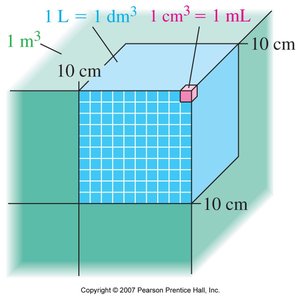
Volume: The amount of space occupied by matter. Common units include liter (L), milliliter (mL), and cubic centimeter (cm3).
1-5 Density and Percent Composition
Density (d) is defined as mass per unit volume:
Extensive Properties: Depend on the amount of matter (e.g., mass, volume).
Intensive Properties: Independent of the amount of matter (e.g., density, temperature).
Density is temperature-dependent; for example, the density of water at 4°C is 1.000 g/mL, while at 20°C it is 0.9982 g/mL.
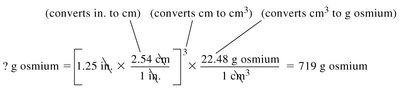
Example: Calculating the mass of a cube of osmium (density = 22.48 g/cm3) with a side length of 1.25 inches:
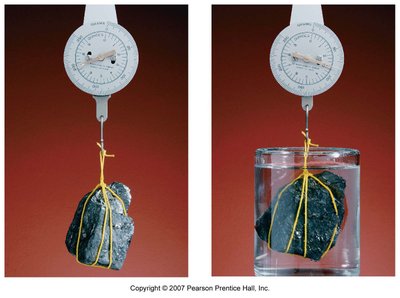
Measuring Volume of Irregular Objects: The volume can be determined by water displacement.
1-6 Uncertainties in Scientific Measurements
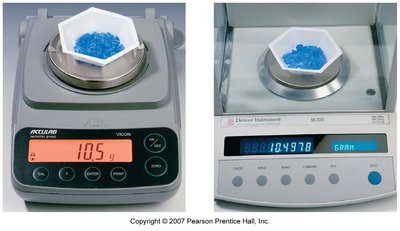
All measurements are subject to error, which can be systematic or random.
Systematic Errors: Consistent, repeatable errors due to faulty equipment or technique, leading to bias.
Random Errors: Fluctuations in measurements due to limitations in reading instruments or environmental factors.
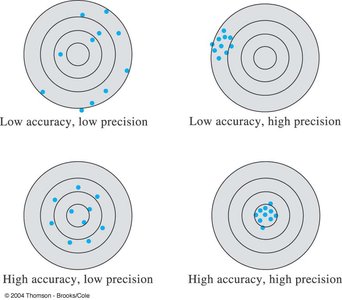
Accuracy: Closeness of a measured value to the true value.
Precision: Reproducibility of measurements under unchanged conditions.
1-7 Significant Figures
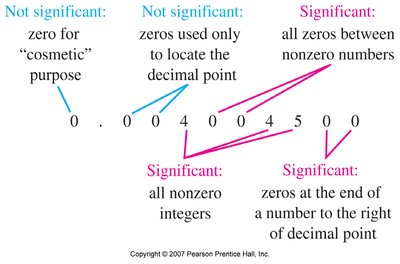
Significant figures reflect the precision of a measured quantity. Rules for determining significant figures:
All nonzero digits are significant.
Zeros between nonzero digits are significant.
Leading zeros are not significant.
Trailing zeros in a number with a decimal point are significant.
Trailing zeros in a whole number without a decimal point are ambiguous.
Calculations with Significant Figures:
Multiplication/Division: The result should have as many significant figures as the least precise measurement.
Addition/Subtraction: The result should have the same number of decimal places as the measurement with the fewest decimal places.
Rounding: If the digit dropped is 5 or greater, increase the last retained digit by one; otherwise, leave it unchanged.
Example: (3 significant figures)
To three significant figures, 15.44 rounds to 15.4, and 15.45 rounds to 15.5.
