 Back
Matter, Measurement, and Problem Solving: General Chemistry Study Notes
Study Guide - Smart Notes
 Tailored notes based on your materials, expanded with key definitions, examples, and context.
Matter, Measurement, and Problem Solving
Atoms and Molecules
Physical properties of matter are determined by the chemical and physical properties of atoms and molecules. Atoms are submicroscopic particles that serve as the building blocks for elements and molecules. Molecules are formed when two or more atoms combine, which can be of the same or different elements.
Atoms: Smallest unit of an element, possessing the chemical properties of that element.
Molecules: Combination of two or more atoms; can be homonuclear (same element) or heteronuclear (different elements).
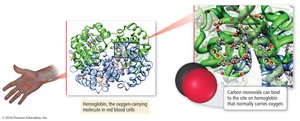
Example: Carbon Monoxide (CO)
CO is a molecule composed of one carbon atom and one oxygen atom. Its unique structure allows it to bind tightly to hemoglobin, preventing hemoglobin from carrying oxygen.
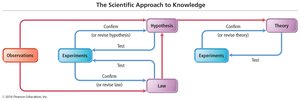
The Scientific Approach to Knowledge
Science is empirical, relying on observation and experimentation. The scientific method is a flexible, organized plan for investigation, involving both scientific and moral components.
Fact: A phenomenon agreed upon by competent observers.
Law: A general statement about relationships in nature, repeatedly tested and not contradicted.
Hypothesis: A testable, falsifiable statement that can be supported but not proven by data.
Theory: A unifying explanation synthesizing well-tested hypotheses.
All about Matter: Classifications and Properties
States of Matter
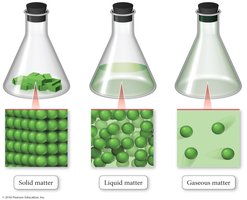
Matter has mass and occupies space, consisting of atoms and molecules in motion. The three main phases are solid, liquid, and gas, each with distinct properties.
Solids: Rigid shape, fixed volume, ordered atomic arrangement (crystalline or amorphous).
Liquids: Fixed volume, no fixed shape, fluid, takes shape of container.
Gases: No fixed volume or shape, expand to fill container, least ordered.
Matter Classifications According to Composition
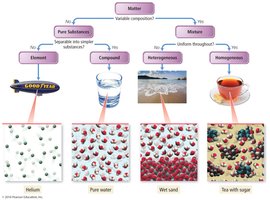
Matter can be classified based on its composition as pure substances or mixtures. Pure substances include elements and compounds, while mixtures can be homogeneous or heterogeneous.
Element: Pure substance made of one type of atom.
Compound: Pure substance made of two or more elements in definite ratios.
Homogeneous mixture: Uniform composition throughout (e.g., air, tea).
Heterogeneous mixture: Non-uniform composition (e.g., sand, forest floor).
Mixtures and Separation Techniques
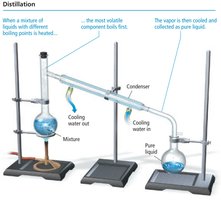
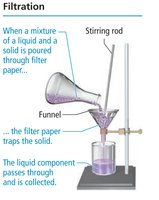
Mixtures are separable due to differences in physical or chemical properties. Common separation techniques include decanting, distillation, and filtration.
Decanting: Pouring off liquid from a mixture of solid and liquid.
Distillation: Heating a mixture to boil off the more volatile component, then condensing and collecting it.
Filtration: Passing a mixture through filter paper to separate insoluble solids from liquids.
Physical and Chemical Changes
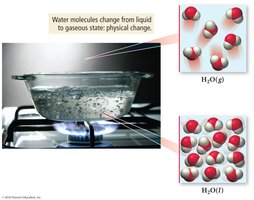
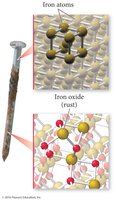
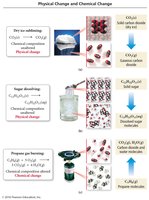
Physical changes alter the state or appearance of matter without changing its composition, while chemical changes transform substances into new compounds.
Physical Change: Phase changes (e.g., ice melting, water boiling).
Chemical Change: Formation of new substances (e.g., rusting of iron).
Energy and Matter
Introduction to Energy
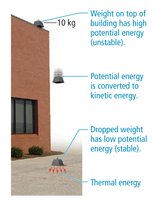
Energy is the capacity to do work and is fundamental to physical and chemical changes. The First Law of Thermodynamics states that energy is conserved in the universe.
Kinetic Energy (KE): Energy of motion.
Potential Energy (PE): Energy of position or composition.
Thermal Energy: Energy associated with temperature, arising from atomic/molecular motion.
Measurement in Chemistry
Scientific Measurements: Units, Precision, and Accuracy
Measurements consist of a numerical value and a unit. The precision and accuracy of measurements are critical in scientific investigations.
SI Units: Standard units for length (meter), mass (kilogram), time (second), temperature (kelvin), and amount (mole).
Precision: Closeness of repeated measurements.
Accuracy: Closeness to the true value.
Metric System: SI Prefix Multipliers
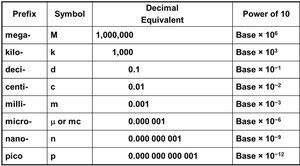
SI prefixes are used to express multiples or fractions of base units.
Prefix | Symbol | Decimal Equivalent | Power of 10 |
|---|---|---|---|
mega- | M | 1,000,000 | Base × 106 |
kilo- | k | 1,000 | Base × 103 |
deci- | d | 0.1 | Base × 10-1 |
centi- | c | 0.01 | Base × 10-2 |
milli- | m | 0.001 | Base × 10-3 |
micro- | μ or mc | 0.000 001 | Base × 10-6 |
nano- | n | 0.000 000 001 | Base × 10-9 |
pico- | p | 0.000 000 000 001 | Base × 10-12 |
Temperature Scales and Conversion
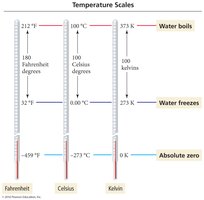
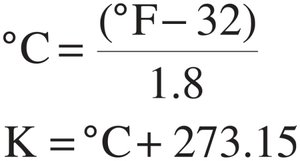
Temperature is measured in Fahrenheit, Celsius, and Kelvin. Celsius and Kelvin degrees are the same size, while Fahrenheit is different. Conversion formulas are essential for calculations.
Fahrenheit (°F): Water freezes at 32°F, boils at 212°F.
Celsius (°C): Water freezes at 0°C, boils at 100°C.
Kelvin (K): Absolute zero is 0 K; water freezes at 273 K.
Conversion formulas:
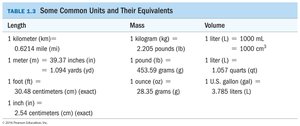
Common Units and Their Equivalents
Understanding unit equivalencies is crucial for dimensional analysis and problem solving.
Length | Mass | Volume |
|---|---|---|
1 kilometer (km) = 0.6214 mile (mi) | 1 kilogram (kg) = 2.205 pounds (lb) | 1 liter (L) = 1000 mL = 1000 cm3 |
1 meter (m) = 39.37 inches (in) | 1 pound (lb) = 453.59 grams (g) | 1 liter (L) = 1.057 quarts (qt) |
1 foot (ft) = 30.48 centimeters (cm) | 1 ounce (oz) = 28.35 grams (g) | 1 U.S. gallon (gal) = 3.785 liters (L) |
1 inch (in) = 2.54 centimeters (cm) |
Intensive and Extensive Properties
Properties of matter are classified as intensive or extensive. Intensive properties do not depend on the amount of substance, while extensive properties do.
Intensive property: Density, color, boiling point.
Extensive property: Mass, volume.
Density
Density is an intensive property defined as mass per unit volume. It is affected by temperature, especially for liquids and gases.
Significant Figures and Calculations
Counting Significant Figures
The number of significant figures in a measurement reflects its precision. Rules for counting significant figures include:
All nonzero digits are significant.
Zeros between nonzero digits are significant.
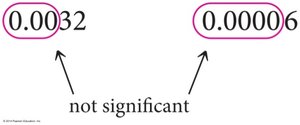
Leading zeros are not significant.
Trailing zeros after a decimal point are significant.
Significant Figures in Calculations
Results of calculations must reflect the precision of the measured quantities.
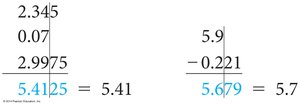
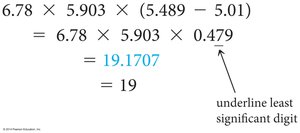
Multiplication/Division: Result has the same number of significant figures as the factor with the fewest.
Addition/Subtraction: Result has the same number of decimal places as the quantity with the fewest decimal places.

Rules for Rounding
Round down if the last digit dropped is four or less; round up if it is five or more. Only round the final answer in multistep calculations.
Solving Chemical Problems: Dimensional Analysis
Dimensional Analysis
Dimensional analysis uses units as a guide to solve problems, especially unit conversions. Conversion factors are derived from equivalence statements.
Arrange conversion factors so the starting unit cancels.
String conversion factors as needed to reach the desired unit.

Units Raised to a Power
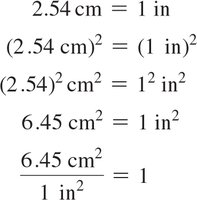
When converting units raised to a power, raise both the number and the unit to the power.
Reliability of Measurement: Precision, Accuracy, and Uncertainty
Precision vs. Accuracy
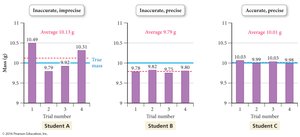
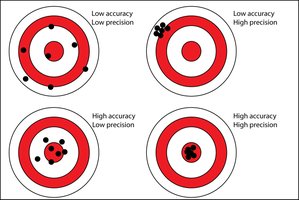
Precision is the agreement among repeated measurements, while accuracy is the agreement with the true value. Uncertainty is reported as a confidence interval.
Precision: Repeatability of measurements.
Accuracy: Closeness to the actual value.
Uncertainty: Degree of difference, reported as (+/-).
Estimating Precision of Laboratory Equipment
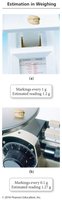
For instruments with a scale, estimate the last digit by mentally dividing the gap between marks into tenths.
Dimensional Analysis: Conversion Factors
Conversion factors are relationships between two units, exact or measured. Arrange them so the starting unit cancels, and string as needed.
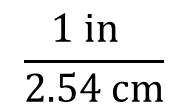
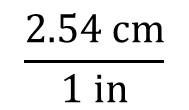
Example: To convert 2.00 ft to inches:
