 Back
BackMeasuring and Expressing Enthalpy Changes (Thermochemistry)
Study Guide - Smart Notes
 Tailored notes based on your materials, expanded with key definitions, examples, and context.
Measuring and Expressing Enthalpy Changes
Introduction to Enthalpy and Heat Flow
Thermochemistry is the study of energy changes, particularly heat, that accompany chemical reactions and physical changes. The enthalpy change (ΔH) of a reaction is a key concept, representing the heat absorbed or released at constant pressure.
Enthalpy (H): The heat content of a system at constant pressure.
ΔH (Enthalpy Change): The difference in enthalpy between products and reactants; positive for endothermic, negative for exothermic reactions.
Heat (q): Energy transferred due to temperature difference; at constant pressure, q = ΔH.
Calorimetry: Measuring Heat Flow
Calorimetry is the experimental technique used to measure the heat flow into or out of a system during chemical and physical processes. The device used is called a calorimeter.
Calorimeter: An insulated device for measuring heat absorbed or released.
In endothermic processes, the system absorbs heat from the surroundings.
In exothermic processes, the system releases heat to the surroundings.
Constant-Pressure Calorimetry
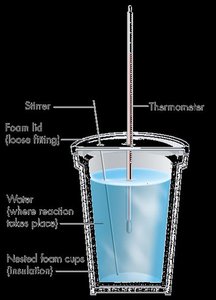
Most laboratory reactions occur at constant atmospheric pressure. A simple calorimeter can be made from nested foam cups, which minimize heat exchange with the environment.
Foam cup calorimeters are used for reactions in aqueous solution.
The enthalpy change (ΔH) is determined by measuring the temperature change of the water (surroundings).
Key formula:
Where:
m = mass of water (g)
C = specific heat of water (J/g·°C)
ΔT = change in temperature ()
The heat absorbed by the surroundings is equal in magnitude and opposite in sign to the heat released by the system:
Thus,
Constant-Volume (Bomb) Calorimetry
For reactions involving combustion or gases, a bomb calorimeter is used. This device operates at constant volume and is highly insulated.
A sample is burned in a steel chamber (the bomb) surrounded by water.
The temperature increase of the water is used to calculate the heat released.
Bomb calorimeters are ideal for measuring heats of combustion.
Sample Calculations in Calorimetry
To determine the enthalpy change in a calorimetry experiment, follow these steps:
Calculate the total mass of the solution (using density and volume).
Determine the temperature change ().
Apply the formula:
Convert units as needed (e.g., J to kJ).
Example: Mixing 25.0 mL of 0.025 mol HCl and 25.0 mL of 0.025 mol NaOH at 25.0°C, final temperature 32.0°C, density 1.00 g/mL, J/(g·°C):
Total mass = 50.0 g
Thermochemical Equations
A thermochemical equation is a balanced chemical equation that includes the enthalpy change (ΔH) for the reaction as written. The enthalpy change can be shown as a reactant (endothermic) or product (exothermic).
Exothermic example:
Endothermic example:
The physical states of reactants and products must be specified, as enthalpy changes depend on state.
Standard conditions: 101.3 kPa (1 atm) and 25°C.
Heats of Reaction and Heats of Combustion
The heat of reaction is the enthalpy change for a chemical equation as written. The heat of combustion is the enthalpy change for the complete burning of one mole of a substance.
Heats of reaction (ΔH): Reported for the equation as written, with physical states and standard conditions.
Heats of combustion: Always exothermic; e.g., burning 1 mol methane releases 890 kJ:
Substance | Formula | ΔH (kJ/mol) |
|---|---|---|
Hydrogen | H2(g) | –286 |
Carbon (graphite) | C(s) | –394 |
Methane | CH4(g) | –890 |
Acetylene | C2H2(g) | –1300 |
Ethanol | C2H6O(l) | –1368 |
Propane | C3H8(g) | –2220 |
Glucose | C6H12O6(s) | –2808 |
Octane | C8H18(l) | –5471 |
Sucrose | C12H22O11(s) | –5645 |
Key Terms
Calorimetry: Precise measurement of heat flow in chemical and physical processes.
Calorimeter: Insulated device for measuring heat absorption or release.
Enthalpy (H): Heat content at constant pressure.
Thermochemical equation: Chemical equation including enthalpy change.
Heat of reaction: Enthalpy change for a chemical equation as written.
Heat of combustion: Enthalpy change for complete burning of one mole of a substance.
Summary Equation
The value of ΔH for a reaction at constant pressure can be determined by:
