 Back
BackMole Quantities, Percent Composition, and Empirical/Molecular Formulas
Study Guide - Smart Notes
 Tailored notes based on your materials, expanded with key definitions, examples, and context.
MODULE 6: Chemical Quantities and Formulas
Mole Quantities and Avogadro's Number
The mole is a fundamental unit in chemistry that represents a specific quantity of particles (atoms, molecules, ions, etc.). The number of particles in one mole is known as Avogadro's number, which is particles per mole. This allows chemists to count atoms and molecules by weighing them.
Conversion factor: 1 mol = items (atoms, molecules, ions, etc.)
Used to convert between number of particles and moles.

Mole Conversions and Molar Mass
Molar mass is defined as the mass of one mole of a substance, expressed in grams per mole (g/mol). It is numerically equal to the sum of the atomic masses of all atoms in a chemical formula. Molar mass is used as a conversion factor between mass and moles.
To convert mass to moles: Divide the mass of the sample by its molar mass.
To convert moles to mass: Multiply the number of moles by the molar mass.
To convert between mass, moles, and number of particles: Use both the molar mass and Avogadro's number as conversion factors.

Percent Composition by Mass
Percent composition by mass expresses the mass percentage of each element in a compound. It is calculated using the formula:
\( \text{Percent by mass of element E} = \frac{\text{mass of E in 1 mol of compound}}{\text{molar mass of compound}} \times 100\% \)
Percent composition is useful for determining empirical formulas and for chemical analysis.
Empirical and Molecular Formulas
The empirical formula of a compound shows the simplest whole-number ratio of atoms of each element present. The molecular formula gives the actual number of atoms of each element in a molecule and is always a whole-number multiple of the empirical formula.
Empirical formula: Simplest ratio (e.g., for hydrogen peroxide, H2O2, the empirical formula is HO).
Molecular formula: Actual number of atoms (e.g., H2O2).
Relationship: \( \text{Molecular formula} = n \times \text{Empirical formula} \), where n is a whole number.
Steps to Determine the Empirical Formula
Assume a 100 g sample (so percent values become grams).
Convert the mass of each element to moles using their molar masses.
Divide each mole value by the smallest number of moles calculated.
If necessary, multiply all mole ratios by the smallest whole number to obtain whole numbers.
Write the empirical formula using these whole-number ratios as subscripts.
Example: Empirical Formula Calculation
A compound contains 69.94% iron (Fe) and 30.06% oxygen (O). Find its empirical formula.
Assume 100 g sample: 69.94 g Fe, 30.06 g O.
Convert to moles:
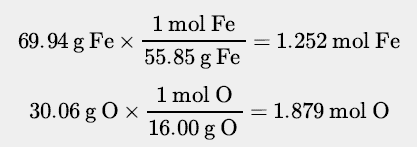
Divide by the smallest number of moles (1.252):
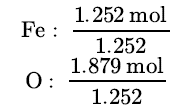
Fe:
O:
Since O is not a whole number, multiply both by 2: Fe = 2, O = 3.
Empirical formula: Fe2O3
Practice Problems
Practice converting between mass, moles, and number of particles.
Calculate percent composition and empirical formulas for given compounds.
Additional info: The empirical formula is especially important in analytical chemistry and for determining the simplest formula from experimental data. The molecular formula is determined when the molar mass of the compound is known.
