 Back
Molecular Compounds: Formulas and Names
Study Guide - Smart Notes
 Tailored notes based on your materials, expanded with key definitions, examples, and context.
Chapter Three: Molecules and Compounds
3.6 Molecular Compounds: Formulas and Names
Molecular compounds are chemical substances composed of two or more nonmetal elements. The systematic naming and formula writing of these compounds is essential for clear communication in chemistry.
Definition: Molecular compounds are formed when nonmetals combine, sharing electrons to create molecules.
Formula Writing: The element with the smallest group number is written first in the formula. If both elements are in the same group, the one with the greatest row number is written first.
Examples:
NO2 (Nitrogen dioxide), not O2N
CO (Carbon monoxide), not OC
SO2 (Sulfur dioxide), not O2S
Prefixes are used in the names of molecular compounds to indicate the number of atoms of each element present. These prefixes are translated into subscripts in the chemical formula.
Common Prefixes:
Mono- (1)
Di- (2)
Tri- (3)
Tetra- (4)
Penta- (5)
Hexa- (6)
Hepta- (7)
Octa- (8)
Formula Example: Dinitrogen trioxide is written as N2O3.
Naming Binary Molecular Compounds
Binary molecular compounds consist of two different nonmetal elements. The naming convention uses prefixes to indicate the number of atoms, but the prefix 'mono-' is usually omitted for the first element.
Examples:
CO: Carbon monoxide
CS2: Carbon disulfide
N2O: Dinitrogen monoxide
N2O5: Dinitrogen pentoxide
Naming Acids
Acids are a special class of molecular compounds, typically consisting of hydrogen and another element or polyatomic ion, dissolved in water. Their naming depends on their composition.
Binary Acids: Composed of hydrogen and a nonmetal. Named with the prefix 'hydro-', the base name of the nonmetal, the suffix '-ic', and the word 'acid'.
HCl(aq): Hydrochloric acid
HF(aq): Hydrofluoric acid
HBr(aq): Hydrobromic acid
Oxyacids: Composed of hydrogen and an oxyanion (polyatomic ion containing oxygen). Naming depends on the ending of the polyatomic ion:
If the ion ends in '-ate', change to '-ic' (e.g., H2SO4: Sulfuric acid)
If the ion ends in '-ite', change to '-ous' (e.g., H2SO3: Sulfurous acid)
Summary of Inorganic Nomenclature
Inorganic nomenclature provides systematic rules for naming compounds, ensuring clarity and consistency in chemical communication. Practice problems help reinforce these concepts.
Practice Problem
Apply the rules above to name or write formulas for given molecular compounds and acids.
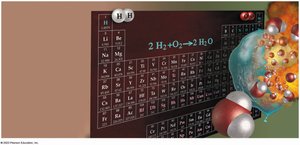
Example Reaction: The image shows the formation of water from hydrogen and oxygen: .
Application: This reaction demonstrates the combination of molecular compounds and the importance of correct formula writing and nomenclature.
