 Back
Molecular Geometries and Bonding Theories: Chapter 9 Study Guide
Study Guide - Smart Notes
 Tailored notes based on your materials, expanded with key definitions, examples, and context.
Molecular Geometries and Bonding Theories
Introduction to Molecular Geometry
Molecular geometry describes the three-dimensional arrangement of atoms within a molecule. Understanding molecular shapes is essential for predicting physical and chemical properties, such as polarity and reactivity. The VSEPR (Valence Shell Electron Pair Repulsion) model is a foundational theory used to predict these shapes based on electron domain repulsions.
Valence Shell Electron Pair Repulsion (VSEPR) Theory
The VSEPR theory states that electron pairs around a central atom will arrange themselves to minimize repulsion, maximizing the distance between them. This arrangement determines the electron-domain geometry and, subsequently, the molecular geometry.
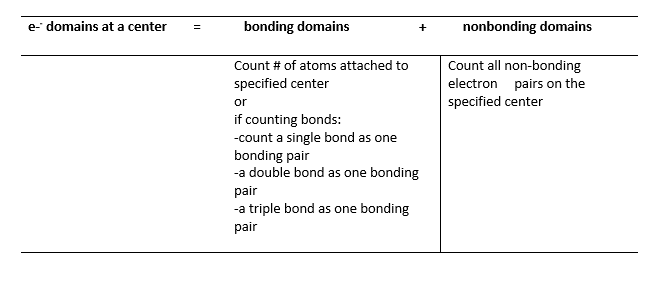
Electron domains include both bonding pairs (single, double, or triple bonds) and nonbonding pairs (lone pairs).
The order of repulsions: lone pair-lone pair > lone pair-bonding pair > bonding pair-bonding pair.
Steps to determine electron-domain/electron pair geometry:
Draw the best Lewis structure of the molecule.
Count electron domains at the specified central atom.
Use reference tables to determine the electron-domain geometry.
Electron-Domain Geometries
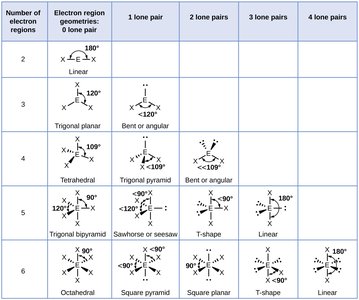
Electron-domain geometry considers all regions where electrons are located, including both bonding and nonbonding domains. The molecular geometry (shape) describes only the arrangement of bonded atoms, not lone pairs.
When there are no lone pairs, molecular geometry matches electron-domain geometry.
Lone pairs modify the molecular geometry from the electron-domain geometry.


Common Electron-Domain Geometries and Bond Angles
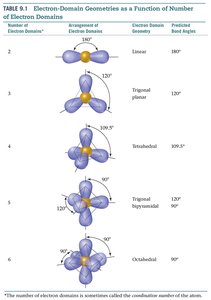
The number of electron domains determines the geometry and bond angles:
2 domains: Linear, 180°
3 domains: Trigonal planar, 120°
4 domains: Tetrahedral, 109.5°
5 domains: Trigonal bipyramidal, 90°/120°
6 domains: Octahedral, 90°
Examples of Molecular Geometry
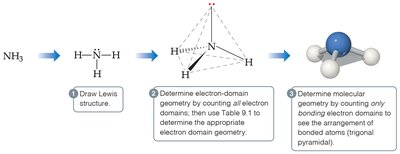
To determine the molecular geometry, count only the bonding domains and use reference tables to see the arrangement of bonded atoms.
NH3: 4 electron domains (3 bonding, 1 nonbonding) → trigonal pyramidal molecular geometry.
H2O: 4 electron domains (2 bonding, 2 nonbonding) → bent molecular geometry.
Hybridization
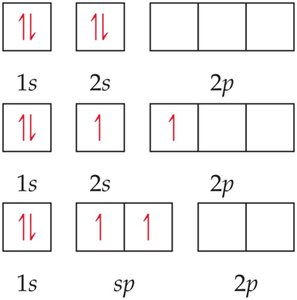
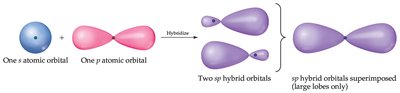
Hybridization is the process by which atomic orbitals mix to form new, degenerate orbitals suitable for bonding. The type of hybridization depends on the number of electron domains around the central atom.
sp: Linear geometry, 2 domains
sp2: Trigonal planar geometry, 3 domains
sp3: Tetrahedral geometry, 4 domains
sp3d: Trigonal bipyramidal geometry, 5 domains
sp3d2: Octahedral geometry, 6 domains

Types of Bonds: Sigma and Pi Bonds
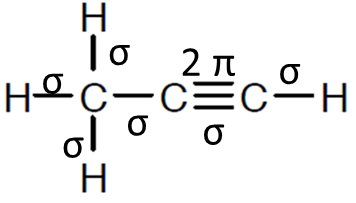
Covalent bonds are classified as sigma (σ) or pi (π) bonds based on orbital overlap:
Sigma (σ) bond: Head-to-head overlap, cylindrical symmetry about the internuclear axis.
Pi (π) bond: Sideways overlap, electron density above and below the internuclear axis.
Single bond = 1 σ bond; Double bond = 1 σ + 1 π bond; Triple bond = 1 σ + 2 π bonds.

Molecule Polarity
Molecular polarity depends on the arrangement of bond dipoles and the symmetry of the molecule:
Nonpolar molecules: Symmetrical, no lone pairs on central atom, identical atoms attached.
Polar molecules: Unsymmetrical, lone pairs on central atom, different atoms attached, polar bonds.
Molecular Orbital Theory
Molecular orbital (MO) theory explains bonding in molecules beyond Lewis structures and VSEPR. Electrons occupy molecular orbitals formed from atomic orbitals, which can be bonding or antibonding.
The number of MOs formed equals the number of atomic orbitals combined.
Bond order is calculated as .
Bond order = 1 for single bond, 2 for double bond, 3 for triple bond.
Diamagnetism: All electrons paired, weakly repelled by magnetic field.
Paramagnetism: One or more unpaired electrons, attracted to magnetic field.

Summary Table: Electron-Domain and Molecular Geometries
The following table summarizes electron-domain and molecular geometries for two, three, and four electron domains:
Number of Electron Domains | Electron-Domain Geometry | Bonding Domains | Nonbonding Domains | Molecular Geometry | Example |
|---|---|---|---|---|---|
4 | Tetrahedral | 4 | 0 | Tetrahedral | CH4 |
4 | Tetrahedral | 3 | 1 | Trigonal pyramidal | NH3 |
4 | Tetrahedral | 2 | 2 | Bent | H2O |
Bond Angles in Common Molecules
Bond angles are affected by the presence of lone pairs:
CH4: 109.5°
NH3: 107°
H2O: 104.5°
Key Equations
Bond Order:
Additional info:
Tables 9.1, 9.2, and 9.3 are referenced for electron-domain and molecular geometries.
MO theory is essential for understanding magnetic properties and color in molecules.
