 Back
BackMolecular Geometries and Bonding Theories: Study Notes
Study Guide - Smart Notes
 Tailored notes based on your materials, expanded with key definitions, examples, and context.
Molecular Geometries and Bonding Theories
Introduction to Lewis Structures
Lewis structures are a foundational tool in chemistry for representing the arrangement of electrons in molecules. They use lines to indicate bonding pairs of electrons and dots for non-bonding (lone) pairs. While Lewis structures show atom connectivity, they do not directly indicate the three-dimensional shape of molecules.
Bonding pairs: Shared electrons between atoms, shown as lines.
Lone pairs: Non-bonding electrons, shown as dots.
Example: Drawing Lewis structures for molecules such as BF3, PCl3, SiCl4, NO+, CO2.
Electron Domains and Molecular Shape
The shape of a molecule is determined by the number of electron domains (regions of electron density) around the central atom. Electron domains include bonding pairs, lone pairs, and multiple bonds (double/triple bonds count as one domain each).
Electron domain: Any region where electrons are likely to be found, including bonds and lone pairs.
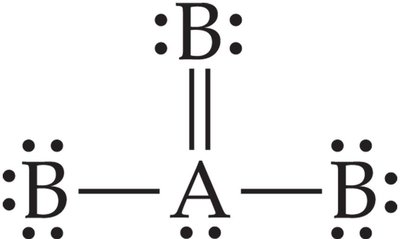
Example: In BF3, the central boron atom has three electron domains.
Valence Shell Electron Pair Repulsion (VSEPR) Theory
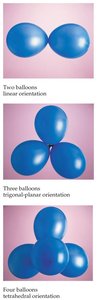
VSEPR theory is used to predict the geometry of molecules based on the repulsion between electron domains. Electron pairs arrange themselves to minimize repulsion, leading to specific molecular shapes.
Repulsion order: Lone pair–lone pair > lone pair–bonding pair > bonding pair–bonding pair.
Key principle: The best arrangement of electron domains minimizes repulsions among them.
Basic Electron-Domain Geometries
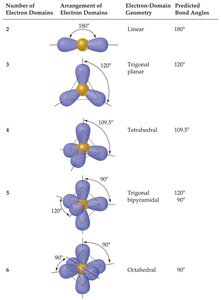
There are five basic electron-domain geometries, each corresponding to a different number of electron domains around the central atom:
Linear: 2 domains, 180° bond angle
Trigonal planar: 3 domains, 120° bond angle
Tetrahedral: 4 domains, 109.5° bond angle
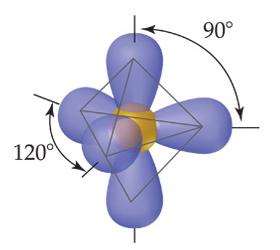
Trigonal bipyramidal: 5 domains, 120° and 90° bond angles
Octahedral: 6 domains, 90° bond angles
Predicting Electron-Domain and Molecular Geometries
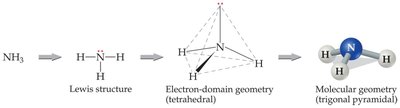
To predict the geometry of a molecule:
Draw the Lewis structure.
Count the number of electron domains (lone pairs and bonds).
Assign the electron-domain geometry based on the number of domains.
Determine the molecular geometry by considering only the positions of atoms (ignore lone pairs).
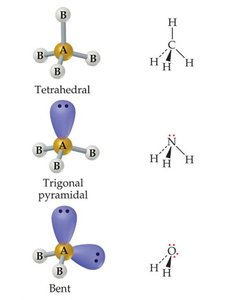
Common Molecular Geometries
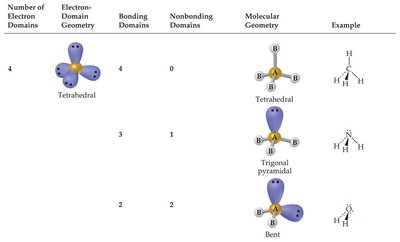
The molecular geometry depends on both the electron-domain geometry and the number of bonding vs. nonbonding pairs:
Electron Domains | Electron-Domain Geometry | Bonding Domains | Nonbonding Domains | Molecular Geometry | Example |
|---|---|---|---|---|---|
2 | Linear | 2 | 0 | Linear | CO2 |
3 | Trigonal planar | 3 | 0 | Trigonal planar | SO3 |
3 | Trigonal planar | 2 | 1 | Bent | SO2 |
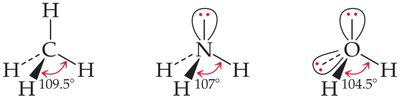
4 | Tetrahedral | 4 | 0 | Tetrahedral | CH4 |
4 | Tetrahedral | 3 | 1 | Trigonal pyramidal | NH3 |
4 | Tetrahedral | 2 | 2 | Bent | H2O |
Trigonal Bipyramidal and Octahedral Geometries
For molecules with five or six electron domains, more complex geometries arise:
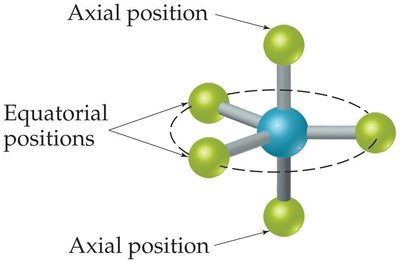
Trigonal bipyramidal: 5 domains; two axial and three equatorial positions. Lone pairs occupy equatorial positions to minimize repulsion.
Octahedral: 6 domains; all positions are equivalent.
Effect of Nonbonding Pairs and Multiple Bonds on Bond Angles
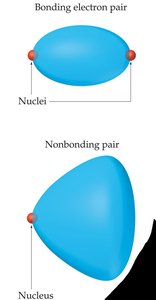
Nonbonding pairs are physically larger than bonding pairs, leading to greater repulsion and smaller bond angles. Multiple bonds (double/triple) also increase electron density and affect bond angles.
Molecular Shape and Polarity
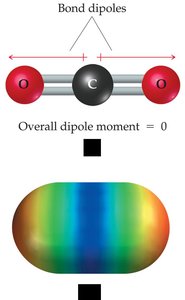
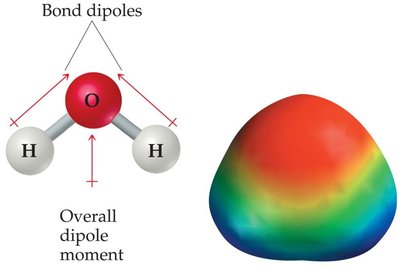
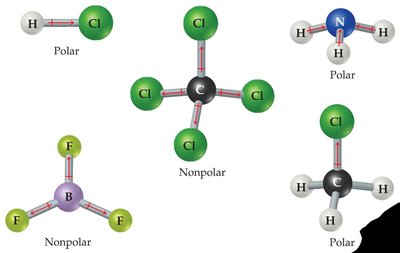
The polarity of a molecule depends on both the polarity of individual bonds and the overall geometry. A molecule is polar if it has a net dipole moment; otherwise, it is nonpolar.
Bond dipole: A measure of the separation of charge in a bond.
Net dipole moment: Vector sum of all bond dipoles in the molecule.
Example: CO2 is nonpolar (linear, dipoles cancel); H2O is polar (bent, dipoles add).
Valence Bond Theory and Orbital Overlap
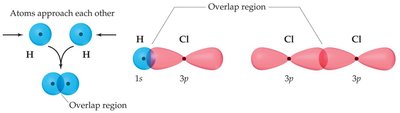
Valence Bond Theory describes covalent bonds as the overlap of atomic orbitals from adjacent atoms. The strength and orientation of the bond depend on the extent of orbital overlap.
Sigma (σ) bonds: Formed by head-to-head overlap, with electron density along the internuclear axis.
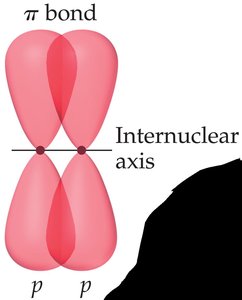
Pi (π) bonds: Formed by side-to-side overlap, with electron density above and below the internuclear axis.
Hybridization of Atomic Orbitals
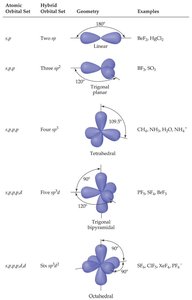
Hybridization is the mixing of atomic orbitals to form new, equivalent hybrid orbitals suitable for the pairing of electrons to form chemical bonds. The type of hybridization corresponds to the electron-domain geometry:
Electron-Domain Geometry | Hybridization | Example |
|---|---|---|
Linear | sp | BeF2 |
Trigonal planar | sp2 | BF3 |
Tetrahedral | sp3 | CH4 |
Trigonal bipyramidal | sp3d | PF5 |
Octahedral | sp3d2 | SF6 |
Sigma and Pi Bonds in Multiple Bonds
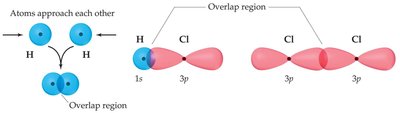
In multiple bonds, one bond is always a sigma bond, and the others are pi bonds. Sigma bonds result from head-to-head overlap, while pi bonds result from side-to-side overlap of p orbitals.
Delocalized Bonding and Resonance
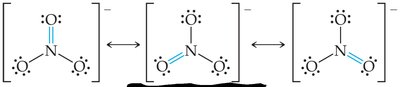
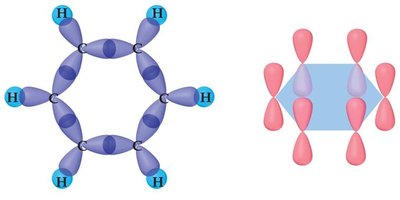
Some molecules cannot be adequately described by a single Lewis structure. Resonance structures are used to represent delocalized bonding, where electrons are spread over several atoms.
Example: Nitrate ion (NO3-) and benzene (C6H6).

Molecular Orbital (MO) Theory
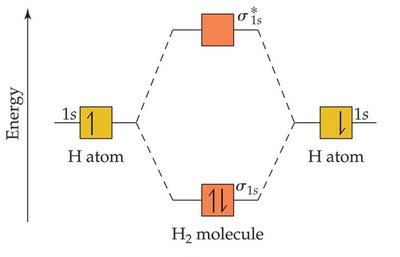
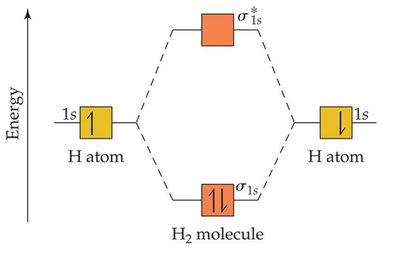
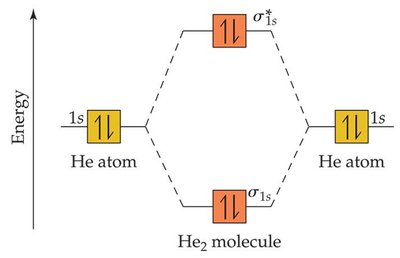
Molecular Orbital Theory describes bonding in terms of molecular orbitals that are formed from the combination of atomic orbitals. These orbitals can be bonding (lower energy) or antibonding (higher energy), depending on whether the atomic orbitals combine constructively or destructively.
Bond order (BO):
Bond order interpretation: BO = 1 (single bond), BO = 2 (double bond), BO = 3 (triple bond), BO = 0 (no bond).
MO Diagrams for Second-Row Diatomic Molecules
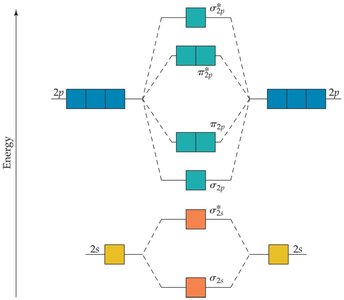
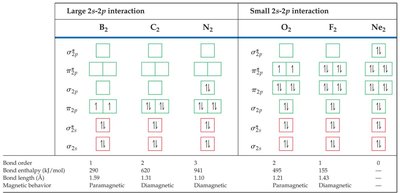
For molecules with both s and p orbitals, molecular orbitals are formed by both head-to-head (σ) and side-to-side (π) interactions. The arrangement of electrons in these orbitals determines the bond order and magnetic properties of the molecule.
Molecule | Bond Order | Magnetic Property |
|---|---|---|
B2 | 1 | Paramagnetic |
C2 | 2 | Diamagnetic |
N2 | 3 | Diamagnetic |
O2 | 2 | Paramagnetic |
Magnetic Properties
Paramagnetic: Substances with unpaired electrons; attracted to a magnetic field.
Diamagnetic: Substances with all electrons paired; repelled from a magnetic field.
Ethics in Chemistry: Forensic Chemist Case Study
Forensic chemists play a critical role in the justice system by analyzing evidence. Ethical conduct is essential, as falsifying results or mishandling evidence can have severe consequences for individuals and society.
Duties: Analyze samples, follow protocols, report results honestly.
Unethical behavior: Falsifying results, tampering with evidence, not following procedures.
Consequences: Wrongful convictions, loss of public trust, legal penalties.
