 Back
Molecular Geometry and Bonding Theories – General Chemistry Study Notes
Study Guide - Smart Notes
 Tailored notes based on your materials, expanded with key definitions, examples, and context.
Chapter 9: Molecular Geometry and Bonding Theories
9.1 Molecular Shapes
Molecular geometry describes the three-dimensional arrangement of atoms in a molecule. While Lewis structures show bonding and lone pairs, they do not always reflect the true shape of a molecule. However, Lewis structures are useful for predicting molecular shapes using models such as VSEPR.
Key Point 1: The arrangement of atoms (not lone pairs) determines the molecular geometry.
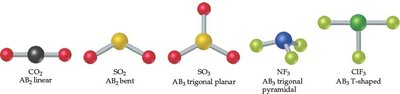
Key Point 2: Common shapes for molecules with two or three atoms connected to a central atom include linear, bent, trigonal planar, trigonal pyramidal, and T-shaped.
Example: CO2 (linear), SO2 (bent), SO3 (trigonal planar), NF3 (trigonal pyramidal), ClF3 (T-shaped).
9.2 The VSEPR Model
The Valence-Shell Electron-Pair Repulsion (VSEPR) model predicts molecular shapes based on the repulsion between electron domains (regions where electrons are most likely found, including bonds and lone pairs) around a central atom.
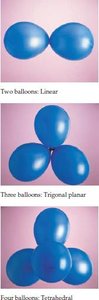
Key Point 1: Electron domains repel each other and arrange themselves to minimize repulsion, defining the geometry of the molecule.
Key Point 2: The number of electron domains determines the electron-domain geometry, which in turn influences the molecular geometry.
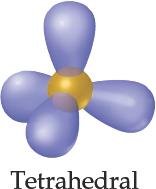
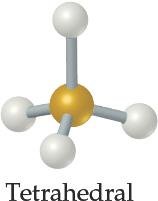
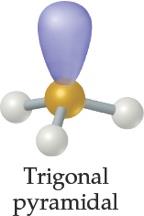
Example: For AB3 with 3 bonding and 1 nonbonding domain, the electron-domain geometry is tetrahedral.
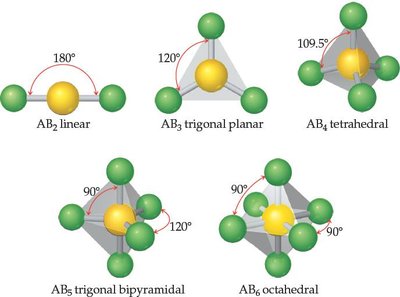
Electron Domains and Geometries
Electron domains include both bonding pairs (single, double, or triple bonds count as one domain) and nonbonding pairs (lone pairs). The arrangement of these domains determines the electron-domain geometry.
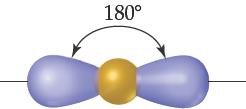
Linear: 2 domains, 180° bond angle.
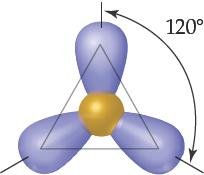
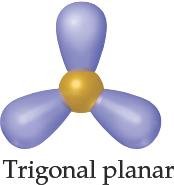
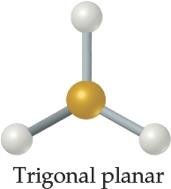
Trigonal planar: 3 domains, 120° bond angle.
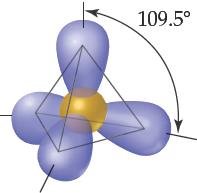
Tetrahedral: 4 domains, 109.5° bond angle.
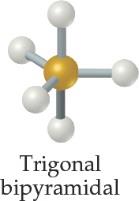
Trigonal bipyramidal: 5 domains, 120° and 90° bond angles.
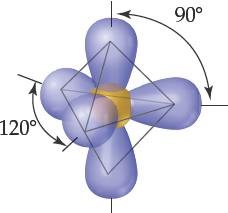
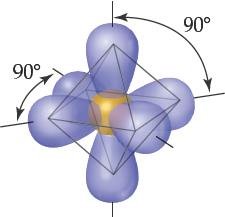
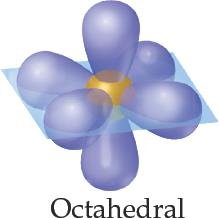
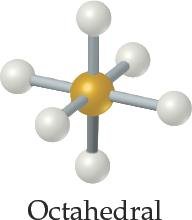
Octahedral: 6 domains, 90° bond angles.
Using VSEPR to Determine Molecular Shapes
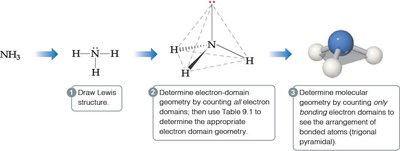
To predict molecular geometry using VSEPR:
Draw the best Lewis structure.
Determine the electron-domain geometry by counting all electron domains around the central atom.
Determine the molecular geometry by considering only the arrangement of bonded atoms (ignore lone pairs for this step).
Electron-Domain and Molecular Geometries
The following table summarizes the relationship between electron-domain geometry, number of bonding and nonbonding domains, molecular geometry, and examples:
Number of Electron Domains | Electron-Domain Geometry | Bonding Domains | Nonbonding Domains | Molecular Geometry | Example |
|---|---|---|---|---|---|
2 | Linear | 2 | 0 | Linear | CO2 |
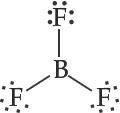
3 | Trigonal planar | 3 | 0 | Trigonal planar | BF3 |
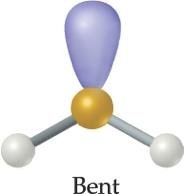
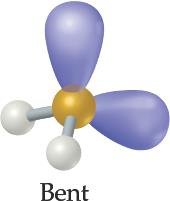
3 | Trigonal planar | 2 | 1 | Bent | SO2 |
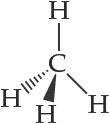
4 | Tetrahedral | 4 | 0 | Tetrahedral | CH4 |
4 | Tetrahedral | 3 | 1 | Trigonal pyramidal | NH3 |
4 | Tetrahedral | 2 | 2 | Bent | H2O |
Nonbonding Pairs, Multiple Bonds, and Bond Angles
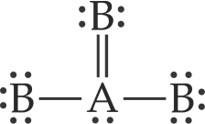
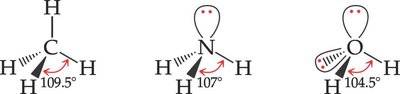
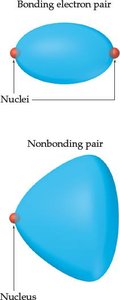
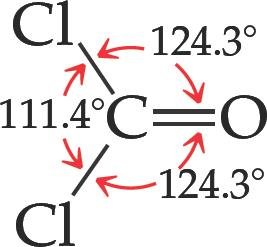
Nonbonding (lone) pairs are larger and closer to the central atom than bonding pairs, causing greater repulsion and compressing bond angles. Multiple bonds (double or triple) also exert greater repulsive force than single bonds, affecting bond angles.
Trigonal Bipyramidal and Octahedral Electron Domains
For five and six electron domains, more complex geometries arise:
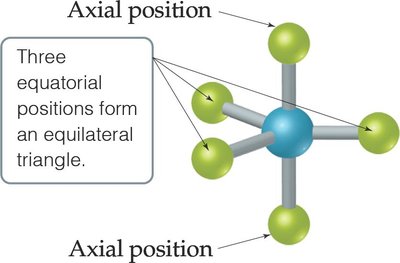
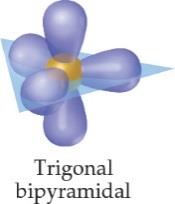
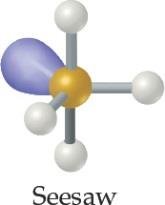
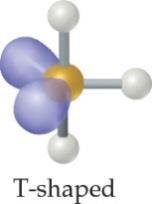
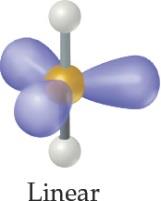
Trigonal bipyramidal: 5 domains, with axial and equatorial positions. Lone pairs occupy equatorial positions to minimize repulsion.
Octahedral: 6 domains, all positions are equivalent.
Number of Electron Domains | Electron-Domain Geometry | Bonding Domains | Nonbonding Domains | Molecular Geometry | Example |
|---|---|---|---|---|---|
5 | Trigonal bipyramidal | 5 | 0 | Trigonal bipyramidal | PCl5 |
5 | Trigonal bipyramidal | 4 | 1 | Seesaw | SF4 |
5 | Trigonal bipyramidal | 3 | 2 | T-shaped | ClF3 |
5 | Trigonal bipyramidal | 2 | 3 | Linear | XeF2 |
6 | Octahedral | 6 | 0 | Octahedral | SF6 |
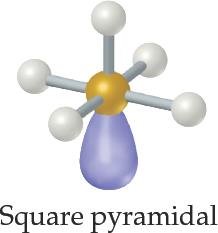
6 | Octahedral | 5 | 1 | Square pyramidal | BrF5 |
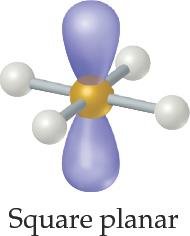
6 | Octahedral | 4 | 2 | Square planar | XeF4 |
Shapes of Larger Molecules
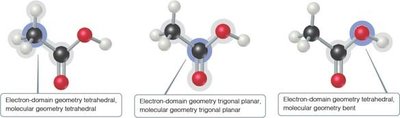
For larger molecules, VSEPR is applied to each central atom individually. For example, in acetic acid (CH3COOH), the geometry around each carbon and oxygen atom is considered separately.
9.3 Molecular Shape and Polarity
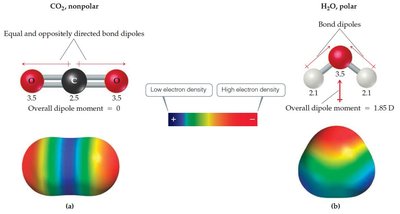
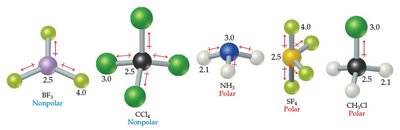
Molecular polarity depends on both the polarity of individual bonds (determined by electronegativity differences) and the overall geometry of the molecule. The vector sum of bond dipoles determines whether a molecule is polar or nonpolar.
Polar molecules: Have polar bonds arranged asymmetrically, resulting in a net dipole moment (e.g., H2O).
Nonpolar molecules: Either have nonpolar bonds or polar bonds arranged symmetrically so that dipoles cancel (e.g., CO2).
9.4 Covalent Bonding and Orbital Overlap
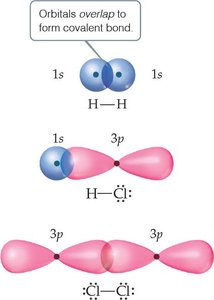
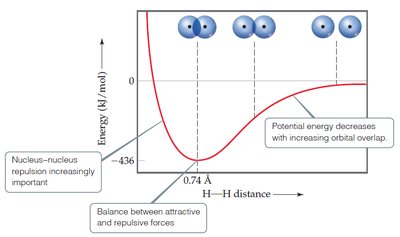
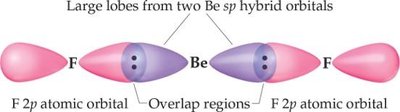
Valence-bond theory explains covalent bonding as the overlap of atomic orbitals from two atoms, allowing electrons of opposite spin to occupy the same region of space and form a bond.
Key Point 1: The greater the overlap, the stronger the bond (lower energy, shorter bond length).
Key Point 2: Atoms cannot get too close due to nuclear repulsion.
Example: H2 molecule forms by overlap of two 1s orbitals.
9.5 Hybrid Orbital Theory
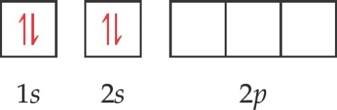
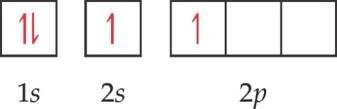
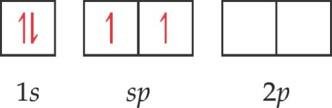
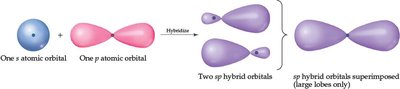
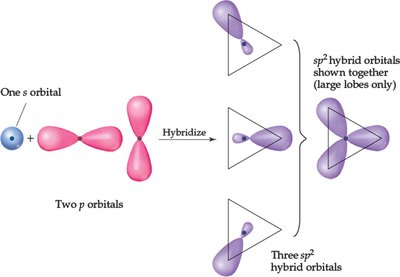
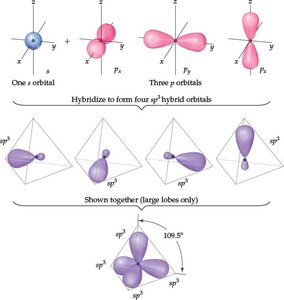
Hybridization is the mixing of atomic orbitals to form new, equivalent hybrid orbitals that explain observed molecular geometries. The type of hybridization depends on the electron-domain geometry around the central atom.
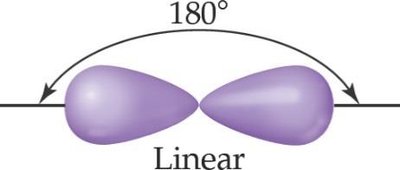
sp hybridization: Linear geometry, 180° bond angle (e.g., BeF2).
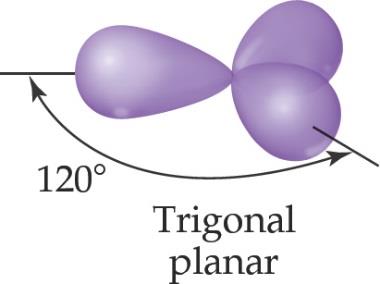
sp2 hybridization: Trigonal planar geometry, 120° bond angle (e.g., BF3).
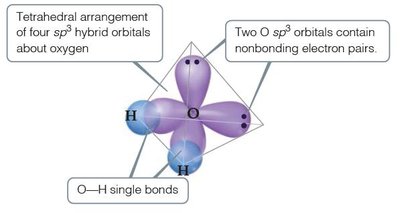
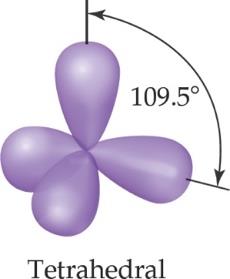
sp3 hybridization: Tetrahedral geometry, 109.5° bond angle (e.g., CH4).
Hybrid Orbital Summary Table
Atomic Orbital Set | Hybrid Orbital Set | Geometry | Examples |
|---|---|---|---|
s, p | Two sp | Linear (180°) | BeF2, HgCl2 |
s, p, p | Three sp2 | Trigonal planar (120°) | BF3, SO3 |
s, p, p, p | Four sp3 | Tetrahedral (109.5°) | CH4, NH3, H2O, NH4+ |
9.6 Multiple Bonds: Sigma (σ) and Pi (π) Bonds
Single bonds are always sigma (σ) bonds, formed by head-to-head overlap along the internuclear axis. Multiple bonds (double, triple) consist of one sigma bond and one or two pi (π) bonds, formed by sideways overlap of p orbitals above and below the axis.
Key Point 1: Sigma bonds have cylindrical symmetry; pi bonds have electron density above and below the axis.
Key Point 2: Electrons in sigma and pi bonds can be localized (between two atoms) or delocalized (shared among several atoms, as in resonance structures).
9.7 Molecular Orbital (MO) Theory
MO theory describes bonding as the combination of atomic orbitals to form molecular orbitals that extend over the entire molecule. Each MO can hold two electrons with opposite spins. When two atomic orbitals combine, they form a bonding MO (lower energy, constructive interference) and an antibonding MO (higher energy, destructive interference, with a nodal plane).
Bond order:
Example: H2 has a bond order of 1; He2 has a bond order of 0 (does not exist).
9.8 Molecular-Orbital Description of Period 2 Diatomic Molecules
MO diagrams for second-period diatomic molecules (Li2 to Ne2) show the combination of s and p atomic orbitals to form σ, σ*, π, and π* molecular orbitals. The order and energy of these orbitals depend on the elements involved.
Diamagnetism: All electrons are paired (e.g., N2).
Paramagnetism: One or more unpaired electrons (e.g., O2).
Heteronuclear diatomics: MO diagrams are adjusted for differences in atomic orbital energies due to electronegativity differences.
Additional info: This summary covers the core concepts of molecular geometry, VSEPR, hybridization, and molecular orbital theory as presented in a standard General Chemistry curriculum. All images included are directly relevant to the explanation of the adjacent text and reinforce the educational content.
