 Back
Molecular Geometry and Bonding Theories – General Chemistry Study Notes
Study Guide - Smart Notes
 Tailored notes based on your materials, expanded with key definitions, examples, and context.
Chapter 9: Molecular Geometry and Bonding Theories
Introduction to Molecular Geometry
Molecular geometry describes the three-dimensional arrangement of atoms within a molecule. Understanding molecular geometry is essential for predicting molecular properties, reactivity, and polarity. Lewis structures provide a foundation for determining molecular shapes, but do not directly indicate the spatial arrangement of atoms.
9.1 Molecular Shapes
Lewis structures show bonding and lone pairs but do not denote the actual shape of molecules. The arrangement of atoms in space is determined by the number of atoms bonded to a central atom and the presence of lone pairs.
Key Point: The shape of a molecule is influenced by the number of bonding and nonbonding electron pairs around the central atom.
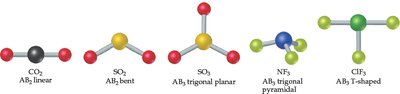
Example: CO2 (linear), SO2 (bent), SO3 (trigonal planar), NF3 (trigonal pyramidal), ClF3 (T-shaped).
9.2 The VSEPR Model
The Valence-Shell Electron-Pair Repulsion (VSEPR) model is used to predict the geometry of molecules based on the repulsion between electron domains (regions where electrons are likely to be found) around a central atom.
Electron Domains: Bonding domains (single, double, triple bonds) and nonbonding domains (lone pairs).
Key Principle: Electron pairs arrange themselves as far apart as possible to minimize repulsion.
Example: A molecule with three electron domains (e.g., AB3) will have a trigonal planar geometry.
Electron-Domain Geometries
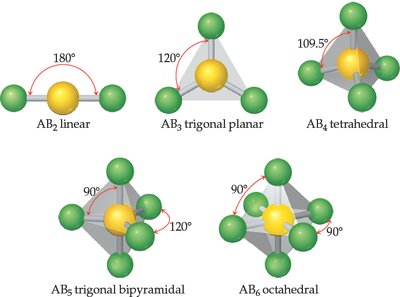
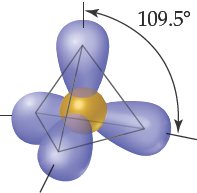
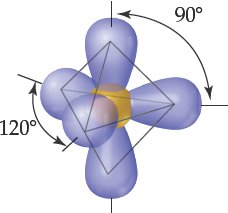
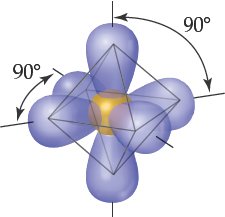
The arrangement of electron domains around a central atom determines the electron-domain geometry, which in turn influences the molecular geometry.
Number of Electron Domains | Electron Domain Geometry | Predicted Bond Angles |
|---|---|---|
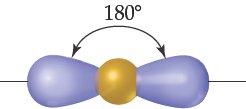
2 | Linear | 180° |
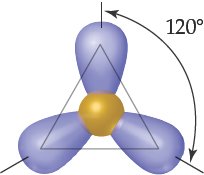
3 | Trigonal planar | 120° |
4 | Tetrahedral | 109.5° |
5 | Trigonal bipyramidal | 120° and 90° |
6 | Octahedral | 90° |
Applying VSEPR to Determine Molecular Shapes
To determine the molecular geometry:
Draw the best Lewis structure.
Determine the electron-domain geometry by counting all bonding and nonbonding electron domains.
Use the arrangement of bonded atoms to determine the molecular geometry.
Electron-Domain and Molecular Geometries
The number of bonding and nonbonding domains leads to specific molecular geometries:
Electron Domains | Bonding Domains | Nonbonding Domains | Molecular Geometry | Example |
|---|---|---|---|---|
2 | 2 | 0 | Linear | CO2 |
3 | 3 | 0 | Trigonal planar | BF3 |
3 | 2 | 1 | Bent | NO2- |
4 | 4 | 0 | Tetrahedral | CH4 |
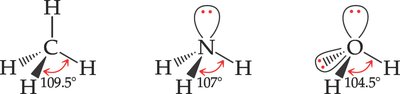
4 | 3 | 1 | Trigonal pyramidal | NH3 |
4 | 2 | 2 | Bent | H2O |
Nonbonding Pairs and Bond Angles
Nonbonding (lone) pairs are physically larger than bonding pairs, leading to greater repulsions and compression of bond angles. Double and triple bonds also exert greater repulsive forces than single bonds, affecting bond angles.
Molecules with Expanded Valence Shells
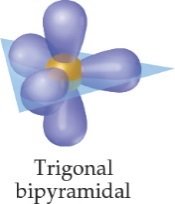
Elements in periods 3 through 6 can have more than four electron domains due to the availability of d-orbitals, resulting in trigonal bipyramidal (5 domains) and octahedral (6 domains) geometries.
Trigonal Bipyramidal and Octahedral Geometries
Electron Domains | Bonding Domains | Nonbonding Domains | Molecular Geometry | Example |
|---|---|---|---|---|
5 | 5 | 0 | Trigonal bipyramidal | PCl5 |
5 | 4 | 1 | Seesaw | SF4 |
5 | 3 | 2 | T-shaped | ClF3 |
5 | 2 | 3 | Linear | XeF2 |
6 | 6 | 0 | Octahedral | SF6 |
6 | 5 | 1 | Square pyramidal | BrF5 |
6 | 4 | 2 | Square planar | XeF4 |
9.3 Molecular Shape and Polarity
Molecular polarity depends on both the polarity of individual bonds and the overall geometry of the molecule. If bond dipoles do not cancel due to asymmetry, the molecule is polar; otherwise, it is nonpolar.
Key Point: Use vector addition of bond dipoles to determine molecular polarity.
Example: CO2 is nonpolar (linear, dipoles cancel); H2O is polar (bent, dipoles do not cancel).
9.4 Covalent Bonding and Orbital Overlap
Valence-bond theory explains the formation of covalent bonds as the overlap of atomic orbitals from two atoms, allowing electrons of opposite spin to occupy the same region of space.
Bond Strength: Determined by the balance between electron-nucleus attraction and internuclear repulsion.
Bond Length: The distance at which the energy is minimized.
9.5 Hybrid Orbitals
Hybridization is the mixing of atomic orbitals to form new, degenerate hybrid orbitals that accommodate electron pairs in specific geometries.
Electron Domains | Hybridization | Geometry | Examples |
|---|---|---|---|
2 | sp | Linear (180°) | BeF2 |
3 | sp2 | Trigonal planar (120°) | BF3 |
4 | sp3 | Tetrahedral (109.5°) | CH4, NH3, H2O |
5 | sp3d | Trigonal bipyramidal | PCl5 |
6 | sp3d2 | Octahedral | SF6 |
9.6 Multiple Bonds
Multiple bonds involve both sigma (σ) and pi (π) bonds:
Sigma (σ) bond: Head-to-head overlap, electron density along the internuclear axis.
Pi (π) bond: Sideways overlap, electron density above and below the internuclear axis.
Single bond: Always a σ bond.
Double bond: One σ and one π bond.
Triple bond: One σ and two π bonds.
9.7 Molecular Orbitals
Molecular Orbital (MO) Theory describes bonding as the combination of atomic orbitals to form molecular orbitals that extend over the entire molecule. Each MO can hold two electrons with opposite spins.
Bonding MO: Constructive combination, increases electron density between nuclei.
Antibonding MO: Destructive combination, node between nuclei, decreases stability.
Bond Order:
Example: H2 has a bond order of 1; He2 has a bond order of 0 (does not exist).
MO Diagrams for Period 2 Diatomic Molecules
The number of MOs formed equals the number of atomic orbitals combined.
Core electrons are typically not involved in bonding.
MO diagrams explain magnetic properties: diamagnetism (all electrons paired) and paramagnetism (unpaired electrons).
O2 is paramagnetic due to two unpaired electrons in π* orbitals.
Homonuclear vs. Heteronuclear Diatomic Molecules
Homonuclear: Two identical atoms; MO diagram is symmetric.
Heteronuclear: Two different atoms; more electronegative atom's orbitals are lower in energy, affecting MO composition.
Summary Table: Electron-Domain and Molecular Geometries
Electron Domains | Bonding Domains | Nonbonding Domains | Molecular Geometry | Bond Angles |
|---|---|---|---|---|
2 | 2 | 0 | Linear | 180° |
3 | 3 | 0 | Trigonal planar | 120° |
3 | 2 | 1 | Bent | <120° |
4 | 4 | 0 | Tetrahedral | 109.5° |
4 | 3 | 1 | Trigonal pyramidal | <109.5° |
4 | 2 | 2 | Bent | <109.5° |
5 | 5 | 0 | Trigonal bipyramidal | 120°, 90° |
5 | 4 | 1 | Seesaw | <120°, <90° |
5 | 3 | 2 | T-shaped | <90° |
5 | 2 | 3 | Linear | 180° |
6 | 6 | 0 | Octahedral | 90° |
6 | 5 | 1 | Square pyramidal | <90° |
6 | 4 | 2 | Square planar | 90° |
Additional info: These notes integrate textbook content, lecture slides, and academic context to provide a comprehensive overview of molecular geometry and bonding theories, suitable for exam preparation in General Chemistry.
