 Back
Chapter 9: Molecular Geometry and Bonding Theories: Study Guide
Study Guide - Smart Notes
 Tailored notes based on your materials, expanded with key definitions, examples, and context.
Molecular Geometry and Bonding Theories
Introduction to Molecular Shapes
The shape of a molecule is a fundamental aspect of its chemical behavior and properties. While Lewis structures show the arrangement of atoms and electron pairs, they do not directly indicate the three-dimensional shape. Molecular geometry is determined by the arrangement of atoms and electron pairs around a central atom.
Lewis Structures: Used to predict molecular shapes by identifying bonding and lone pairs.
Common Shapes: Examples include linear, bent, trigonal planar, trigonal pyramidal, and tetrahedral.
Bond Angles: The angles between bonds are characteristic of each geometry.
Bond Lengths: The distances between nuclei also affect molecular size.
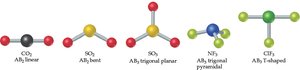
Valence-Shell Electron-Pair Repulsion (VSEPR) Model
The VSEPR model is used to predict the shape of molecules based on the repulsion between electron pairs. Electron pairs (bonding and lone pairs) arrange themselves as far apart as possible to minimize repulsion, determining the geometry of the molecule.
Electron Domains: Directions in which electrons are located, including bonds and lone pairs.
VSEPR Principle: The best arrangement minimizes repulsions among electron domains.
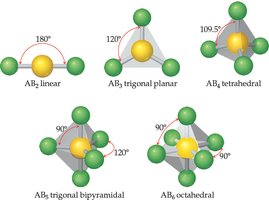

Electron-Domain Geometries
Electron-domain geometry is determined by counting the total number of electron domains (lone pairs, single, double, and triple bonds) around the central atom. The geometry depends on the number of domains:
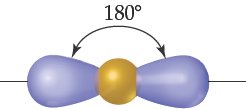
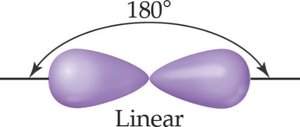
2 Domains: Linear (180°)
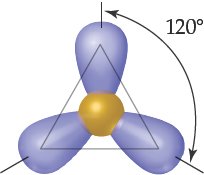
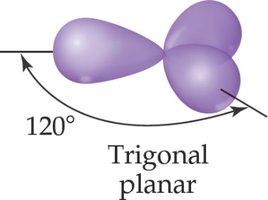
3 Domains: Trigonal planar (120°)
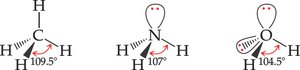
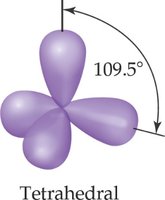
4 Domains: Tetrahedral (109.5°)
5 Domains: Trigonal bipyramidal (90°, 120°)
6 Domains: Octahedral (90°)
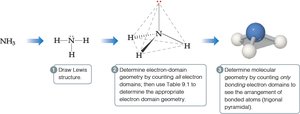
Molecular Geometries
Molecular geometry describes the arrangement of atoms (not electron pairs) in a molecule. To determine molecular geometry:
Draw the best Lewis structure.
Determine electron-domain geometry.
Use the arrangement of bonded atoms to determine molecular geometry.
Linear Electron Domain
In the linear domain, the only molecular geometry is linear. If a molecule consists of only two atoms, it will always be linear.
Example: CO2 (carbon dioxide) is linear.
Trigonal Planar Electron Domain
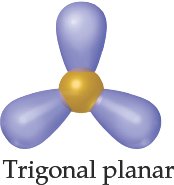
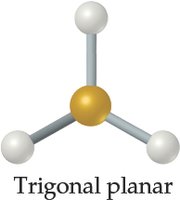
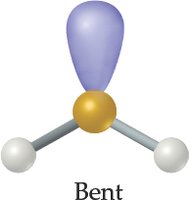
For three electron domains, there are two possible molecular geometries:
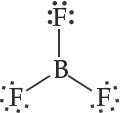
Trigonal Planar: All domains are bonding pairs.
Bent: One domain is a lone pair.
Tetrahedral Electron Domain
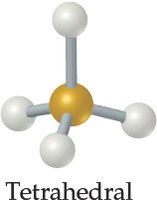
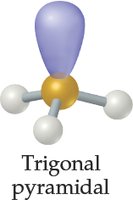
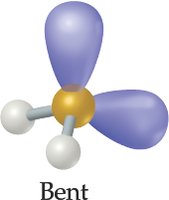
For four electron domains, there are three possible molecular geometries:
Tetrahedral: All are bonding pairs.
Trigonal Pyramidal: One is a lone pair.
Bent: Two are lone pairs.
Effect of Nonbonding Pairs and Multiple Bonds on Bond Angles
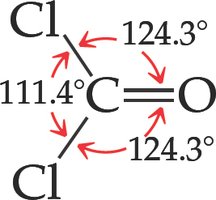
Nonbonding pairs are physically larger than bonding pairs, causing greater repulsion and compressing bond angles. Double and triple bonds have larger electron domains and exert greater repulsive force, increasing bond angles.
Bond Angle Compression: Nonbonding pairs reduce bond angles between bonding pairs.
Bond Angle Expansion: Multiple bonds increase bond angles.
Expanding Beyond the Octet Rule
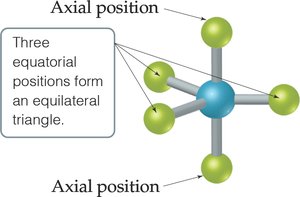
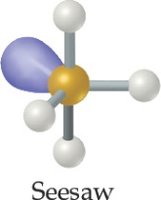
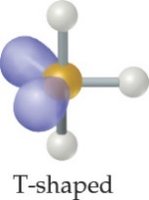
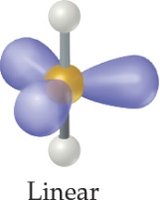
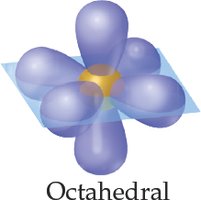
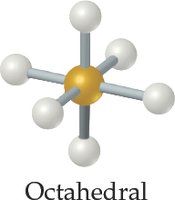
Some elements can have more than four electron domains, breaking the octet rule. This leads to trigonal bipyramidal (five domains) and octahedral (six domains) geometries.
Trigonal Bipyramidal: Five electron domains; two distinct positions (axial and equatorial).
Octahedral: Six electron domains; all positions equivalent.
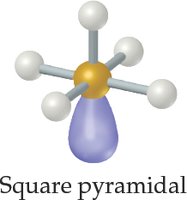
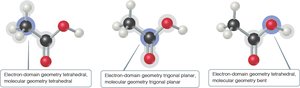
Shapes of Larger Molecules
For larger molecules, the geometry about each atom is considered rather than the overall shape. This approach helps in understanding the local environment and reactivity of each atom.
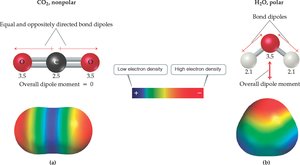
Polarity of Molecules
Molecular polarity depends on the type of bonds and their arrangement. If the bonds are polar and their dipoles do not cancel, the molecule is polar. If the dipoles cancel, the molecule is nonpolar.
Bond Dipole: A measure of bond polarity.
Overall Dipole Moment: Determines molecular polarity.
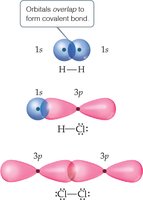
Valence-Bond Theory
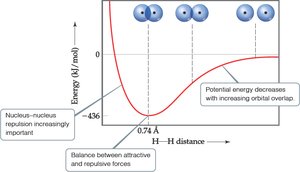
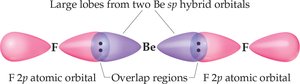
Valence-bond theory describes covalent bonding as the overlap of atomic orbitals. Electrons of opposite spin occupy the same space, forming a bond. Increased overlap brings atoms together until a balance is reached between repulsive and attractive forces.
Orbital Overlap: The sharing of space between two electrons.
Bond Formation: Covalent bonds result from orbital overlap.
Hybrid Orbitals and Hybridization
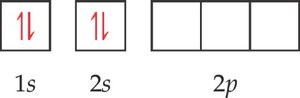
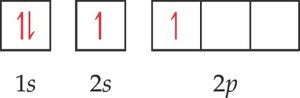
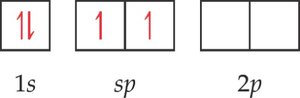
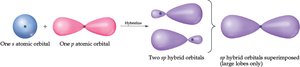
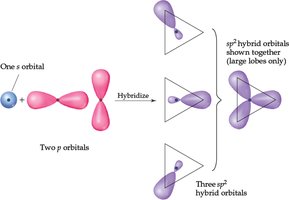
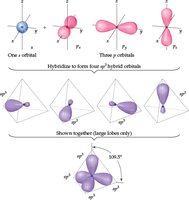
Hybridization is the mixing of atomic orbitals to form new orbitals of equal energy (degenerate orbitals). The type of hybrid orbitals formed depends on the electron-domain geometry.
sp Hybridization: Linear geometry (180°).
sp2 Hybridization: Trigonal planar geometry (120°).
sp3 Hybridization: Tetrahedral geometry (109.5°).
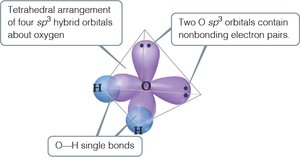
Hybrid Orbital Summary
To determine the hybrid orbitals needed:
Draw the Lewis structure.
Use VSEPR to determine electron-domain geometry.
Specify the hybrid orbitals needed for electron pairs.
Types of Bonds: Sigma and Pi Bonds
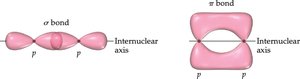
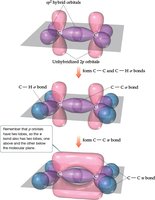
Single bonds are always sigma (σ) bonds, formed by head-to-head overlap. Multiple bonds contain one sigma bond and one or more pi (π) bonds, formed by sideways overlap.
Sigma (σ) Bond: Cylindrical symmetry about the internuclear axis.
Pi (π) Bond: Electron density above and below the internuclear axis.
Localized and Delocalized Electrons
Bonding electrons shared between two atoms are localized. In molecules with resonance, some electrons are delocalized, shared by multiple atoms.
Localized Electrons: Shared between two atoms.
Delocalized Electrons: Shared among multiple atoms (resonance).
Molecular Orbital (MO) Theory
MO theory uses wave properties to describe electron energies in molecules. Molecular orbitals represent the entire molecule, not just a single atom. When atomic orbitals overlap, two molecular orbitals are formed: one bonding and one antibonding.
Bonding Orbitals: Constructive combinations of atomic orbitals.
Antibonding Orbitals: Destructive combinations, with a nodal plane.
MO Diagram: Shows how atomic orbitals combine to form molecular orbitals.
Bond Order: Determines stability;
Guiding Principles for Molecular Orbital Formation
The number of MOs formed equals the number of atomic orbitals combined.
Atomic orbitals combine with those of similar energy.
Each MO can accommodate at most two electrons with opposite spin (Pauli exclusion principle).
Hund's rule applies: one electron enters each orbital before pairing.
MO Diagrams and Magnetism
Diamagnetism occurs when all electrons are spin-paired; paramagnetism occurs when there are unpaired electrons. MO diagrams can predict magnetic properties, such as the paramagnetism of O2.
Diamagnetic: All electrons paired; weakly repelled by magnetic field.
Paramagnetic: One or more unpaired electrons; attracted to magnetic field.
Heteronuclear Diatomic Molecules
MO diagrams for diatomic molecules with different elements reflect differences in atomic orbital energies. The more electronegative atom has lower energy orbitals, so bonding orbitals resemble them more closely.
Energy Differences: Affect the nature of molecular orbitals.
Summary Table: Electron-Domain and Molecular Geometries
The following table summarizes the electron-domain and molecular geometries for two through six electron domains:
Electron Domains | Electron-Domain Geometry | Molecular Geometry | Bond Angles |
|---|---|---|---|
2 | Linear | Linear | 180° |
3 | Trigonal Planar | Trigonal Planar, Bent | 120° |
4 | Tetrahedral | Tetrahedral, Trigonal Pyramidal, Bent | 109.5° |
5 | Trigonal Bipyramidal | Trigonal Bipyramidal, Seesaw, T-shaped, Linear | 90°, 120° |
6 | Octahedral | Octahedral, Square Pyramidal, Square Planar | 90° |
Additional info: This study guide expands on the original notes with academic context, definitions, and examples to ensure completeness and clarity for exam preparation.
