 Back
BackMolecular Geometry and Bonding Theories: VSEPR and Hybridization
Study Guide - Smart Notes
 Tailored notes based on your materials, expanded with key definitions, examples, and context.
Molecular Geometry and Bonding Theories
Introduction to Molecular Shape
The shape of a molecule is determined by the arrangement of its atoms in space, which is governed by the repulsions between electron pairs around the central atom. The Valence-Shell Electron-Pair Repulsion (VSEPR) model is used to predict the geometry of molecules based on the number of electron domains (regions of electron density) surrounding a central atom.
VSEPR Model: Electron Domains and Molecular Geometry
Electron Domain: A region where electrons are likely to be found, including bonding pairs (single, double, or triple bonds) and nonbonding pairs (lone pairs).
Bonding Pair: Electrons shared between two atoms in a covalent bond.
Nonbonding Pair (Lone Pair): Electrons localized on a single atom, not involved in bonding.
To minimize electron-electron repulsion, electron domains arrange themselves as far apart as possible in three-dimensional space, leading to characteristic molecular shapes.

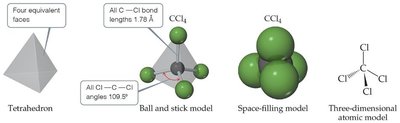
Common Electron Domain Geometries
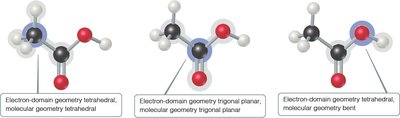
The arrangement of electron domains around a central atom determines the electron domain geometry, which in turn influences the molecular geometry (the arrangement of only the atoms, not lone pairs).
Number of Electron Domains | Electron Domain Geometry | Predicted Bond Angles |
|---|---|---|
2 | Linear | 180° |
3 | Trigonal planar | 120° |
4 | Tetrahedral | 109.5° |
5 | Trigonal bipyramidal | 120°, 90° |
6 | Octahedral | 90° |
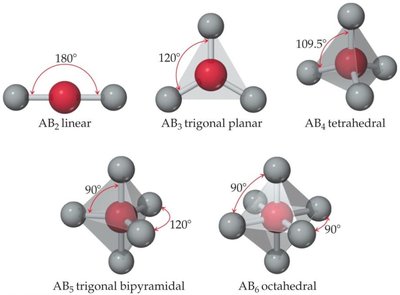
Examples of Electron Domain Geometries
Linear (2 domains): Example: CO2. All atoms are arranged in a straight line with a bond angle of 180°.
Trigonal Planar (3 domains): Example: BF3. Atoms are arranged at the corners of an equilateral triangle with 120° bond angles.
Tetrahedral (4 domains): Example: CH4 or CCl4. Atoms are positioned at the corners of a tetrahedron with 109.5° bond angles.
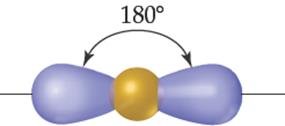
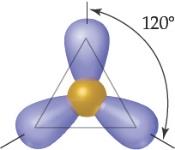
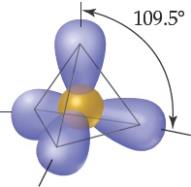
Multiple Bonds and Lone Pairs: Effects on Bond Angles
Multiple bonds (double or triple) count as one electron domain but exert greater repulsion than single bonds, slightly decreasing bond angles. Nonbonding pairs (lone pairs) also exert more repulsion than bonding pairs, further reducing bond angles between atoms.
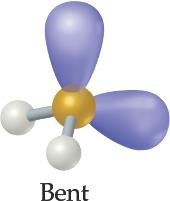
Expanded Valence Shells: Five and Six Electron Domains
Atoms in period 3 or beyond can have more than four electron domains, leading to geometries such as trigonal bipyramidal (5 domains) and octahedral (6 domains).
Number of Electron Domains | Electron Domain Geometry | Bonding Domains | Nonbonding Domains | Molecular Geometry | Example |
|---|---|---|---|---|---|
5 | Trigonal bipyramidal | 5 | 0 | Trigonal bipyramidal | PCl5 |
5 | Trigonal bipyramidal | 4 | 1 | Seesaw | SF4 |
5 | Trigonal bipyramidal | 3 | 2 | T-shaped | ClF3 |
5 | Trigonal bipyramidal | 2 | 3 | Linear | XeF2 |
6 | Octahedral | 6 | 0 | Octahedral | SF6 |
6 | Octahedral | 5 | 1 | Square pyramidal | BrF5 |
6 | Octahedral | 4 | 2 | Square planar | XeF4 |
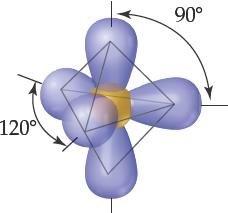
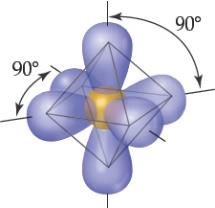
Determining Molecular Geometry: Step-by-Step
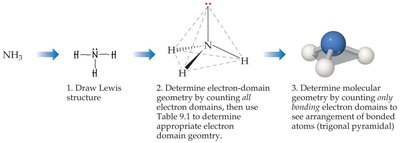
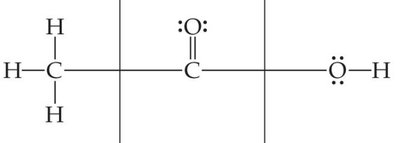
Draw the Lewis structure of the molecule.
Count the total number of electron domains around the central atom.
Assign the electron domain geometry based on the number of domains.
Determine the molecular geometry by considering only the positions of the atoms (ignore lone pairs).
Examples of Molecular Geometries
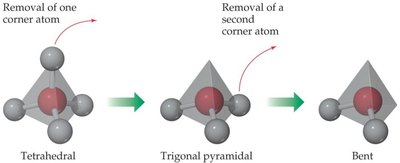
Trigonal Pyramidal: Example: NH3. Three bonding pairs and one lone pair on the central atom.
Bent: Example: H2O. Two bonding pairs and two lone pairs on the central atom.
Molecular Polarity and Dipole Moments
The polarity of a molecule depends on both the polarity of its bonds and its molecular geometry. If the bond dipoles do not cancel, the molecule is polar; if they do, the molecule is nonpolar.
Nonpolar Molecules: All bond dipoles cancel due to symmetry (e.g., CO2, CCl4).
Polar Molecules: Bond dipoles do not cancel (e.g., H2O, NH3).
Sigma (σ) and Pi (π) Bonds
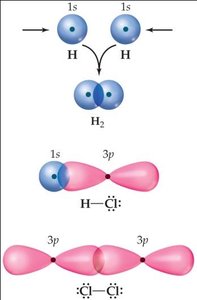
Covalent bonds are formed by the overlap of atomic orbitals. There are two main types of covalent bonds:
Sigma (σ) Bond: Electron density is concentrated along the axis connecting the two nuclei. All single bonds are sigma bonds.
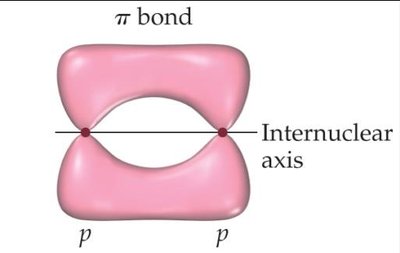
Pi (π) Bond: Electron density is concentrated above and below the plane of the nuclei. Double bonds consist of one sigma and one pi bond; triple bonds have one sigma and two pi bonds.
Hybridization of Atomic Orbitals
Hybridization is the mixing of atomic orbitals to form new, equivalent hybrid orbitals that are oriented to maximize bonding. The type of hybridization depends on the electron domain geometry:
Electron Domain Geometry | Hybridization | Example |
|---|---|---|
Linear (2 domains) | sp | BeCl2 |
Trigonal planar (3 domains) | sp2 | BF3 |
Tetrahedral (4 domains) | sp3 | CH4 |
Trigonal bipyramidal (5 domains) | sp3d | PCl5 |
Octahedral (6 domains) | sp3d2 | SF6 |
Summary Table: Electron Domain and Molecular Geometries
Electron Domains | Electron Domain Geometry | Molecular Geometry | Bond Angles | Example |
|---|---|---|---|---|
2 | Linear | Linear | 180° | CO2 |
3 | Trigonal planar | Trigonal planar | 120° | BF3 |
3 | Trigonal planar | Bent | <120° | SO2 |
4 | Tetrahedral | Tetrahedral | 109.5° | CH4 |
4 | Tetrahedral | Trigonal pyramidal | 107° | NH3 |
4 | Tetrahedral | Bent | 104.5° | H2O |
Key Equations
Bond Order:
Dipole Moment:
Conclusion
Understanding molecular geometry and bonding theories is essential for predicting the physical and chemical properties of molecules. The VSEPR model, combined with the concept of hybridization, provides a robust framework for determining the three-dimensional structure of molecules and their reactivity.
