 Back
BackMolecular Geometry and Bonding Theories: VSEPR, Hybridization, and Molecular Polarity
Study Guide - Smart Notes
 Tailored notes based on your materials, expanded with key definitions, examples, and context.
Chapter 9: Molecular Geometry and Bonding Theories
9.1 Molecular Shapes
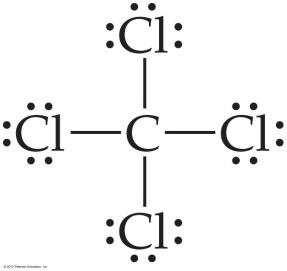
The three-dimensional shape of a molecule is crucial in determining its physical and chemical properties. While Lewis structures show the connectivity of atoms and the types of bonds, they do not represent the actual spatial arrangement of atoms.
Lewis Structures: Illustrate the number and types of bonds but depict all atoms in a single plane, which is not always accurate for real molecules.
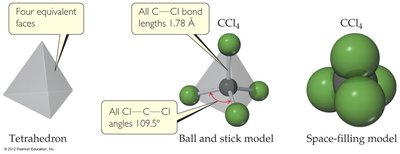
Actual Molecular Shape: Atoms are arranged in three dimensions to minimize electron pair repulsions, often resulting in geometries such as tetrahedral, trigonal planar, or linear.
Example: The Lewis structure of carbon tetrachloride (CCl4) shows four Cl atoms around a central C atom, but the actual shape is tetrahedral.
9.2 Valence-Shell Electron-Pair Repulsion (VSEPR) Model
The VSEPR model is used to predict the shapes of molecules based on the repulsion between electron domains (regions where electrons are likely to be found) around a central atom.
Electron Domain: A region where electrons are most likely found, including bonding pairs (shared between atoms) and non-bonding pairs (lone pairs on a single atom).
Bonding Pair: Electrons shared between two atoms.
Non-bonding Pair (Lone Pair): Electrons localized on one atom.
Electron Domain Geometry: The arrangement of electron domains around the central atom to minimize repulsions.
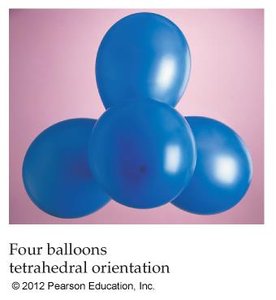
Counting Electron Domains
When using VSEPR, only the electron domains around the central atom are counted. Double and triple bonds count as one domain each.
Common Electron Domain Geometries
Number of Electron Domains | Arrangement | Electron-Domain Geometry | Predicted Bond Angles |
|---|---|---|---|
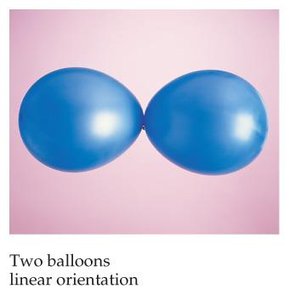
2 | Linear | Linear | 180° |
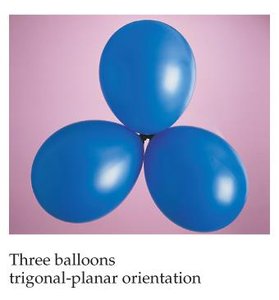
3 | Trigonal planar | Trigonal planar | 120° |
4 | Tetrahedral | Tetrahedral | 109.5° |
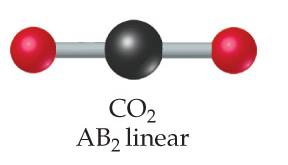
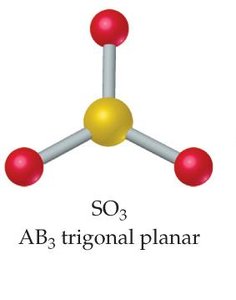
Examples of Electron Domain Geometries
CO2: 2 domains, linear geometry, 180° bond angle.
SO3: 3 domains, trigonal planar geometry, 120° bond angle.
CCl4: 4 domains, tetrahedral geometry, 109.5° bond angle.
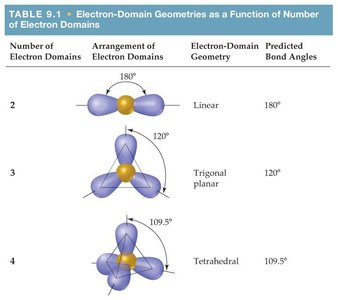
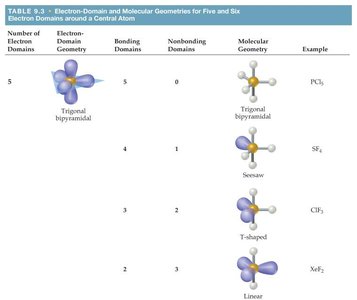
Expanded Electron Domain Geometries
Number of Electron Domains | Electron-Domain Geometry | Bond Angles |
|---|---|---|
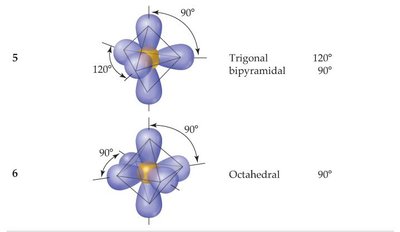
5 | Trigonal bipyramidal | 120°, 90° |
6 | Octahedral | 90° |
9.2 Molecular Geometry
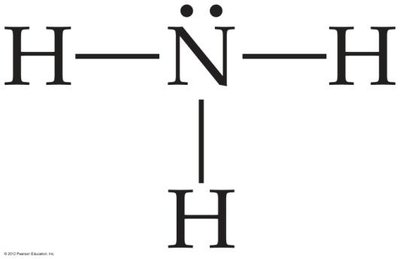
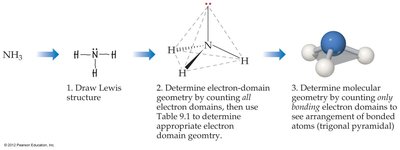
Molecular geometry describes the arrangement of only the atoms (not lone pairs) in a molecule. The presence of lone pairs can alter the observed geometry from the electron domain geometry.
Example: Ammonia (NH3) has a tetrahedral electron domain geometry but a trigonal pyramidal molecular geometry due to one lone pair on nitrogen.
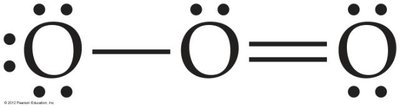
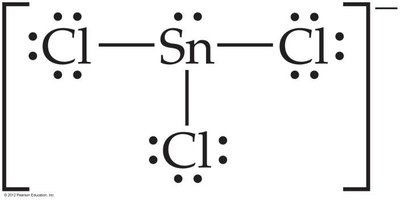
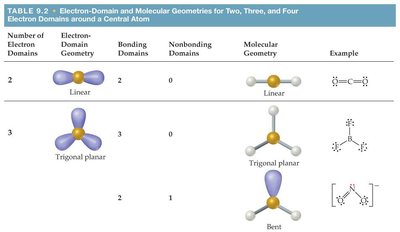
Example: Ozone (O3) and SnCl3- have bent and trigonal pyramidal geometries, respectively.
Summary Table: Electron-Domain and Molecular Geometries
Number of Electron Domains | Electron-Domain Geometry | Molecular Geometry | Example |
|---|---|---|---|
2 | Linear | Linear | CO2 |
3 | Trigonal planar | Trigonal planar / Bent | SO3 / O3 |
4 | Tetrahedral | Tetrahedral / Trigonal pyramidal / Bent | CH4 / NH3 / H2O |
9.3 Molecular Shape and Molecular Polarity
The polarity of a molecule depends on both the polarity of individual bonds and the overall molecular geometry. Bond dipoles are vector quantities; their sum determines the molecular dipole moment.
Non-polar Molecules: If all outer atoms are the same and the molecular geometry is symmetrical, bond dipoles cancel, resulting in a non-polar molecule (e.g., CCl4, CO2).
Polar Molecules: If the geometry is asymmetrical or the outer atoms are different, bond dipoles do not cancel, resulting in a polar molecule (e.g., CH3Cl, H2O).


9.4 Covalent Bonding and Orbital Overlap
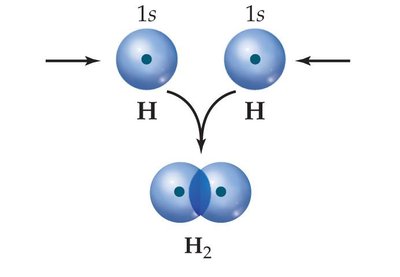
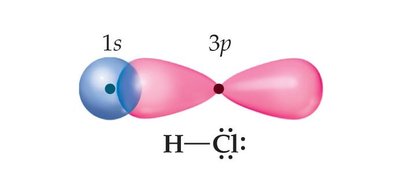
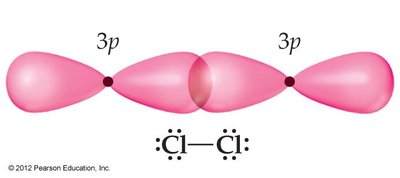
Valence bond theory explains covalent bonding as the overlap of atomic orbitals from different atoms. The strength and directionality of bonds depend on the extent and orientation of this overlap.
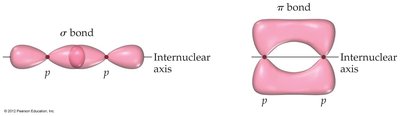
Sigma (σ) Bonds: Formed by head-on overlap of orbitals along the internuclear axis (e.g., s-s, s-p, or p-p overlap).
Pi (π) Bonds: Formed by side-to-side overlap of p orbitals above and below the internuclear axis; present in double and triple bonds.
9.5 Hybrid Orbitals
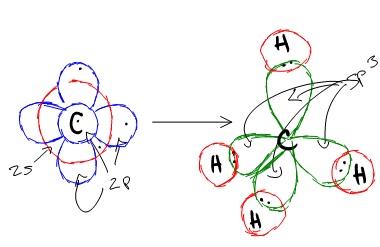
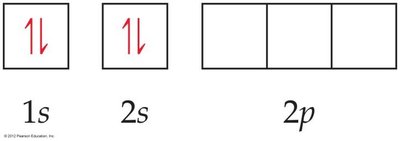
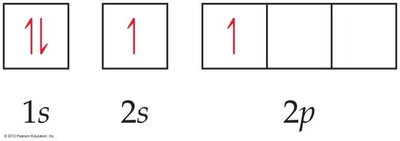
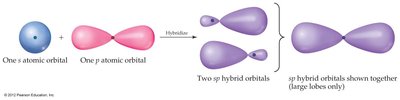
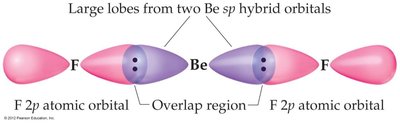
Hybridization is the mixing of atomic orbitals on a central atom to form new, equivalent hybrid orbitals that explain observed molecular geometries.
sp Hybridization: Linear geometry, 180° bond angles (e.g., BeF2).
sp2 Hybridization: Trigonal planar geometry, 120° bond angles (e.g., BF3).
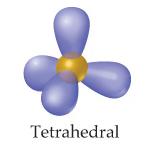
sp3 Hybridization: Tetrahedral geometry, 109.5° bond angles (e.g., CH4).

Summary Table: Hybridization and Geometry
Atomic Orbital Set | Hybrid Orbital Set | Geometry | Examples |
|---|---|---|---|
s, p | sp | Linear (180°) | BeF2, HgCl2 |
s, p, p | sp2 | Trigonal planar (120°) | BF3, SO3 |
s, p, p, p | sp3 | Tetrahedral (109.5°) | CH4, NH3, H2O |
9.6 Multiple Bonds
Multiple bonds consist of one sigma (σ) bond and one or more pi (π) bonds. Sigma bonds are stronger due to greater orbital overlap, while pi bonds are weaker and result from side-to-side overlap of unhybridized p orbitals.
Single Bond: One σ bond (e.g., H–Cl, H–H, Cl–Cl).
Double Bond: One σ bond and one π bond (e.g., O2).
Triple Bond: One σ bond and two π bonds (e.g., N2).
Example: Formaldehyde (CH2O)
Electron Domain Geometry: Trigonal planar around carbon.
Hybridization: Carbon is sp2 hybridized.
Bonding: C–H bonds are σ bonds (sp2–1s overlap); C=O bond consists of one σ (sp2–sp2) and one π (p–p) bond.
Example: Acetonitrile (CH3CN)
Hybridization: Central carbon is sp hybridized; terminal carbon is sp3 hybridized; nitrogen is sp hybridized.
Bonds: C–H and C–C are σ bonds; C≡N is one σ and two π bonds.
Example: Ethanol (C2H5OH)
Hybridization: All central atoms are sp3 hybridized.
Bonds: All single bonds (σ bonds).
Additional info: The number of electrons in the π-system is equal to the number of electrons in unhybridized p orbitals involved in π bonding. Resonance structures can delocalize π electrons over multiple atoms.
