 Back
BackChemistry Chapter 9
Study Guide - Smart Notes
 Tailored notes based on your materials, expanded with key definitions, examples, and context.
Chapter 9: Molecular Geometry and Bonding Theories
9.1 Molecular Shapes
The three-dimensional shape of a molecule is crucial in determining its physical and chemical properties. While Lewis structures show the connectivity of atoms and the types of bonds, they do not represent the actual spatial arrangement of atoms. Molecular geometry describes the arrangement of atoms in space, which is influenced by the number of electron domains (regions of electron density) around the central atom.
Lewis Structures: Show the number and types of bonds but not the true geometry.
Actual Geometry: Atoms are arranged in three dimensions to minimize electron pair repulsions.
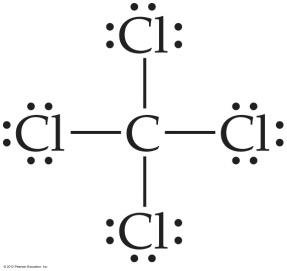
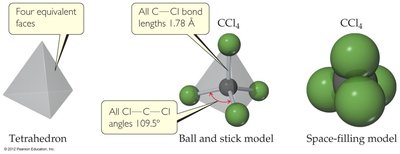
Example: In carbon tetrachloride (CCl4), the Lewis structure suggests a flat arrangement, but the actual geometry is tetrahedral, with bond angles of 109.5°.
9.2 Valence-Shell Electron-Pair Repulsion (VSEPR) Theory
The VSEPR model predicts molecular shapes based on the repulsion between electron domains (bonding and non-bonding pairs) around a central atom. Electron domains arrange themselves as far apart as possible to minimize repulsion.
Electron Domain: A region where electrons are likely found (bonding pairs or lone pairs).
Bonding Pair: Shared electrons between two atoms.
Non-bonding Pair (Lone Pair): Electrons localized on one atom.
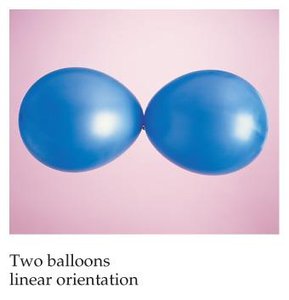
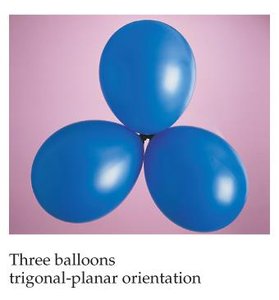
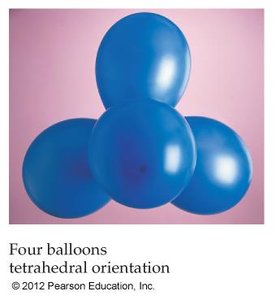
Balloon models help visualize how electron domains repel each other, leading to specific geometries:
2 domains: Linear (180°)
3 domains: Trigonal planar (120°)
4 domains: Tetrahedral (109.5°)
Counting Electron Domains
Only electron domains around the central atom are counted. Double and triple bonds count as one domain each.
Electron Domain Geometries
Number of Electron Domains | Arrangement | Geometry | Bond Angles |
|---|---|---|---|
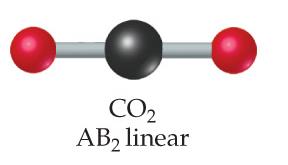
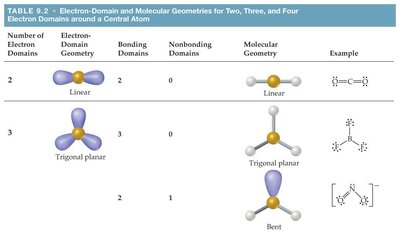
2 | Linear | Linear | 180° |
3 | Trigonal planar | Trigonal planar | 120° |
4 | Tetrahedral | Tetrahedral | 109.5° |
Expanded Electron Domains
Number of Electron Domains | Arrangement | Geometry | Bond Angles |
|---|---|---|---|
5 | Trigonal bipyramidal | Trigonal bipyramidal | 120°, 90° |
6 | Octahedral | Octahedral | 90° |

Examples of Electron Domain Geometries
Molecule | # of Electron Domains | Electron Domain Geometry |
|---|---|---|
BF3 | 3 | Trigonal planar |
CCl4 | 4 | Tetrahedral |
PCl5 | 5 | Trigonal bipyramidal |
XeF2 | 5 | Trigonal bipyramidal |
Predicting Molecular Geometry
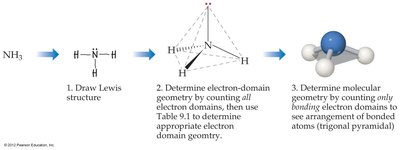
The molecular geometry describes the arrangement of only the atoms (not lone pairs) in a molecule. The presence of lone pairs can alter the observed geometry from the electron domain geometry.
Common Molecular Geometries
Electron Domains | Lone Pairs | Molecular Geometry | Bond Angles |
|---|---|---|---|
2 | 0 | Linear | 180° |
3 | 0 | Trigonal planar | 120° |
3 | 1 | Bent | <120° |
4 | 0 | Tetrahedral | 109.5° |
4 | 1 | Trigonal pyramidal | <109.5° |
4 | 2 | Bent | <109.5° |

Stepwise Prediction Using VSEPR
Draw the Lewis structure and count the number of electron domains around the central atom.
Determine the electron domain geometry.
Use the arrangement of bonded atoms to determine the molecular geometry.

9.3 Molecular Shape and Molecular Polarity
The polarity of a molecule depends on both the polarity of its bonds and its molecular geometry. Bond dipoles are vector quantities; their direction and magnitude determine whether the molecule is polar or non-polar.
Bond Dipole: Arrow points toward the more electronegative atom; length indicates magnitude.
Non-polar Molecule: Bond dipoles cancel due to symmetry (e.g., CO2, CCl4).
Polar Molecule: Bond dipoles do not cancel (e.g., H2O, NH3).
Example: CCl4 is non-polar because all four C–Cl bonds are identical and symmetrically arranged, so their dipoles cancel.
9.4 Covalent Bonding and Orbital Overlap
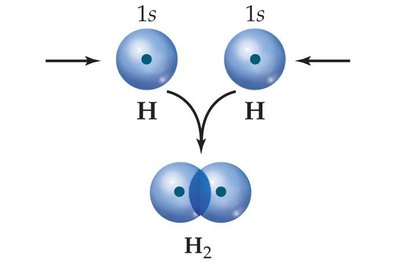
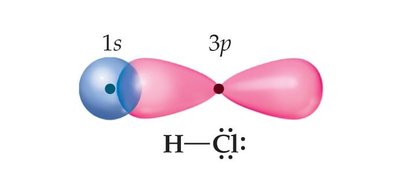
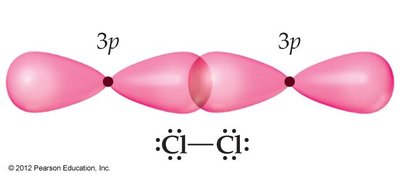
Valence bond theory explains covalent bonding as the overlap of atomic orbitals from different atoms. The shared electron density between nuclei forms a covalent bond.
Sigma (σ) Bond: Electron density is concentrated along the internuclear axis (single bonds).
Pi (π) Bond: Electron density is above and below the internuclear axis (in double and triple bonds).
9.5 Hybrid Orbitals
Hybridization is the mixing of atomic orbitals to form new, equivalent hybrid orbitals that explain observed molecular geometries. The type of hybridization depends on the number of electron domains around the central atom.
sp Hybridization: Linear geometry (2 domains)
sp2 Hybridization: Trigonal planar geometry (3 domains)
sp3 Hybridization: Tetrahedral geometry (4 domains)
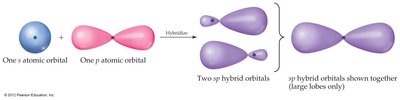
Example: In methane (CH4), the carbon atom undergoes sp3 hybridization to form four equivalent bonds.
9.6 Multiple Bonds
Multiple bonds consist of one sigma (σ) bond and one or more pi (π) bonds. Sigma bonds result from head-on overlap, while pi bonds result from side-by-side overlap of unhybridized p orbitals.
Double Bond: 1 σ + 1 π bond
Triple Bond: 1 σ + 2 π bonds
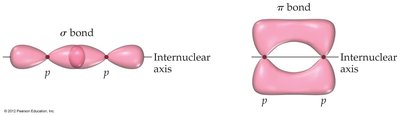
Pi bonds are generally weaker than sigma bonds due to less effective orbital overlap.
Summary Table: Electron-Domain and Molecular Geometries
Number of Electron Domains | Electron-Domain Geometry | Molecular Geometry | Bond Angles | Example |
|---|---|---|---|---|
2 | Linear | Linear | 180° | CO2 |
3 | Trigonal planar | Trigonal planar | 120° | SO3 |
4 | Tetrahedral | Tetrahedral | 109.5° | CCl4 |
5 | Trigonal bipyramidal | Trigonal bipyramidal | 120°, 90° | PCl5 |
6 | Octahedral | Octahedral | 90° | SF6 |
Additional info: The VSEPR model is a powerful tool for predicting molecular shapes, but exceptions can occur, especially with transition metals and molecules with expanded octets. Hybridization theory complements VSEPR by explaining the observed bond angles and molecular geometries through orbital mixing.
