 Back
Molecular Shapes and Bonding Theories: VSEPR, Valence Bond, and Molecular Orbital Theory
Study Guide - Smart Notes
 Tailored notes based on your materials, expanded with key definitions, examples, and context.
Chapter 7: Molecular Shapes and Bonding Theories
Valence Shell Electron Pair Repulsion (VSEPR) Theory
The VSEPR model is used to predict the three-dimensional shapes of molecules based on the repulsion between electron domains (regions of electron density) around a central atom. The arrangement of these domains determines both the electron geometry and the molecular geometry, which in turn affects the physical and chemical properties of the molecule.
Electron Domains: Regions of electron density, including bonding pairs and lone pairs.
Electron Geometry: The spatial arrangement of all electron domains around the central atom.
Molecular Geometry: The arrangement of only the atoms (not lone pairs) in the molecule.
Bond Angles: The angles between adjacent bonds, determined by the geometry.
Key Geometries:
Electron Domains | Bonded Groups | Lone Pairs | Electron Geometry | Molecular Geometry | Bond Angles | Example | Model |
|---|---|---|---|---|---|---|---|
2 | 2 | 0 | Linear | Linear | 180° | CO2 |
|
3 | 3 | 0 | Trigonal planar | Trigonal planar | 120° | NO3- | |
3 | 2 | 1 | Trigonal planar | Bent | <120° | NO2- |
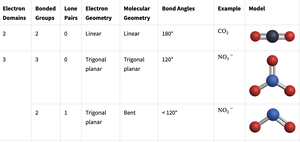
Linear: Two electron domains, bond angle 180°.
Trigonal Planar: Three electron domains, bond angle 120°.
Bent: Three electron domains (one lone pair), bond angle <120°.
Four Electron Domains: Tetrahedral Geometry
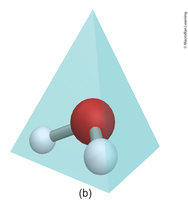
When four electron domains surround a central atom, the most stable arrangement is tetrahedral, with bond angles of 109.5°. Lone pairs cause deviations from ideal angles, resulting in trigonal pyramidal or bent molecular geometries.
Electron Domains | Lone Pairs | Electron Geometry | Molecular Geometry | Bond Angles | Example | Model |
|---|---|---|---|---|---|---|
4 | 0 | Tetrahedral | Tetrahedral | 109.5° | CH4 | |
4 | 1 | Tetrahedral | Trigonal pyramidal | <109.5° | NH3 | |
4 | 2 | Tetrahedral | Bent | <109.5° | H2O |
|
Five and Six Electron Domains: Expanded Valence Geometries
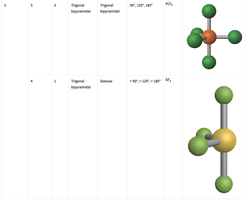
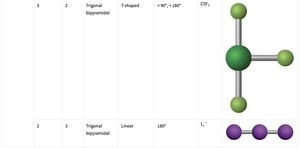
Atoms with five or six electron domains exhibit more complex geometries, such as trigonal bipyramidal and octahedral. Lone pairs occupy positions that minimize repulsion, resulting in shapes like see-saw, T-shaped, square pyramidal, and square planar.
Electron Domains | Lone Pairs | Electron Geometry | Molecular Geometry | Bond Angles | Example | Model |
|---|---|---|---|---|---|---|
5 | 0 | Trigonal bipyramidal | Trigonal bipyramidal | 90°, 120°, 180° | PCl5 |
|
5 | 1 | Trigonal bipyramidal | See-saw | <90°, <120°, <180° | SF4 | |
5 | 2 | Trigonal bipyramidal | T-shaped | <90°, <180° | ClF3 |
|
5 | 3 | Trigonal bipyramidal | Linear | 180° | I3- | |
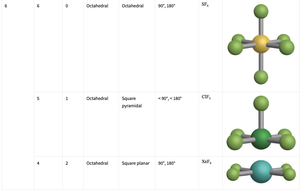
6 | 0 | Octahedral | Octahedral | 90°, 180° | SF6 |
|
6 | 1 | Octahedral | Square pyramidal | <90°, <180° | ClF5 | |
6 | 2 | Octahedral | Square planar | 90°, 180° | XeF4 |
Polarity and Molecular Geometry
Molecular polarity depends on both the presence of polar bonds (differences in electronegativity) and the molecular geometry. Symmetrical molecules may be nonpolar even if they contain polar bonds, while asymmetrical molecules are often polar.
Bond Dipole: Created by differences in electronegativity between atoms.
Molecular Dipole: The vector sum of all bond dipoles; determines overall polarity.
Example: CO2 is linear and nonpolar; H2O is bent and polar.
Valence Bond Theory and Hybridization
Valence Bond (VB) theory explains covalent bond formation as the overlap of atomic orbitals. Hybridization is the mixing of atomic orbitals to form new hybrid orbitals, which better explain observed molecular geometries.
sp3 Hybridization: Four hybrid orbitals, tetrahedral geometry (e.g., CH4).
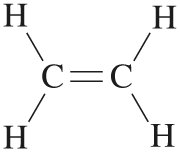
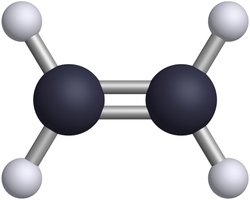
sp2 Hybridization: Three hybrid orbitals, trigonal planar geometry (e.g., C2H4).
sp Hybridization: Two hybrid orbitals, linear geometry (e.g., C2H2).
Sigma (σ) Bonds: Head-to-head overlap along the internuclear axis.
Pi (π) Bonds: Side-to-side overlap above and below the internuclear axis.
Example: Ethene (C2H4) contains a double bond composed of one σ and one π bond.
Molecular Orbital Theory
Molecular Orbital (MO) theory describes the formation of molecular orbitals from the combination of atomic orbitals. Electrons fill these orbitals according to quantum mechanical principles, and the bond order is calculated as:
Bond Order Formula:
Paramagnetism: Molecules with unpaired electrons (e.g., O2) are attracted to magnetic fields.
Diamagnetism: Molecules with all paired electrons are slightly repelled by magnetic fields.
Practice Problems and Applications
Practice problems reinforce understanding of molecular shapes, hybridization, and molecular orbital theory. Students are asked to draw Lewis structures, predict geometries, identify hybridization, and calculate bond orders.
Example: Draw the Lewis structure and determine the geometry of SeCl4, I3-, PSCl3, IF4-, PH2-, TeF42-, N3-, SeOCl4, PH4+.
Example: Draw the molecular orbital diagram for B2 and determine the number of unpaired electrons.
Example: Calculate the bond order in O2+ and N2+.
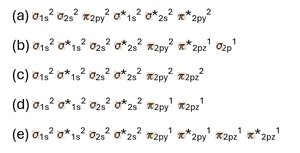
Example: Identify the correct electron configuration for C2.
Summary: Understanding molecular shapes, bonding theories, and hybridization is essential for predicting molecular behavior, reactivity, and properties. These concepts are critical in fields such as medical equipment design, where molecular geometry and polarity affect gas mixing and delivery systems.
----------------------------------------
