 Back
Molecular Shapes, VSEPR Theory, and Chemical Bonding II
Study Guide - Smart Notes
 Tailored notes based on your materials, expanded with key definitions, examples, and context.
Chemical Bonding II: Molecular Shapes, Valence Bond Theory, and Molecular Orbital Theory
Molecular Geometry and Valence Shell Electron Pair Repulsion Theory (VSEPR)
VSEPR theory is a fundamental model used to predict the three-dimensional shapes of molecules based on the repulsion between electron groups around a central atom. The arrangement of these groups is determined by minimizing repulsions, leading to specific molecular geometries.
Key Principle: Electron groups (bonding pairs and lone pairs) repel each other and arrange themselves to minimize repulsion.
Electron Groups: Each bond (single, double, or triple) and each lone pair counts as one electron group.
Geometry: The spatial arrangement of electron groups determines the molecule's geometry.
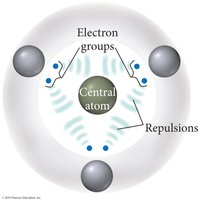
Lewis Structures and VSEPR Theory
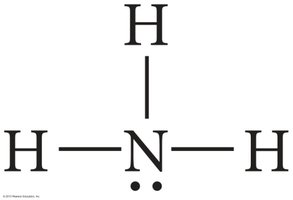
Lewis structures are used to visualize the distribution of valence electrons in molecules, which is essential for applying VSEPR theory. Each lone pair and each bond to the central atom is considered an electron group.
Lone Pairs: Each lone pair on the central atom is an electron group.
Bonds: Each bond (regardless of type) is counted as one electron group.
Example: Ammonia (NH3) has three bonds and one lone pair on nitrogen.
Electron Group Geometries: The Five Basic Families
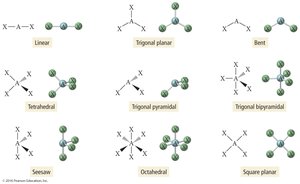
There are five fundamental electron group geometries based on the number of electron groups around the central atom:
Linear: 2 electron groups, bond angle 180°
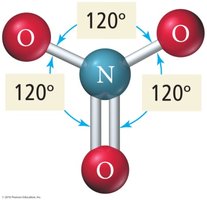
Trigonal Planar: 3 electron groups, bond angle 120°
Tetrahedral: 4 electron groups, bond angle 109.5°
Trigonal Bipyramidal: 5 electron groups, bond angles 90° and 120°
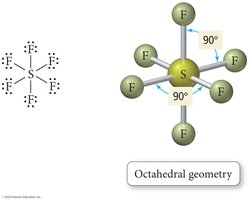
Octahedral: 6 electron groups, bond angle 90°
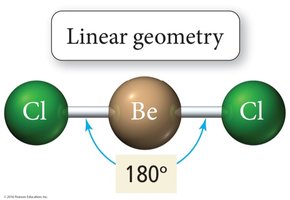
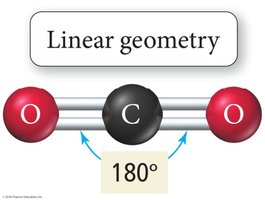
Linear Electron Pair Geometry
Linear geometry occurs when two electron groups are attached to the central atom. The bond angle is 180°.
Example: BeCl2 and CO2 both exhibit linear geometry.
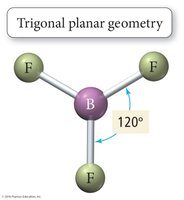
Trigonal Planar Electron Pair Geometry
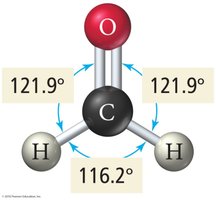
Trigonal planar geometry is observed when three electron groups surround the central atom, with bond angles of 120°.
Example: BF3 and formaldehyde (CH2O).
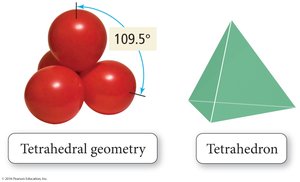
Tetrahedral Electron Pair Geometry
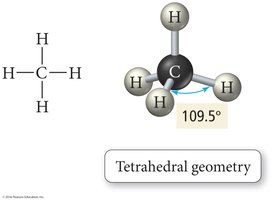
Tetrahedral geometry arises when four electron groups surround the central atom, with bond angles of 109.5°.
Example: Methane (CH4).
Trigonal Bipyramidal Electron Pair Geometry
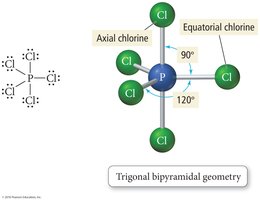
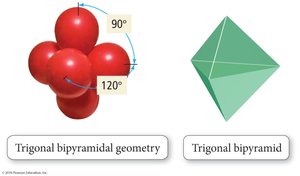
Trigonal bipyramidal geometry is found when five electron groups are attached to the central atom. The bond angles are 120° (equatorial) and 90° (axial).
Example: PCl5.
Octahedral Electron Pair Geometry
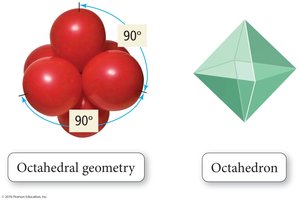
Octahedral geometry occurs when six electron groups surround the central atom, with all bond angles at 90°.
Example: SF6.
Resonance Structures and Geometric Arrangements
Resonance structures are different possible arrangements of electrons in a molecule. The molecular geometry remains the same for all resonance forms.
Example: Nitrate ion (NO3–) has trigonal planar geometry in all resonance forms.

Effect of Lone Pairs on Molecular Geometry
Lone pairs occupy more space than bonding pairs, causing distortions in bond angles and molecular shapes. The repulsive force interactions follow the order: (Lone Pair – Lone Pair) > (Lone Pair – Bonding Pair) > (Bonding Pair – Bonding Pair).
Example: Ammonia (NH3) has a trigonal pyramidal shape due to one lone pair.
Example: Water (H2O) has a bent shape due to two lone pairs.
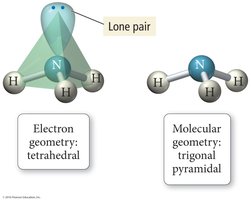
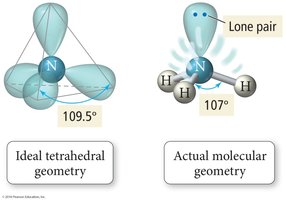
Table of Electron Pair and Molecular Geometries
This table summarizes the possible electron pair and molecular geometries based on the number of electron groups and lone pairs.
Electron Groups | Electron Geometry | Molecular Geometry | Example |
|---|---|---|---|
2 | Linear | Linear | CO2 |
3 | Trigonal Planar | Trigonal Planar, Bent | BF3, SO2 |
4 | Tetrahedral | Tetrahedral, Trigonal Pyramidal, Bent | CH4, NH3, H2O |
5 | Trigonal Bipyramidal | Trigonal Bipyramidal, Seesaw, T-shaped, Linear | PCl5, SF4, ClF3, I3– |
6 | Octahedral | Octahedral, Square Pyramidal, Square Planar | SF6, BrF5, XeF4 |
Multicentral Atom Compounds
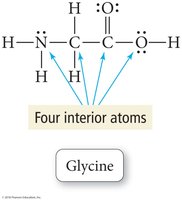
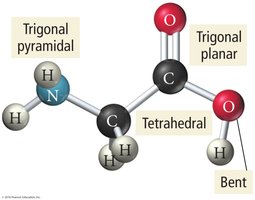
Large molecules may have more than one central atom, each with its own geometry. For example, glycine has four interior atoms, each with a distinct geometry.
Example: Glycine exhibits trigonal pyramidal, tetrahedral, trigonal planar, and bent geometries.
Representing Three-Dimensional Shapes on Paper
To depict molecular shapes on a two-dimensional surface, conventions such as straight lines, solid wedges, and hatched wedges are used to indicate the spatial orientation of bonds.
Straight line: Bond in the plane of the paper
Solid wedge: Bond coming out of the page
Hatched wedge: Bond going into the page

Predicting Electron Pair and Molecular Geometries
To predict the geometry of a compound:
Identify the central atom and draw the Lewis structure.
Count the number of atom groups and lone pairs attached to the central atom.
Determine the electron pair geometry (family group) and molecular geometry (shape).
Example: NH3 has four electron groups (three bonds, one lone pair) – tetrahedral electron geometry, trigonal pyramidal molecular geometry.
Example: BF3 has three electron groups (three bonds) – trigonal planar electron and molecular geometry.
Molecular Polarity
Molecular polarity depends on the presence of polar covalent bonds and the overall symmetry of the molecule. A net dipole moment arises if the molecule is asymmetric and contains polar bonds.
Polar molecules: Have a net dipole moment (e.g., H2O).
Nonpolar molecules: Symmetric, no net dipole moment (e.g., CO2).
Polarity affects: Solubility, melting and boiling points.
Theories of Chemical Bonding
Lewis theory, Valence Bond (VB) theory, and Molecular Orbital (MO) theory are used to explain chemical bonding. Each has strengths and limitations.
Lewis Theory: Good for predicting trends, but limited in explaining bond strength, resonance, and magnetism.
Valence Bond Theory: Explains bond formation via overlap of atomic orbitals and hybridization; electrons are localized.
Molecular Orbital Theory: Electrons are delocalized in molecular orbitals; explains bond order, magnetism, and stability.
Sigma (σ) and Pi (π) Bonds
Sigma bonds are formed by direct overlap of atomic orbitals along the internuclear axis. Pi bonds are formed by sideways overlap of unhybridized p orbitals above and below the axis.
Sigma bond: Present in all single bonds; can be formed from s or p orbitals.
Pi bond: Present in double and triple bonds; formed from unhybridized p orbitals.
Hybridization and Molecular Geometry
Hybridization is the mixing of atomic orbitals to form new hybrid orbitals suitable for bonding. The type of hybridization corresponds to the electron pair geometry.
Electron Geometry | Hybridization | Comments |
|---|---|---|
Linear | sp | Triple bond |
Trigonal planar | sp2 | Double bond |
Tetrahedral | sp3 | Single bonds |
Trigonal bipyramidal | sp3d | Five groups |
Octahedral | sp3d2 | Six groups |
Molecular Orbital (MO) Theory
MO theory describes bonding as the formation of molecular orbitals from atomic orbitals. Electrons fill these orbitals according to the Pauli exclusion principle and Hund’s rule.
Bonding MO: Lower energy, stabilizing
Antibonding MO: Higher energy, destabilizing
Bond Order:
Example: He2 has bond order 0, does not exist as a molecule.
Molecular Orbitals and Magnetism
MO theory can predict magnetic properties based on the presence of unpaired electrons. Paramagnetic substances have unpaired electrons; diamagnetic substances have all electrons paired.
Example: O2 is paramagnetic due to unpaired electrons in its MO diagram.
Summary Table: Electron Pair and Molecular Geometries
Electron Groups | Electron Geometry | Molecular Geometry | Example |
|---|---|---|---|
2 | Linear | Linear | CO2 |
3 | Trigonal Planar | Trigonal Planar, Bent | BF3, SO2 |
4 | Tetrahedral | Tetrahedral, Trigonal Pyramidal, Bent | CH4, NH3, H2O |
5 | Trigonal Bipyramidal | Trigonal Bipyramidal, Seesaw, T-shaped, Linear | PCl5, SF4, ClF3, I3– |
6 | Octahedral | Octahedral, Square Pyramidal, Square Planar | SF6, BrF5, XeF4 |
Additional info: This study guide covers the essential concepts of molecular geometry, VSEPR theory, hybridization, and molecular orbital theory, providing a comprehensive overview for General Chemistry students.
