 Back
BackMolecular Shapes, VSEPR Theory, and Hybridization: A Study Guide
Study Guide - Smart Notes
 Tailored notes based on your materials, expanded with key definitions, examples, and context.
Chemical Bonding II: Molecular Shapes, VSEPR Theory, and Hybridization
Valence-Shell Electron-Pair Repulsion (VSEPR) Theory
VSEPR theory is a model used to predict the geometry of individual molecules based on the repulsion between electron groups around a central atom. Electron groups include bonds (single, double, or triple), lone pairs, and single electrons. The arrangement of these groups determines the overall shape of the molecule.
Electron Group: Any region of electron density (bond or lone pair) around a central atom.
Basic Principle: Electron groups repel each other and arrange themselves as far apart as possible.
Five Basic Electron Geometries
The five fundamental arrangements of electron groups around a central atom are:
Linear (2 groups, 180°)
Trigonal Planar (3 groups, 120°)
Tetrahedral (4 groups, 109.5°)
Trigonal Bipyramidal (5 groups, 120° and 90°)
Octahedral (6 groups, 90°)
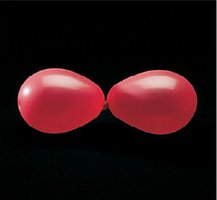
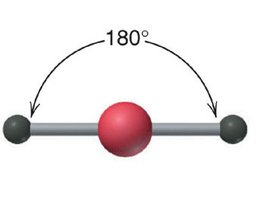
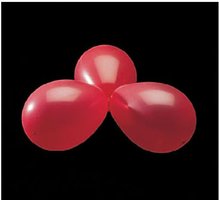
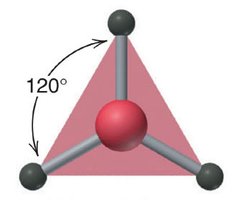
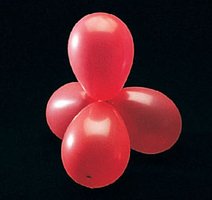
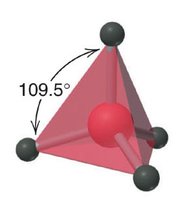
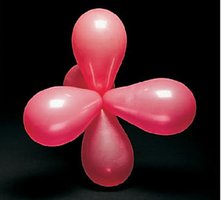
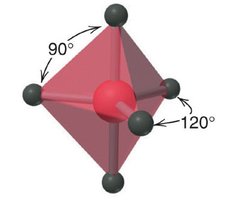
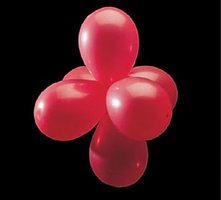
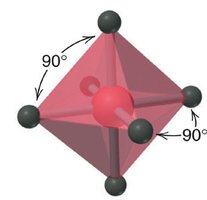
Electron-Group Arrangement vs. Molecular Shape
The electron-group arrangement considers all electron groups (bonding and nonbonding), while the molecular geometry considers only the positions of the atoms (bonding groups). The notation AXmEn is used, where A is the central atom, X is a surrounding atom, and E is a nonbonding electron group.
Effect of Lone Pairs and Multiple Bonds
Lone pairs repel more strongly than bonding pairs, reducing bond angles between atoms.
Double and triple bonds have greater electron density and also cause bond angle distortions.
Common Molecular Geometries and Bond Angles
Electron Groups | Bonding Groups | Lone Pairs | Electron Geometry | Molecular Geometry | Bond Angles |
|---|---|---|---|---|---|
2 | 2 | 0 | Linear | Linear | 180° |
3 | 3 | 0 | Trigonal Planar | Trigonal Planar | 120° |
3 | 2 | 1 | Trigonal Planar | Bent | <120° |
4 | 4 | 0 | Tetrahedral | Tetrahedral | 109.5° |
4 | 3 | 1 | Tetrahedral | Trigonal Pyramidal | <109.5° |
4 | 2 | 2 | Tetrahedral | Bent | <109.5° |
5 | 5 | 0 | Trigonal Bipyramidal | Trigonal Bipyramidal | 120°, 90° |
6 | 6 | 0 | Octahedral | Octahedral | 90° |
Examples of Molecular Shapes
CO2: Linear (AX2), 180°
BF3: Trigonal planar (AX3), 120°
CH4: Tetrahedral (AX4), 109.5°
NH3: Trigonal pyramidal (AX3E), <109.5°
H2O: Bent (AX2E2), <109.5°
Representing 3D Shapes on Paper
To depict three-dimensional molecular shapes, use:
Straight lines for bonds in the plane
Solid wedges for bonds coming out of the plane
Hashed wedges for bonds going into the plane
Molecular Shape and Polarity
A molecule is polar if it contains polar bonds and the bond dipoles do not cancel due to the molecular shape. The overall polarity is measured by the dipole moment (μ, in debye).
CO2: Nonpolar (linear, dipoles cancel)
H2O: Polar (bent, dipoles do not cancel)
Valence Bond Theory and Hybridization
Valence Bond (VB) Theory explains bonding as the overlap of atomic orbitals. Hybridization describes the mixing of atomic orbitals to form new, equivalent hybrid orbitals that match observed molecular shapes.
sp: Linear (2 groups, 180°)
sp2: Trigonal planar (3 groups, 120°)
sp3: Tetrahedral (4 groups, 109.5°)
sp3d: Trigonal bipyramidal (5 groups)
sp3d2: Octahedral (6 groups)
Types of Covalent Bonds
Sigma (σ) bond: End-to-end overlap, all single bonds are σ bonds.
Pi (π) bond: Sideways overlap, present in double (one σ, one π) and triple bonds (one σ, two π).
Summary Table: Electron and Molecular Geometries
Electron Groups | Bonding Groups | Lone Pairs | Electron Geometry | Molecular Geometry | Bond Angles |
|---|---|---|---|---|---|
2 | 2 | 0 | Linear | Linear | 180° |
3 | 3 | 0 | Trigonal Planar | Trigonal Planar | 120° |
3 | 2 | 1 | Trigonal Planar | Bent | <120° |
4 | 4 | 0 | Tetrahedral | Tetrahedral | 109.5° |
4 | 3 | 1 | Tetrahedral | Trigonal Pyramidal | <109.5° |
4 | 2 | 2 | Tetrahedral | Bent | <109.5° |
5 | 5 | 0 | Trigonal Bipyramidal | Trigonal Bipyramidal | 120°, 90° |
6 | 6 | 0 | Octahedral | Octahedral | 90° |
Example: Methanol (CH3OH)
The C atom is sp3 hybridized (tetrahedral geometry).
The O atom is also sp3 hybridized (bent geometry for the O-H group).
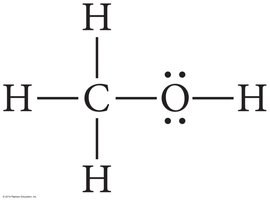
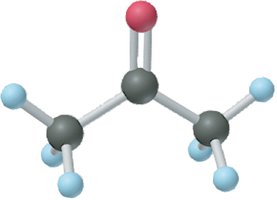
Example: Acetone ((CH3)2CO)
Each CH3 group: C is sp3 hybridized (tetrahedral).
Central C (in CO): sp2 hybridized (trigonal planar).
Practice Problems
Predict the electron geometry, molecular geometry, and bond angles for NF3, OF2, BrF5, IF4+, IF2-.
Determine the polarity of SiCl4, IF5, CHCl3, OF2, I3-, BCl3, SeF6.
Key Equations
Bond Angle (Linear):
Bond Angle (Trigonal Planar):
Bond Angle (Tetrahedral):
Bond Angle (Trigonal Bipyramidal):
Bond Angle (Octahedral):
Additional info: For more complex molecules with multiple central atoms, describe the geometry around each central atom separately. The overall molecular shape is a combination of these local geometries.
