 Back
BackMolecules, Compounds, and Chemical Equations: A Comprehensive Study Guide
Study Guide - Smart Notes
 Tailored notes based on your materials, expanded with key definitions, examples, and context.
Chapter 3: Molecules, Compounds, and Chemical Equations
Introduction to Compounds and Chemical Diversity
Elements combine to form compounds, resulting in the vast diversity of substances observed in nature. The properties of compounds are often dramatically different from those of their constituent elements.
Elements, Compounds, and Mixtures
Element: A pure substance consisting of only one type of atom.
Compound: A substance composed of two or more elements in fixed, definite proportions.(H₂O, CO₂)
Mixture: A combination of two or more substances in variable proportions.(saltwater, air...due to pollution can vary)
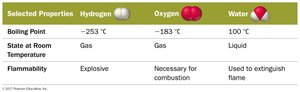
For example, hydrogen and oxygen are both gases, but when combined in a 2:1 ratio, they form water, a liquid with very different properties.
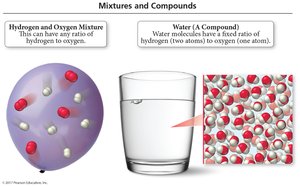
Mixtures vs. Compounds
In mixtures, elements can combine in any proportion (e.g., a balloon with varying ratios of H2 and O2).
In compounds, elements combine in fixed, definite proportions (e.g., H2O always has two hydrogens for every oxygen).
Chemical Bonds
Atoms in compounds are held together by chemical bonds, which are classified as:
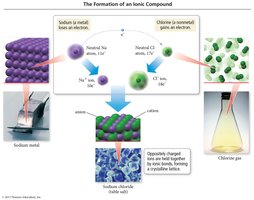
Ionic bonds: Involve the transfer of electrons from a metal to a nonmetal, forming cations and anions.
Covalent bonds: Involve the sharing of electrons between nonmetals, forming molecules.
Ionic Compounds
Ionic compounds form a three-dimensional lattice of alternating cations and anions in the solid state.
Covalent Compounds
Covalent (molecular) compounds consist of molecules formed by shared electrons between nonmetals.
Representing Compounds: Chemical Formulas and Models
Chemical formula: Indicates the elements present and the relative number of atoms (e.g., 2H1O, 1C2O).Tells what and how many but doesn't explain structure
Empirical formula: Shows the simplest whole-number ratio of atoms(H₂O₂ → HO (simplest ratio 1:1) Glucose (C₆H₁₂O₆) → CH₂O
Molecular formula: Shows the actual number of atoms in a molecule (e.g., H2O2).
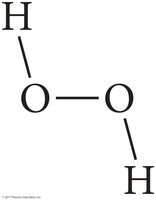
Structural formula: Shows how atoms are connected (e.g., for H2O2):

Molecular models: Ball-and-stick and space-filling models provide three-dimensional representations of molecules.
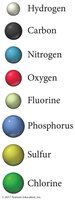
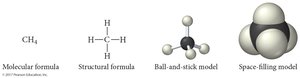
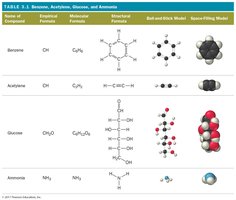
Classification of Elements and Compounds
Atomic elements: Exist as single atoms (e.g., Na, Ne). 1 of something
Molecular elements: Exist as molecules (e.g., H2, O2, N2, F2, Cl2, Br2, I2, P4, S8). multiples of the same thing (Diatomic)
Molecular compounds: Composed of two non metal molecules (e.g., H2O, CO2). two elements combined
Ionic compounds: Composed of cations and anions; metal to nonmetal (e.g., NaCl).
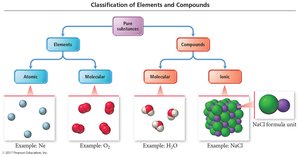
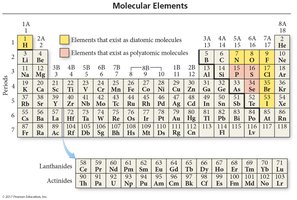
Polyatomic Ions
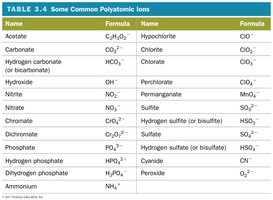
Some ions consist of groups of covalently bonded atoms with an overall charge, called polyatomic ions (e.g., NO3−, CO32−).
Naming Ionic Compounds
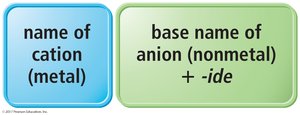
Type I: Metal forms only one type of ion (charge is invariant).Stays the same= +1 charge, no roman numeral
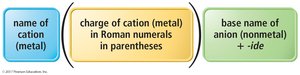
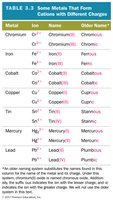
Type II: Metal forms more than one type of ion (charge varies, only transition metals). =2 or more charges, need roman numeral
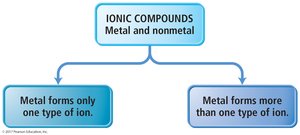
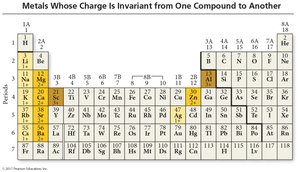
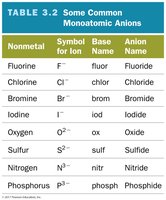
For Type II, the charge of the metal is indicated by a Roman numeral in parentheses.
Naming Ionic Compounds with Polyatomic Ions
Use the name of the polyatomic ion as it appears in the formula (e.g., NaNO2 is sodium nitrite).
Oxyanions
Oxyanions are polyatomic ions containing oxygen and another element.
Suffixes: -ate (more O), -ite (fewer O).
Prefixes: per- (more O than -ate), hypo- (fewer O than -ite).
Hydrated Ionic Compounds
Hydrates contain a specific number of water molecules per formula unit (e.g., MgSO4·7H2O is magnesium sulfate heptahydrate).
Naming Molecular Compounds
Composed of two or more nonmetals. REMEMBER!!!!
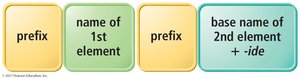
Prefixes indicate the number of each atom (mono-, di-, tri-, tetra-, etc.).
The prefix mono- is usually omitted for the first element.
Acids
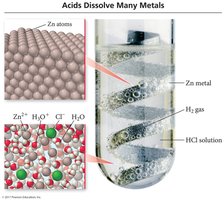
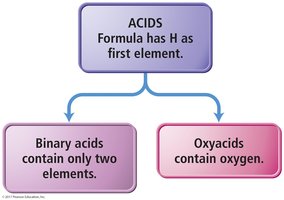
Acids are molecular compounds that release H+ ions in water. They are classified as:
Binary acids: Contain H and one other nonmetal (e.g., HCl).
Oxyacids: Contain H, O, and another element (e.g., H2SO4).
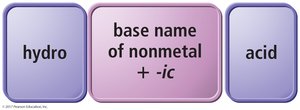
Binary acids: hydro- + base name of nonmetal + -ic + acid (e.g., HCl is hydrochloric acid).
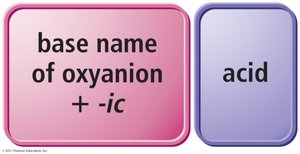
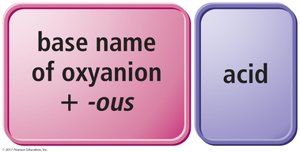
Oxyacids: If the polyatomic ion ends in -ate, use -ic; if -ite, use -ous (e.g., HNO3 is nitric acid, HNO2 is nitrous acid).
Formula Mass and Molar Mass
Formula mass is mass of on particle
Formula mass
one particle
amu
Molar mass
one mole of particles
g/mol
Molar mass: The mass in grams of one mole of a compound, numerically equal to the formula mass in amu.( mass of all atoms! H20= mass of 2 hydrogen and 1 oxygen)

Percent Composition
The percent composition of a compound is the percentage by mass of each element in the compound.
Calculated using the formula: Find mass of both elements add them together to get molar mass of compund, then take mass of each element and dived into mollar mass seperately and multiple by 100%
 find mass of each elemens/by atomic weight multiple x 100
Empirical and Molecular Formulas
Empirical formula: Simplest whole-number ratio of atoms in a compound. divide by atomic weight stops at small ratios
Molecular formula: Actual number of atoms in a molecule; a whole-number multiple of the empirical formula.
Relationship:
Where find molar mass of each element/ divide by atomic mass, then take smallest number, divide mass over each
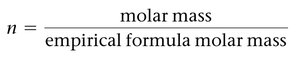 reduce molecules to its simplest form, by the number its divisible by, then divide by molar mass
Combustion Analysis
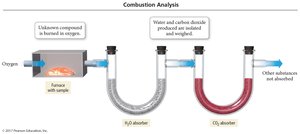
Combustion analysis is used to determine the empirical formula of compounds, especially organic compounds containing C, H, and O. The compound is burned in oxygen, and the masses of CO2 and H2O produced are measured to calculate the original amounts of C and H.
Chemical Reactions and Equations
Chemical reactions involve the rearrangement of atoms to form new substances.
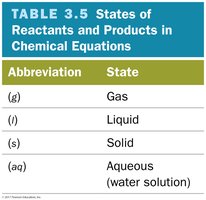
Chemical equations use formulas and symbols to represent reactions, showing reactants and products, their states, and their relative quantities.
Balancing Chemical Equations
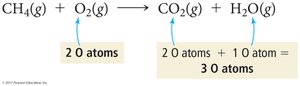
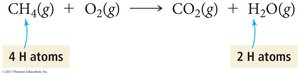
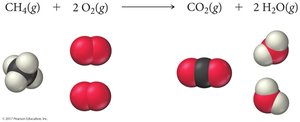
Equations must be balanced to obey the Law of Conservation of Mass.
Only coefficients (not subscripts) are changed to balance equations.
Organic Compounds
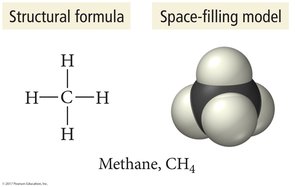
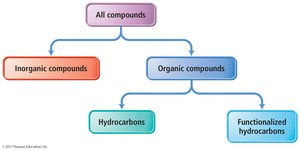
Organic compounds are primarily composed of carbon and hydrogen, sometimes with O, N, P, S, and other elements.
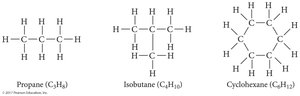
Carbon forms four covalent bonds and can create chains, branches, and rings.
Hydrocarbons
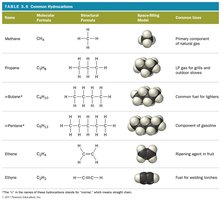
Hydrocarbons contain only carbon and hydrogen.
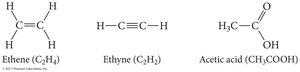
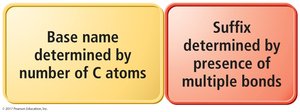
Classified as alkanes (single bonds), alkenes (double bonds), and alkynes (triple bonds).
Base names are determined by the number of carbon atoms (meth-, eth-, prop-, etc.).

Functionalized Hydrocarbons
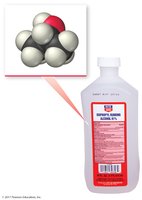
Functional groups are specific atoms or groups of atoms that impart characteristic chemical properties to organic compounds. Families of organic compounds are defined by their functional groups (e.g., alcohols, ethers, ketones, carboxylic acids, esters, amines).
Additional info: This guide covers the essential concepts of molecules, compounds, chemical equations, and the basics of organic chemistry, as outlined in a typical general chemistry curriculum.
