 Back
Molecules, Compounds, and Ionic Compound Formulas & Naming
Study Guide - Smart Notes
 Tailored notes based on your materials, expanded with key definitions, examples, and context.
Chapter Three: Molecules and Compounds
An Atomic-Level View of Elements and Compounds
Pure substances are classified as elements or compounds. Elements can exist as individual atoms or as molecules, while compounds are either molecular or ionic. Understanding these classifications is fundamental to recognizing how substances are structured at the atomic level.
Elements: Substances composed of only one type of atom. They can be atomic (single atoms, e.g., Ne) or molecular (two or more atoms bonded, e.g., O2).
Compounds: Substances composed of two or more different elements. They can be molecular (e.g., CO2) or ionic (e.g., NaCl).
Molecular compounds: Consist of molecules formed by covalent bonds between nonmetals.
Ionic compounds: Consist of ions held together by electrostatic forces (ionic bonds).
Example: Water (H2O) is a molecular compound, while sodium chloride (NaCl) is an ionic compound.
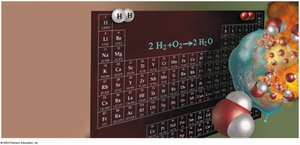
Elements: Atomic and Molecular
Elements are further classified based on their atomic arrangement. Atomic elements exist as single atoms, while molecular elements exist as molecules composed of two or more identical atoms.
Atomic elements: Exist as individual atoms (e.g., He, Ne).
Molecular elements: Exist as molecules (e.g., O2, N2).
Example: Oxygen gas (O2) is a molecular element, while neon gas (Ne) is an atomic element.
Compounds: Molecular and Ionic
Compounds are classified as molecular or ionic based on the types of elements and the nature of their bonding.
Molecular compounds: Formed from nonmetals sharing electrons (covalent bonds).
Ionic compounds: Formed from metals and nonmetals, where electrons are transferred, resulting in cations and anions.
Example: Carbon dioxide (CO2) is a molecular compound; sodium chloride (NaCl) is an ionic compound.
Classification of Substances
Substances can be classified as atomic elements, molecular elements, molecular compounds, or ionic compounds based on their composition and bonding.
Atomic element: Single atoms (e.g., Ar).
Molecular element: Molecules of the same element (e.g., O2).
Molecular compound: Molecules of different elements (e.g., CO2).
Ionic compound: Lattice of ions (e.g., NaCl).
Ionic Compounds: Formulas and Names
Formulas of Ionic Compounds
Ionic compounds always contain positive (cations) and negative (anions) ions. The chemical formula must reflect the smallest whole-number ratio of ions, ensuring the sum of the charges equals zero.
Cations: Positively charged ions, usually metals.
Anions: Negatively charged ions, usually nonmetals.
Charge balance: The sum of cation and anion charges must equal zero.
Formula unit: The simplest ratio of ions in an ionic compound.
Example: Magnesium oxide (MgO): Magnesium forms 2+ ions, oxygen forms 2− ions, so the formula is MgO.
Predicting Charges of Ions
The charges of representative (main group) elements can be predicted from their group numbers. Transition metals often form multiple charges, so their charge must be specified.
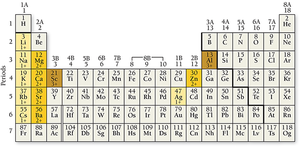
Main group elements: Form predictable charges (e.g., Group 1A: +, Group 2A: 2+).
Transition metals: Can form multiple charges; charge is not easily predicted.
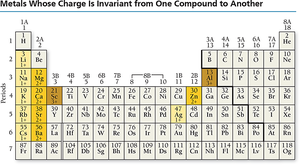
Metals Whose Charge Is Invariant
Some metals always have the same charge in their compounds. These are typically main group metals and a few transition metals.
Examples: Sodium (Na+), Magnesium (Mg2+), Aluminum (Al3+), Silver (Ag+), Zinc (Zn2+).
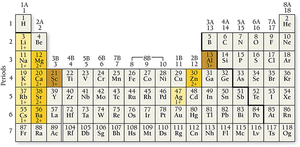
Writing Formulas of Ionic Compounds
To write the formula for an ionic compound, combine the cation and anion in a ratio that balances their charges.
Step 1: Identify the cation and its charge.
Step 2: Identify the anion and its charge.
Step 3: Combine ions in the smallest whole-number ratio so the total charge is zero.
Example: Magnesium (Mg2+) and oxygen (O2−) combine to form MgO.
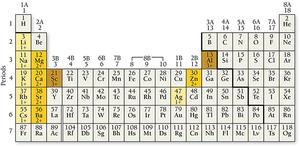
Practice: Calcium (Ca2+) and chlorine (Cl−) combine to form CaCl2.
Naming Ionic Compounds
Ionic compounds are named based on the type of metal present. There are two main types: Type I (main group metals) and Type II (transition metals).
Type I: Main group metals with invariant charge.
Type II: Transition metals with variable charge.
Naming Binary Ionic Compounds
Binary ionic compounds consist of a metal and a nonmetal. The naming rules differ for Type I and Type II compounds.
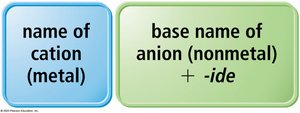
Type I: Name the metal as is; name the nonmetal with "-ide" ending.
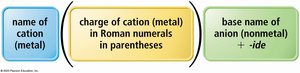
Type II: Name the metal as is; indicate its charge in Roman numerals in parentheses; name the nonmetal with "-ide" ending.
Examples:
FeO: Iron(II) oxide
Fe2O3: Iron(III) oxide
CuS: Copper(II) sulfide
KCl: Potassium chloride
CaO: Calcium oxide
MgS: Magnesium sulfide
Naming Ionic Compounds Containing Polyatomic Ions
Some ionic compounds contain polyatomic ions. The naming convention is to use the metal's name, its charge in Roman numerals (if variable), and the name of the polyatomic ion.
Example: Fe(NO3)2: Iron(II) nitrate; Fe(NO3)3: Iron(III) nitrate.
Naming Hydrated Ionic Compounds
Hydrated ionic compounds contain a specific number of water molecules per formula unit. Prefixes are used to indicate the number of water molecules.
Common prefixes: mono-, di-, tri-, tetra-, penta-, hexa-, etc.
Example: CuSO4·5H2O: Copper(II) sulfate pentahydrate.
