 Back
BackMolecules, Compounds, and Nomenclature: Study Guide
Study Guide - Smart Notes
 Tailored notes based on your materials, expanded with key definitions, examples, and context.
Molecules, Compounds, and Nomenclature
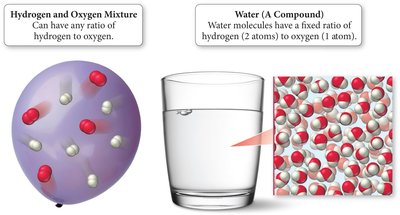
Hydrogen, Oxygen, and Water
The study of molecules and compounds begins with understanding the basic elements hydrogen and oxygen, and their combination to form water. Hydrogen and oxygen can exist as a mixture, where the ratio of hydrogen to oxygen is variable, or as a compound, water, where the ratio is fixed at two hydrogen atoms to one oxygen atom.
Mixture: Any ratio of hydrogen to oxygen; properties depend on the proportions.
Compound (Water): Fixed ratio (H2O); properties are consistent and distinct from the elements.
Properties: Hydrogen is explosive, oxygen is necessary for combustion, water extinguishes flames.

Chemical Bonds
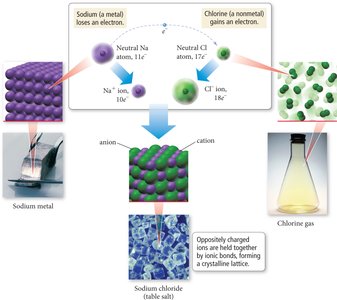
Chemical bonds are the forces that hold atoms together in compounds. There are two primary types: ionic and covalent bonds.
Ionic Bonds: Formed by the transfer of electrons from a metal to a nonmetal, resulting in oppositely charged ions held together by electrostatic attraction.
Covalent Bonds: Formed when two nonmetals share electrons, resulting in a stable molecule.
Representing Compounds: Chemical Formulas and Molecular Models
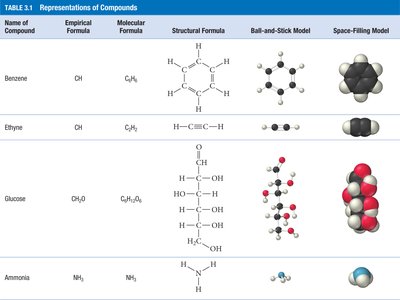
Compounds can be represented in several ways, each providing different information about the molecule.
Empirical Formula: Shows the simplest whole-number ratio of elements.
Molecular Formula: Shows the actual number of atoms of each element in a molecule.
Structural Formula: Shows how atoms are connected and the bonds between them.
Molecular Models: Ball-and-stick and space-filling models visually represent the 3D structure.
Name of Compound | Empirical Formula | Molecular Formula | Structural Formula | Ball-and-Stick Model | Space-Filling Model |
|---|---|---|---|---|---|
Benzene | CH | C6H6 | Ring structure | Ball-and-stick | Space-filling |
Ethyne | CH | C2H2 | Linear structure | Ball-and-stick | Space-filling |
Glucose | CH2O | C6H12O6 | Ring structure | Ball-and-stick | Space-filling |
Ammonia | NH3 | NH3 | Trigonal pyramidal | Ball-and-stick | Space-filling |
Classification of Matter
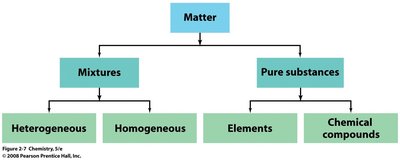
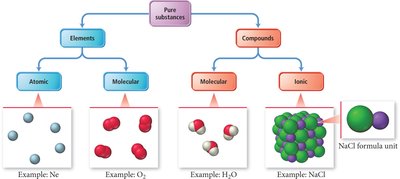
Matter is classified as mixtures or pure substances. Mixtures can be heterogeneous or homogeneous, while pure substances are either elements or compounds.
Mixtures: Variable composition; can be separated physically.
Pure Substances: Fixed composition; cannot be separated physically.
Elements: Consist of only one type of atom.
Compounds: Consist of two or more elements chemically combined.
Molecular and Ionic Compounds
Pure substances are further classified as elements (atomic or molecular) and compounds (molecular or ionic).
Atomic Elements: Exist as single atoms (e.g., Ne).
Molecular Elements: Exist as molecules (e.g., O2).
Molecular Compounds: Composed of molecules (e.g., H2O).
Ionic Compounds: Composed of ions (e.g., NaCl).
Formula Mass and the Mole Concept for Compounds
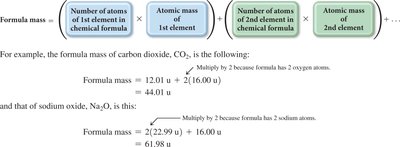
The formula mass of a compound is the sum of the atomic masses of all atoms in its chemical formula. The mole concept allows chemists to count molecules by weighing.
Formula Mass:
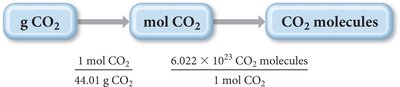
Molar Mass: Mass in grams of one mole of a substance; numerically equivalent to formula mass in amu.
Counting Molecules: Use molar mass and Avogadro's number to convert grams to molecules.
Composition of Compounds
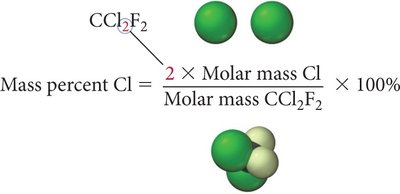
The mass percent composition of a compound expresses the percentage by mass of each element in the compound.
Mass Percent Formula:
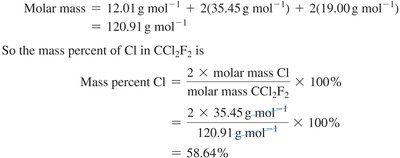
Example: Calculate the mass percent of Cl in CCl2F2 using the formula:
Determining a Chemical Formula from Experimental Data
Empirical formulas are determined from experimental data by calculating the simplest mole ratio of elements in a compound.
Empirical Formula: Simplest whole-number ratio of elements.
Molecular Formula: Empirical formula multiplied by an integer n.
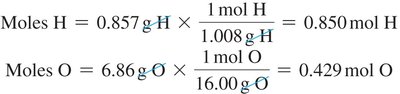
Calculation Steps: Convert mass to moles, find the simplest ratio, and multiply to get the molecular formula if molar mass is known.
Combustion Analysis
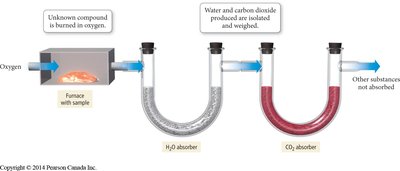
Combustion analysis is a laboratory technique used to determine the empirical formula of a compound, especially organic compounds containing carbon, hydrogen, and oxygen.
Process: Compound is burned in oxygen; products (CO2 and H2O) are collected and weighed.
Application: Used to determine the composition of unknown compounds.
Additional info: These notes cover the essential concepts of molecules, compounds, chemical bonding, formula representation, classification of matter, and methods for determining chemical formulas, all of which are foundational topics in general chemistry.
