 Back
BackMoles, Molar Mass, Percent Composition, Empirical & Molecular Formulas, Balancing Equations, Limiting Reagents, Density, and Percent Yield
Study Guide - Smart Notes
 Tailored notes based on your materials, expanded with key definitions, examples, and context.
4.1 Moles and Molar Mass
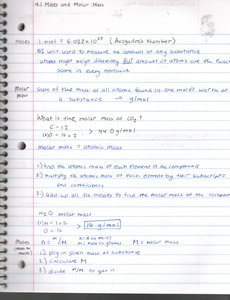
Mole
The mole is a fundamental unit in chemistry used to measure the amount of substance. One mole contains Avogadro's number of particles, which is .
Avogadro's Number: particles/mole
Used to relate microscopic quantities to macroscopic amounts.
Allows chemists to count atoms, molecules, or ions in a sample.
Molar Mass
Molar mass is the sum of the masses of all atoms in one mole of a substance, expressed in grams per mole (g/mol).
Calculated by adding the atomic masses of each element in a compound.
Example: Molar mass of CO2 = 12 (C) + 2 × 16 (O) = 44 g/mol
Calculating Moles
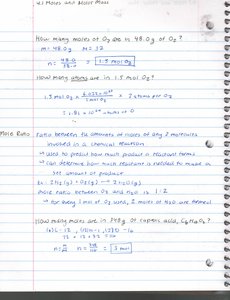
To find the number of moles in a given mass:
Example: 48 g O2 with molar mass 32 g/mol: moles
Mole Ratios
Mole ratios are used to relate the amounts of reactants and products in a chemical reaction.
Derived from balanced chemical equations.
Example: In 2H2 + O2 → 2H2O, the ratio is 2:1:2.
4.2 Percent Composition
Percent Composition
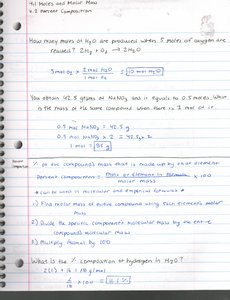
Percent composition is the percentage by mass of each element in a compound.
Calculated as:
Example: %H in H2O =
Applications
Used to determine the composition of compounds.
Helps in identifying unknown substances.
4.3 Empirical and Molecular Formulas
Empirical Formula
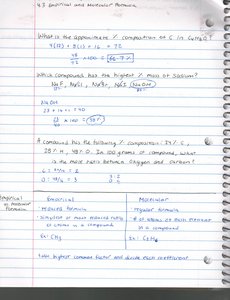
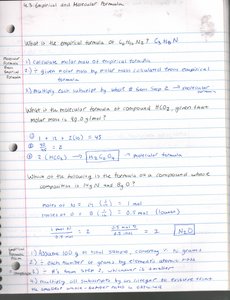
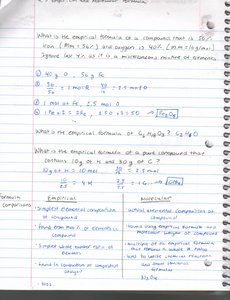
The empirical formula represents the simplest whole-number ratio of elements in a compound.
Determined from percent composition or mass data.
Example: C6H12O6 has empirical formula CH2O
Molecular Formula
The molecular formula shows the actual number of atoms of each element in a molecule.
Obtained by multiplying the empirical formula by a whole number.
Example: If empirical formula mass is 30 g/mol and molecular mass is 60 g/mol, molecular formula is twice the empirical formula.
Comparison Table
Empirical Formula | Molecular Formula |
|---|---|
Lowest whole-number ratio | Actual number of atoms |
Determined from percent composition | Determined from molar mass |
Example: CH2O | Example: C6H12O6 |
4.4 Balancing Equations
Balancing Chemical Equations
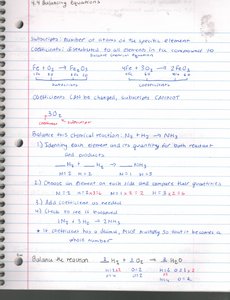
Balancing equations ensures the law of conservation of mass is obeyed, meaning the number of atoms of each element is the same on both sides of the equation.
Steps:
Write the unbalanced equation.
Count atoms of each element on both sides.
Add coefficients to balance atoms.
Check your work.
Example: N2 + 3H2 → 2NH3
4.5 Calculating Masses from Balanced Equations
Stoichiometry
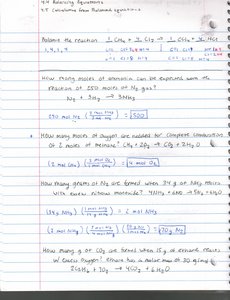
Stoichiometry is the calculation of reactants and products in chemical reactions using balanced equations.
Uses mole ratios to convert between substances.
Example: 2H2 + O2 → 2H2O; 5 moles O2 produces 10 moles H2O.
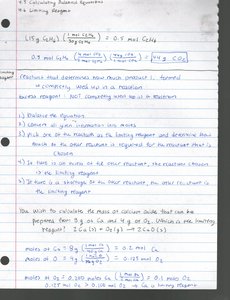
4.6 Limiting Reagent
Limiting Reagent
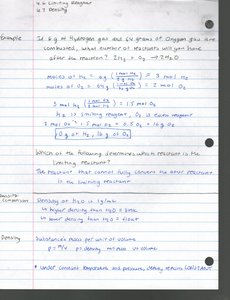
The limiting reagent is the reactant that is completely consumed first, thus limiting the amount of product formed.
Identify by comparing mole ratios from the balanced equation.
Example: If 6 g H2 and 48 g O2 are combined, calculate moles and determine which is limiting.
4.7 Density
Density
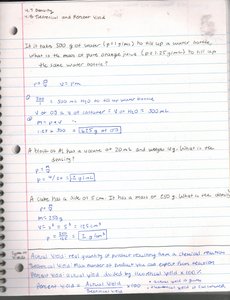
Density is the mass per unit volume of a substance, commonly expressed in g/mL or g/cm3.
Formula:
Used to identify substances and solve for mass or volume.
Example: If 500 g of water fills a 500 mL bottle, density is g/mL.
4.8 Theoretical and Percent Yield
Theoretical Yield
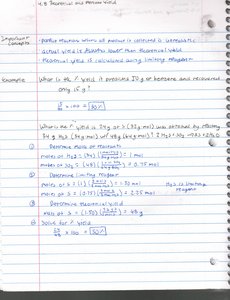
The theoretical yield is the maximum amount of product that can be formed from given reactants, calculated using stoichiometry.
Percent Yield
Percent yield measures the efficiency of a reaction:
Formula:
Actual yield is often less than theoretical due to losses.
Significant Figures
Significant figures reflect the precision of measured quantities and should be considered in all calculations.
Use the least number of significant figures from the data in your final answer.
Summary Table: Key Formulas
Concept | Formula |
|---|---|
Moles | |
Percent Composition | |
Density | |
Percent Yield |
Additional info: These notes cover essential topics in general chemistry, including mole calculations, molar mass, percent composition, empirical and molecular formulas, balancing equations, stoichiometry, limiting reagents, density, and percent yield. Each topic is foundational for understanding chemical reactions and laboratory calculations.
