 Back
BackNetwork Covalent and Ionic Solids: Crystal Structures and Energy Changes
Study Guide - Smart Notes
 Tailored notes based on your materials, expanded with key definitions, examples, and context.
Network Covalent Solids and Ionic Solids
Network Covalent Solids
Network covalent solids are materials in which atoms are bonded together in a continuous network by covalent bonds. These solids exhibit unique properties due to the strength and directionality of covalent bonds.
Key Point 1: Atoms are connected in a vast, repeating network, resulting in very high melting points and hardness.
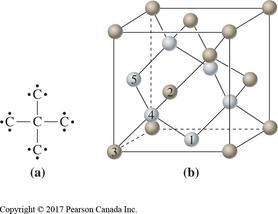
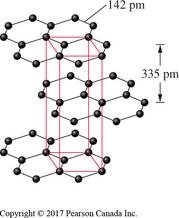
Key Point 2: Examples include diamond and graphite, both forms of carbon but with different structures and properties.
Example: Diamond is a three-dimensional network where each carbon atom is tetrahedrally bonded to four others, while graphite consists of layers of hexagonally arranged carbon atoms with weak forces between layers.
Characteristics of Crystalline Solids
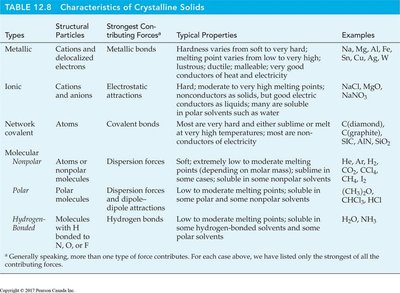
Crystalline solids are classified based on their structural particles, bonding forces, and typical properties. Understanding these classifications helps predict their behavior and applications.
Key Point 1: Types include metallic, ionic, network covalent, molecular (nonpolar, polar, hydrogen-bonded).
Key Point 2: The strongest contributing force determines the physical properties, such as hardness, melting point, and conductivity.
Example: Ionic solids like NaCl are hard and have high melting points due to strong electrostatic attractions, while molecular solids are softer and have lower melting points.
Type | Structural Particles | Strongest Force | Properties | Examples |
|---|---|---|---|---|
Metallic | Cations & delocalized electrons | Metallic bonds | Hardness varies, high melting points, good conductors | Na, Mg, Al, Fe |
Ionic | Cations & anions | Electrostatic attractions | Hard, high melting points, conductors in liquid | NaCl, MgO |
Network covalent | Atoms | Covalent bonds | Very hard, high melting points, non-conductors | Diamond, SiC |
Molecular (Nonpolar) | Atoms/molecules | Dispersion forces | Low melting points, soluble in nonpolar solvents | He, Ar |
Molecular (Polar) | Polar molecules | Dipole-dipole | Moderate melting points, soluble in polar solvents | CHCl3, HCl |
Hydrogen-bonded | Molecules with H bonded to N, O, F | Hydrogen bonds | Higher melting points, soluble in polar solvents | H2O, NH3 |
Ionic Solids and Lattice Energy
Ionic Solids
Ionic solids are composed of cations and anions held together by strong electrostatic forces. Their structure and properties are determined by the arrangement and size of ions.
Key Point 1: The lattice energy is the energy released when gaseous ions combine to form an ionic solid.
Key Point 2: Lattice energy is always exothermic and is a measure of the strength of the ionic bonds.
Example: Formation of NaCl from Na+(g) and Cl-(g) releases lattice energy.
Predicting Physical Properties of Ionic Compounds
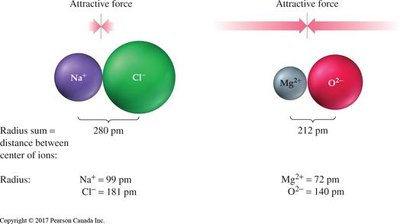
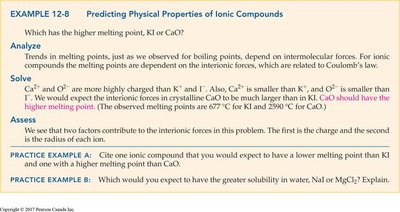
The melting point of ionic compounds depends on the strength of the electrostatic forces between ions, which is influenced by the charge and size of the ions.
Key Point 1: Higher charges and smaller ionic radii result in stronger attractions and higher melting points.
Key Point 2: CaO has a higher melting point than KI due to higher charges and smaller ions.
Example: The melting points of KI and CaO are 677°C and 2590°C, respectively.
Crystal Structures
Crystal Lattices and Unit Cells
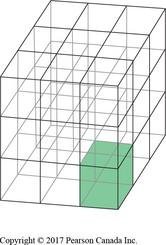
Crystalline solids are arranged in a repeating pattern called a crystal lattice. The smallest repeating unit is the unit cell, which defines the structure of the entire crystal.
Key Point 1: Unit cells can be cubic, tetragonal, orthorhombic, etc., but cubic is most common in ionic solids.
Key Point 2: The arrangement of atoms in the unit cell determines the properties of the solid.
Example: The cubic unit cell is the basis for many crystal structures, including NaCl and CsCl.
Types of Cubic Unit Cells
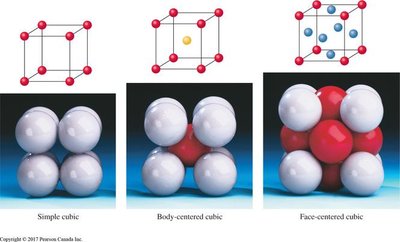
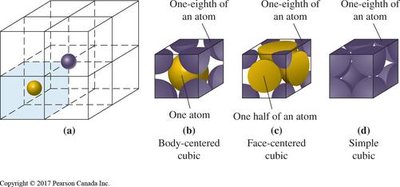
There are three main types of cubic unit cells: simple cubic, body-centered cubic (bcc), and face-centered cubic (fcc). Each has a distinct arrangement and number of atoms per unit cell.
Key Point 1: Simple cubic has atoms at each corner; bcc has an additional atom at the center; fcc has atoms at each face.
Key Point 2: The packing efficiency and coordination number vary among these types.
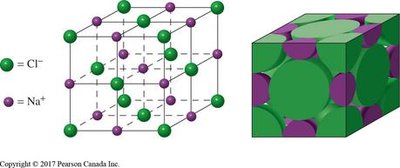
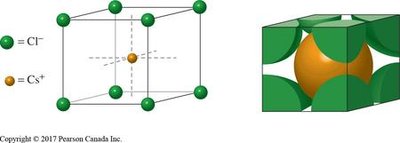
Example: NaCl adopts the fcc structure, while CsCl adopts the simple cubic structure.
Closest Packed Structures
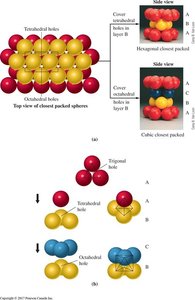
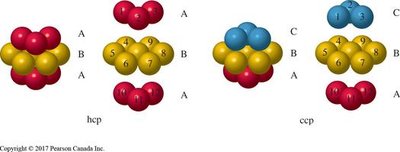
Closest packing refers to the arrangement of spheres (atoms or ions) to maximize density. The two main types are hexagonal closest packed (hcp) and cubic closest packed (ccp).
Key Point 1: hcp and ccp structures differ in the stacking sequence of layers.
Key Point 2: These arrangements are important for metals and some ionic solids.
Example: Many metals crystallize in hcp or ccp structures.

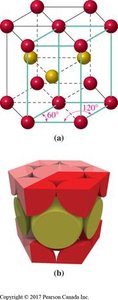
Coordination Number and Number of Atoms per Unit Cell
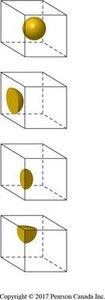
The coordination number is the number of nearest neighbors to an atom in a crystal. The number of atoms per unit cell depends on the type of cubic cell.
Key Point 1: Simple cubic: 1 atom per unit cell; bcc: 2 atoms; fcc: 4 atoms.
Key Point 2: Coordination number is 6 for simple cubic, 8 for bcc, and 12 for fcc.
Example: In fcc, each atom is surrounded by 12 others.
X-Ray Diffraction and Crystal Structure Determination
X-Ray Diffraction
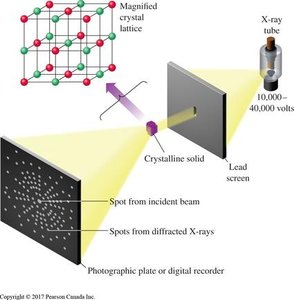
X-ray diffraction is a powerful technique used to determine the arrangement of atoms in a crystal. The diffraction pattern provides information about the distances between planes of atoms.
Key Point 1: Bragg's equation relates the wavelength, angle, and spacing between planes:
Key Point 2: X-ray diffraction is essential for identifying crystal structures and unit cell dimensions.
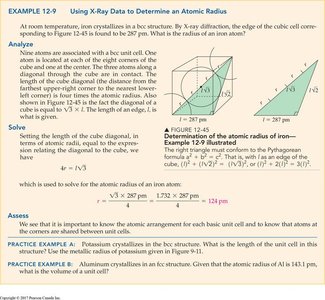
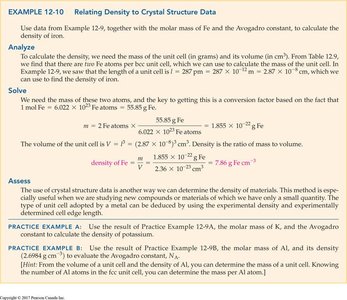
Example: The atomic radius and density of iron can be determined using X-ray data.
Ionic Crystal Structures
Types of Ionic Crystal Structures
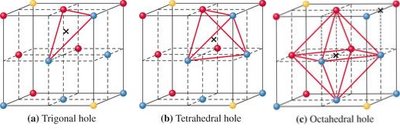
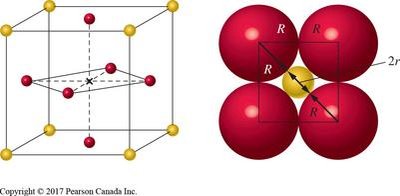
The arrangement of ions in ionic crystals depends on the relative sizes of cations and anions. The ratio determines the type of hole the cation occupies.
Key Point 1: Tetrahedral holes are occupied when ; octahedral holes for ; cubic holes for .
Key Point 2: Anions typically form a face-centered cubic lattice, with cations filling the holes.
Example: NaCl structure has cations in octahedral holes; CsCl structure has cations in cubic holes.
Working Example: Ionic Crystal Structures
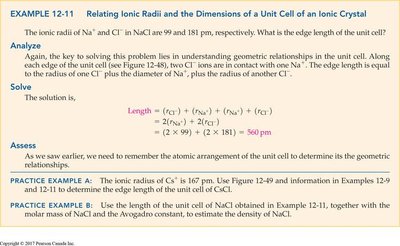
Calculating the edge length of a unit cell and relating ionic radii to crystal dimensions is important for understanding ionic solids.
Key Point 1: The edge length of NaCl unit cell is determined by the sum of ionic radii.
Key Point 2: The geometric relationships in the unit cell are essential for calculating density and other properties.
Example: The edge length of NaCl unit cell is pm.
Energy Changes in the Formation of Ionic Crystals
Lattice Energy and Enthalpy of Formation
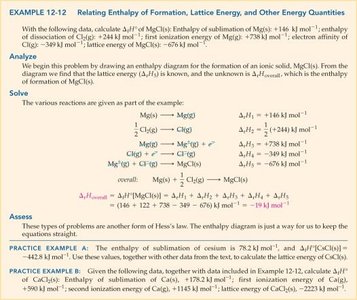
The formation of ionic crystals involves several energy changes, including lattice energy, enthalpy of formation, and other thermodynamic quantities. These can be related using Hess's law.
Key Point 1: Lattice energy is calculated from the enthalpy changes of various steps in the formation of the ionic solid.
Key Point 2: Hess's law allows the determination of unknown energy quantities by combining known values.
Example: The enthalpy diagram for MgCl2 includes sublimation, ionization, dissociation, and lattice energy.
Summary
This guide covers the structure and properties of network covalent and ionic solids, crystal lattices, unit cells, closest packing, X-ray diffraction, ionic crystal structures, and energy changes in the formation of ionic crystals. Understanding these concepts is essential for predicting the behavior and properties of solid materials in general chemistry.
