Back
BackNuclear Chemistry: Decay Pathways, Kinetics, Dating, Fission, Fusion, and Applications
Study Guide - Smart Notes
 Tailored notes based on your materials, expanded with key definitions, examples, and context.
Nuclear Chemistry
Types of Radioactive Decay
Nuclear decay is the process by which unstable atomic nuclei lose energy by emitting radiation. The main types of decay are alpha, beta, gamma, positron emission, and electron capture. Each pathway alters the nucleus and affects stability.
Alpha Decay: Emission of an alpha particle (\( ^4_2\text{He} \)), decreases atomic number by 2 and mass number by 4. Requires heavy shielding (e.g., paper or skin).
Beta Decay: Emission of a beta particle (electron, \( ^0_{-1}\text{e} \)), increases atomic number by 1. Requires moderate shielding (e.g., plastic or glass).
Gamma Decay: Emission of gamma rays (high-energy photons), does not change atomic or mass number. Requires heavy shielding (e.g., lead).
Positron Emission: Emission of a positron (\( ^0_{+1}\text{e} \)), decreases atomic number by 1.
Electron Capture: Nucleus captures an inner electron, decreases atomic number by 1.
Stability: Decay pathways generally increase stability by moving the nucleus toward the band of stability.
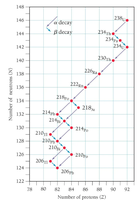
Transmutation and Decay Pathways
Transmutation is the conversion of one element into another via nuclear reactions. For example, to transmute \( ^{203}\text{Pb} \) into \( ^{199}\text{Au} \), a series of decay steps (such as alpha and beta decays) must be proposed, ignoring stability arguments.
Detection and Effects of Radiation
Radiation can be detected using devices such as the Geiger counter, which measures ionizing particles. Acute radiation sickness results from high exposure and includes symptoms such as nausea, vomiting, and fatigue.
Banana Equivalent Dose: 1 banana equivalent dose is \( 10^{-7} \) Sv. Since 1 Sv = 100 rem, the banana equivalent dose is 0.01 μrem.
Radiation Dose by Source
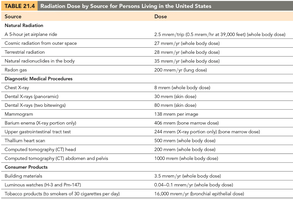
Radiation exposure comes from natural and artificial sources. The table below summarizes typical doses for various activities and procedures.
Source | Dose |
|---|---|
A 5-hour jet airplane ride | 2.5 mrem |
Cosmic radiation from outer space | 27 mrem/year |
Terrestrial radiation | 28 mrem/year |
Radon gas | 200 mrem/year |
Chest X-ray | 8 mrem |
Dental X-ray | 10 mrem |
CT head | 200 mrem |
Banana | 3.5 mrem |
Tobacco products | 16,000 mrem |
... (see full table for more) | ... |
Kinetics of Radioactive Decay
First Order Reactions
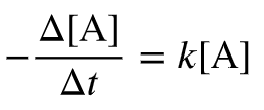
Radioactive decay follows first-order kinetics, where the rate is proportional to the concentration of the reactant.
Rate Law:
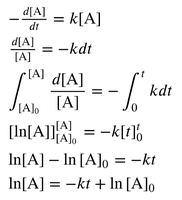
Integrated Rate Law:
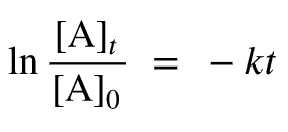
Exponential Decay: The concentration decreases exponentially over time.
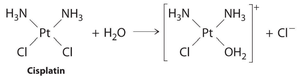
Examples: Radioactive decay, hydrolysis of aspirin, cisplatin in water.
Reaction Half-Life
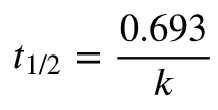
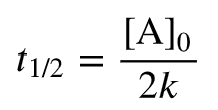
The half-life is the time required for half of the reactant to decay. For first-order reactions, it is independent of initial concentration.
First Order:
Second Order:
Zero Order: Linear with initial concentration.
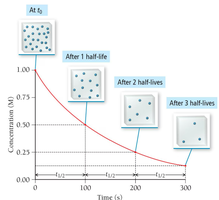
Half-Life Calculations
Half-life calculations are used to determine the remaining amount of a radioactive substance after a given time or to find the half-life from decay data.
Example: If you have 16 g of \( ^{125}\text{I} \) (half-life 59.4 days), after 178.2 days, 2 g remain (3 half-lives).
Example: If 80 g of \( ^{225}\text{Ac} \) decays to 2.5 g in 50 days, the half-life can be calculated using the integrated rate law.
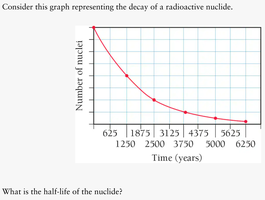
Radiometric Dating
Radiocarbon Dating
Radiocarbon dating uses the decay of \( ^{14}\text{C} \) to estimate the age of formerly living materials. \( ^{14}\text{C} \) is produced in the atmosphere and incorporated into living organisms. After death, its concentration decreases with a known half-life.
Useful Range: Up to ~50,000 years.
Method: Measure \( ^{14}\text{C} \) concentration and compare to standards.
Uranium-Lead Dating
Uranium decays to lead over billions of years, allowing dating of rocks and providing evidence for the age of the Earth.
Useful Range: Up to billions of years.
Method: Measure U/Pb ratio in rocks.
Nuclear Fission and Fusion
Fission
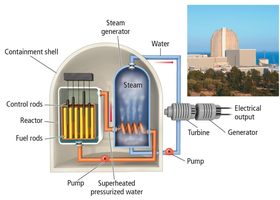
Fission is the splitting of a heavy nucleus into two lighter nuclei, releasing energy due to mass defect (E=mc2). It is used in nuclear power and weapons.
Example:
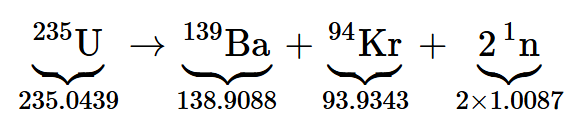
Energy Density: Fission is much more energy dense than combustion.
Issues: Radioactive waste management.
Fusion
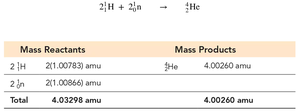
Fusion is the joining of two light nuclei to form a heavier nucleus, also releasing energy due to mass defect. Fusion powers stars and is a potential energy source.
Example:
Energy Density: Even higher than fission.
Challenges: Requires extremely high temperatures and pressures.
Particle Accelerators
Linear Accelerator
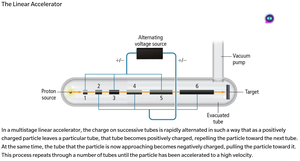
Linear accelerators use alternating voltage to accelerate charged particles in a straight line.
Cyclotron
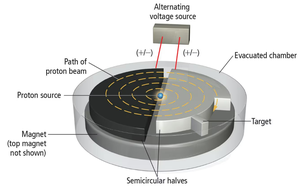
Cyclotrons accelerate particles in a circular path using a magnetic field and alternating voltage.
Synchrotron
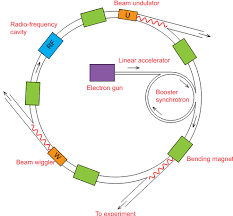
Synchrotrons use a combination of linear and circular acceleration, allowing for high-energy particle collisions.
Binding Energy and Nuclear Stability
Binding Energy Curve
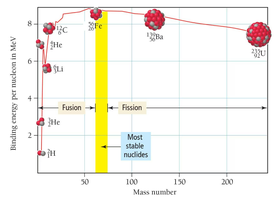
The binding energy per nucleon indicates nuclear stability. Fusion releases energy for light nuclei, fission for heavy nuclei. Iron (Fe) is the most stable element.
Summary and Applications
Nuclear chemistry encompasses decay pathways, kinetics, dating methods, fission, fusion, and their applications in energy and medicine. Understanding these concepts is essential for interpreting nuclear reactions and their impact on society.