 Back
BackNuclear Chemistry: Structure, Reactions, and Applications
Study Guide - Smart Notes
 Tailored notes based on your materials, expanded with key definitions, examples, and context.
Nuclear Chemistry
The Nucleus
The nucleus is the dense center of an atom, composed of protons (positively charged) and neutrons (neutral). These particles are collectively called nucleons. The nucleus is held together by the strong nuclear force, which overcomes the electrostatic repulsion between protons at very short distances (about m).
Protons: Determine the identity of the element (atomic number, Z).
Neutrons: Contribute to the mass number (A), but not to the element's identity.
Electrons: Light particles outside the nucleus; do not contribute significantly to atomic mass.
Element Symbols and Notation
Element symbols are written as , where:
A = mass number (protons + neutrons)
Z = atomic number (number of protons)
X = chemical symbol of the element
For example, represents iron with 26 protons and 30 neutrons.
Band of Stability and Sea of Instability
Stable nuclei have a specific ratio of neutrons to protons. As the number of protons increases, a higher neutron-to-proton ratio is needed for stability. Nuclei outside this band are unstable and undergo radioactive decay.
Types of Nuclear Reactions
Alpha Decay
In alpha decay, an unstable nucleus emits an alpha particle (), reducing its atomic number by 2 and mass number by 4.
Example:
Beta Decay
In beta decay, a neutron is converted into a proton and an electron (beta particle, ) is emitted. The atomic number increases by 1, but the mass number remains unchanged.
Example:
Positron Emission
In positron emission, a proton is converted into a neutron and a positron () is emitted. The atomic number decreases by 1, mass number unchanged.
Example:
Electron Capture
In electron capture, the nucleus captures an inner electron, which combines with a proton to form a neutron. The atomic number decreases by 1, mass number unchanged.
Example:
Gamma Ray Emission
In gamma emission, an excited nucleus releases energy as a gamma photon (), with no change in atomic or mass number.
Example:
Nuclear Decay Kinetics
First-Order Kinetics
Nuclear decay follows first-order kinetics, where the rate depends on the amount of radioactive substance present.
Integrated rate law:
Half-life: (independent of initial amount)
Radioactivity and Units
Radioactivity is the number of decay events per unit time. The SI unit is the Becquerel (Bq): .
Radiocarbon Dating
Radiocarbon dating uses the decay of to estimate the age of formerly living materials. The decay follows first-order kinetics, and the half-life of $^{14}C$ is 5730 years.
Compare current radioactivity to initial levels to determine age.
Nuclear Binding Energy
Mass Defect and Binding Energy
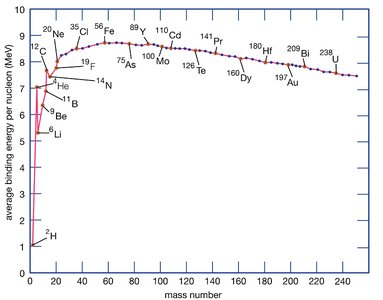
The mass defect is the difference between the expected mass of a nucleus (sum of individual nucleons) and its actual mass. This 'missing' mass is converted to energy when the nucleus forms, called the binding energy.
Equation:
Binding energy per nucleon =
Nuclear Fission
Fission Process
Nuclear fission is the splitting of a heavy nucleus (e.g., ) into smaller nuclei, releasing energy and neutrons. This can lead to a chain reaction if enough fissile material is present (critical mass).
Example:
Critical Mass
Critical mass is the minimum amount of fissile material needed to sustain a chain reaction. Subcritical and supercritical masses result in no reaction or uncontrolled reaction, respectively.
Nuclear Power Plants
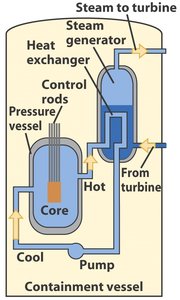
Nuclear reactors use controlled fission to generate heat, which produces steam to drive turbines and generate electricity. Control rods absorb excess neutrons to regulate the reaction.
Nuclear Fusion
Fusion Process
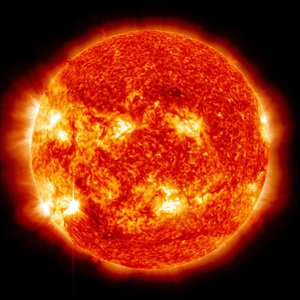
Nuclear fusion is the combination of light nuclei (e.g., hydrogen isotopes) to form a heavier nucleus, releasing energy. Fusion powers stars and has the potential for clean energy on Earth.
Example:
Energetics of Fusion and Fission
Both fusion (for light elements) and fission (for heavy elements) are exothermic due to the binding energy per nucleon curve. The most stable nucleus is .
Nucleosynthesis in Stars
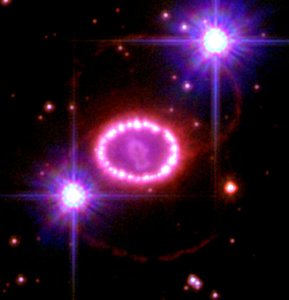
Stars fuse hydrogen into helium in their cores. In hotter stars and supernovae, elements up to and beyond iron are synthesized.
Nucleosynthesis in the Laboratory
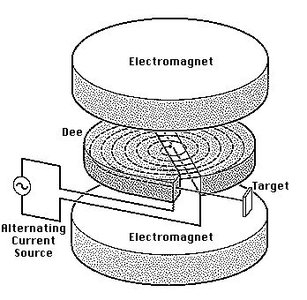
Particle Accelerators
Particle accelerators use electromagnetic fields to accelerate ions to high speeds and collide them, creating new elements not found in nature.
Summary Table: Nuclear Decay Modes
Decay Mode | Symbol | Effect on Nucleus |
|---|---|---|
Alpha decay | A - 4, Z - 2 | |
Beta decay | Z + 1 | |
Positron emission | Z - 1 | |
Electron capture | (captured) | Z - 1 |
Gamma emission | No change |
Key Equations
First-order decay:
Half-life:
Binding energy:
Additional info: The binding energy per nucleon curve explains why fusion is exothermic for light elements and fission is exothermic for heavy elements. The most stable nuclei are those with the highest binding energy per nucleon (around iron-56).
