 Back
BackOrganic Chemistry: Structure, Properties, and Nomenclature of Hydrocarbons and Functional Groups
Study Guide - Smart Notes
 Tailored notes based on your materials, expanded with key definitions, examples, and context.
Organic Chemistry Overview
Definition and Scope
Organic chemistry is the branch of chemistry that studies compounds containing carbon, typically bonded to hydrogen, nitrogen, oxygen, and sulfur. The unique bonding capabilities of carbon allow for millions of different organic compounds, which are central to biological, industrial, and environmental processes.
Organic compounds exclude CO, CO2, carbonates, and carbides.
Most common odors and fragrances are caused by organic molecules.
Unique Properties of Carbon
Bonding and Structure
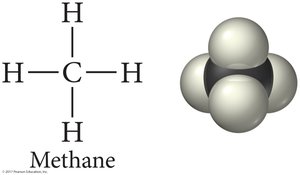
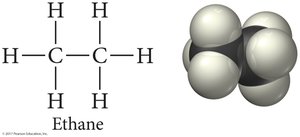
Carbon atoms can form strong, stable bonds with up to four other atoms, including other carbon atoms. This allows for a vast array of molecular structures, including chains, rings, and multiple bonds.
Catenation: Carbon atoms can link together to form long chains.
Bond Types: Carbon can form single, double, or triple bonds.
Ring Structures: Carbon atoms can form cyclic compounds.
Hydrocarbons
Classification
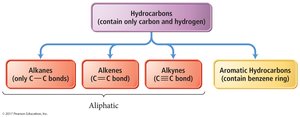
Hydrocarbons are compounds containing only carbon and hydrogen. They are classified as aliphatic (alkanes, alkenes, alkynes) or aromatic (contain benzene rings).
Aliphatic hydrocarbons: Can be saturated (alkanes) or unsaturated (alkenes, alkynes).
Aromatic hydrocarbons: Contain benzene rings.
Types of Hydrocarbons
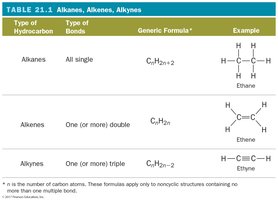
Type of Hydrocarbon | Type of Bonds | Generic Formula | Example |
|---|---|---|---|
Alkanes | All single | CnH2n+2 | Ethane |
Alkenes | One or more double | CnH2n | Ethene |
Alkynes | One or more triple | CnH2n-2 | Ethyne |
Structural Formulas and Isomerism
Structural Formulas
Structural formulas show how atoms are bonded in a molecule. Condensed structural formulas group hydrogens with their attached carbons, while line formulas show only carbon-carbon bonds as lines.
Isomerism
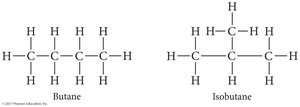
Isomers are compounds with the same molecular formula but different structures.
Structural isomers: Differ in the connectivity of atoms.
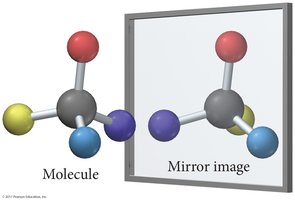
Stereoisomers: Same connectivity, different spatial arrangement.
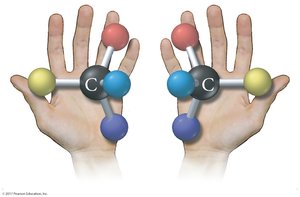
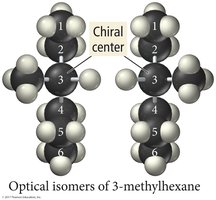
Optical isomers (enantiomers): Nonsuperimposable mirror images, often with chiral centers.
Physical Properties of Hydrocarbons
Boiling Points and Density
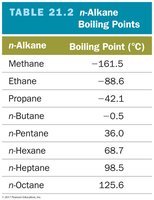
Boiling and melting points of hydrocarbons increase with molar mass. Hydrocarbons are nonpolar and less dense than water, with dispersion forces as the main intermolecular attraction.
n-Alkane | Boiling Point (°C) |
|---|---|
Methane | -161.5 |
Ethane | -88.6 |
Propane | -42.1 |
n-Butane | -0.5 |
n-Pentane | 36.0 |
n-Hexane | 68.7 |
n-Heptane | 98.5 |
n-Octane | 125.6 |
Naming Hydrocarbons: IUPAC System
Alkanes
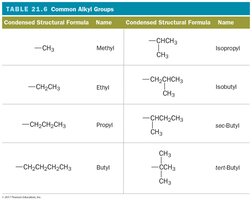
The IUPAC system names alkanes based on the longest continuous carbon chain. Branches are named as alkyl groups and numbered to give the lowest possible numbers to substituents.
Prefixes for base names: meth-, eth-, prop-, but-, pent-, hex-, hept-, oct-, non-, dec-
Substituent prefixes: di-, tri-, tetra- (for multiple identical groups)
Number of Carbon Atoms | Prefix |
|---|---|
1 | meth- |
2 | eth- |
3 | prop- |
4 | but- |
5 | pent- |
6 | hex- |
7 | hept- |
8 | oct- |
9 | non- |
10 | dec- |
Examples of Alkane Nomenclature
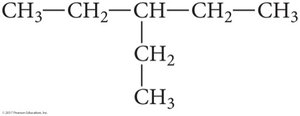
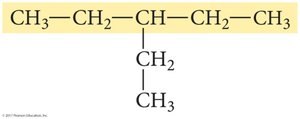
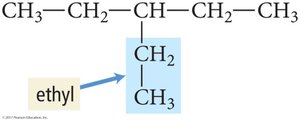
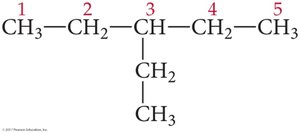
Example: 3-ethylpentane
Longest chain: pentane (5 carbons)
Substituent: ethyl group at carbon 3
Name: 3-ethylpentane
Alkenes and Alkynes
Structure and Nomenclature
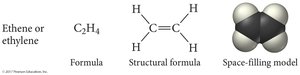
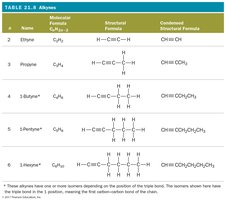
Alkenes contain at least one C=C double bond; alkynes contain at least one C≡C triple bond. The base chain must include the multiple bond, and numbering starts from the end closest to the bond.
Alkene formula: CnH2n
Alkyne formula: CnH2n-2
Base name ends in -ene (alkenes) or -yne (alkynes)
Isomerism in Alkenes: Cis–Trans Isomerism
Geometric Isomers
Rotation around a double bond is restricted, leading to cis–trans isomerism. Cis isomers have substituents on the same side; trans isomers have them on opposite sides.
Hydrocarbon Reactions
Combustion
Combustion of hydrocarbons is highly exothermic and produces CO2 and H2O.
Example equation:
Halogen Substitution (Alkanes)
Alkanes can undergo substitution reactions with halogens, replacing hydrogen atoms with halogen atoms.
Initiated by heat or UV light
Example:
Addition Reactions (Alkenes and Alkynes)
Alkenes and alkynes undergo addition reactions, where molecules add across the multiple bond.
Hydrogenation: Addition of H2 to convert unsaturated to saturated hydrocarbons.
Halogenation: Addition of X2 (halogen).
Hydrohalogenation: Addition of HX, following Markovnikov's rule.
Aromatic Hydrocarbons
Benzene and Its Derivatives
Aromatic hydrocarbons contain benzene rings. Benzene is a resonance hybrid and does not behave like alkenes in addition reactions.
Substitution reactions replace hydrogen atoms with other groups.
Benzene as a substituent is called a phenyl group.
Disubstituted derivatives use ortho-, meta-, para- prefixes for relative positions.
Functional Groups in Organic Chemistry
Alcohols
Alcohols contain the R—OH group. Naming involves numbering the main chain from the end closest to —OH and using the -ol suffix.
Common examples: ethanol, methanol, isopropyl alcohol
Alcohol Reactions
Substitution: Alcohol reacts with acid to form halogenated hydrocarbon and water.
Dehydration: Removal of water to form alkenes.
Oxidation: Alcohols oxidize to aldehydes, then to carboxylic acids.
Reaction with active metals: Forms alkoxide and hydrogen gas.
Aldehydes and Ketones
Contain the carbonyl group (C=O). Aldehydes have at least one hydrogen attached to the carbonyl carbon; ketones have two R groups.
Naming: Aldehydes use -al suffix; ketones use -one suffix.
Reactions: Addition across C=O, reduction to alcohols.
Carboxylic Acids and Esters
Carboxylic acids contain the RCOOH group and are named with the -oic acid suffix. Esters are formed by condensation reactions between carboxylic acids and alcohols, named with the -oate suffix.
Carboxylic acids: Sour taste, weak acids (e.g., acetic acid, citric acid).
Esters: Sweet odor, used in fragrances and flavorings.
Ethers and Amines
Ethers have the general formula ROR and are named by listing the alkyl groups followed by 'ether.' Amines contain nitrogen and are named by listing alkyl groups attached to N, followed by -amine.
Ethers: Common solvent, low boiling point.
Amines: Organic bases, often have strong odors.
Amine Reactions
React with acids to form ammonium salts.
React with carboxylic acids to form amides via condensation.
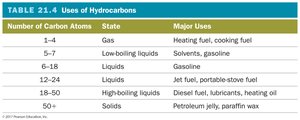
Summary Table: Major Hydrocarbon Uses
Number of Carbon Atoms | State | Major Uses |
|---|---|---|
1–4 | Gas | Heating fuel, cooking fuel |
5–7 | Low-boiling liquids | Solvents, gasoline |
6–18 | Liquids | Gasoline |
12–24 | Liquids | Jet fuel, portable-stove fuel |
18–50 | High-boiling liquids | Diesel fuel, lubricants, heating oil |
50+ | Solids | Petroleum jelly, paraffin wax |
Additional info: This guide covers the essential concepts of organic chemistry relevant to general chemistry, including structure, nomenclature, isomerism, physical properties, and reactions of hydrocarbons and major functional groups.
