 Back
Organometallic Chemistry: Structures, Bonding, and Reactivity
Study Guide - Smart Notes
 Tailored notes based on your materials, expanded with key definitions, examples, and context.
Organometallic Chemistry
Introduction to Organometallic Chemistry
Organometallic chemistry is the study of compounds containing metal-carbon bonds. This field bridges inorganic and organic chemistry, focusing on the unique reactivity and bonding of metals with organic ligands. The chemistry of s- and p-block metals was established early, but the d- and f-block organometallics have seen rapid development since the mid-20th century, leading to new reactions, structures, and applications in synthesis and catalysis.
Definition: Organometallic compounds contain at least one direct metal-carbon bond.
Applications: Used in organic synthesis, industrial catalysis, and material science.
Historical Milestones: Key discoveries include Zeise’s salt, Grignard reagents, and ferrocene.
Transition Metal Compounds in Organometallic Chemistry
Some compounds without direct metal-carbon bonds, such as metal hydrides, N2-complexes, and phosphine complexes, are included in organometallic chemistry due to their similar bonding and reactivity.
Metal Hydride Complexes: Important for hydrogenation and catalytic cycles.
N2-Complexes: Model systems for nitrogen fixation.
Phosphine Complexes: Widely used as ligands in catalysis.






A Brief History of Organometallic Chemistry
The field has evolved from early discoveries of naturally occurring compounds to the synthesis of key reagents and catalysts. Notable milestones include:
Cobalamins: Naturally occurring compounds with Co–C bonds (Vitamin B12).
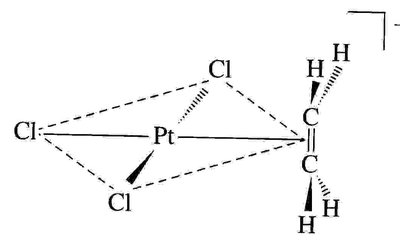
Zeise’s Salt: K[Pt(C2H4)Cl3]·H2O, first synthesized in 1827.
Nickel Carbonyl: Ni(CO)4, synthesized in 1890.
Grignard Reagents: XMgR, discovered around 1900, essential for organic synthesis.
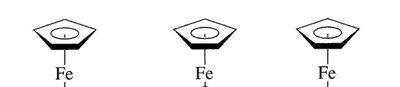
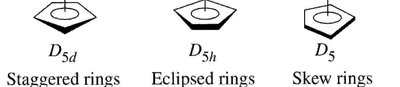
Ferrocene: Synthesized in 1951, marking the start of modern organometallic chemistry.






Common Organometallic Ligands
Ligands in organometallic chemistry include simple anions, π-systems, and bridging groups. Their bonding modes and electron donation properties are central to the structure and reactivity of complexes.
σ-donors: CH3-, Cl-, H2
π-systems: CO (σ donor and π acceptor), alkenes, acetylenes
Bridging ligands: Can connect two metals
Metal-metal bonds: δ bonds from d-d orbital overlap

Electron Counting and Stability Rules
18-16 Electron Rule (Sidgwick Rule)
The stability of organometallic complexes is often predicted by the 18-electron rule, analogous to the octet rule for main group elements. Transition metals prefer to be surrounded by 18 valence electrons, leading to electron-precise structures.
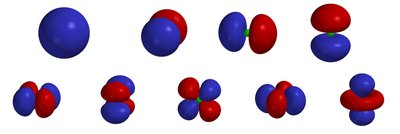
Valence Orbitals: Main group: 8e; Transition metals: 18e
Electron Counting: Sum metal and ligand electrons, adjust for charge
Exceptions: Early transition metals may not reach 18e due to steric constraints; late transition metals often stabilize at 16e
Electron Counting Methods
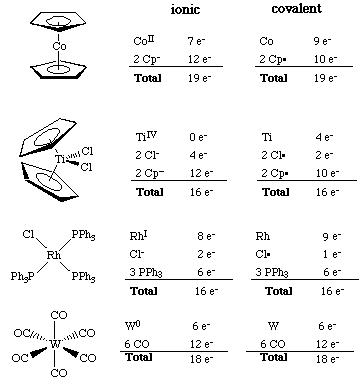
Two main methods are used: covalent and ionic. Both are formal tools to assign electron counts and predict stability, not necessarily reflecting actual electron distribution.
Covalent Method: Count valence electrons, correct for charge, add electrons from covalent and dative bonds, consider hapticity.
Ionic Method: Assign oxidation states, count electrons from ligands as anions.
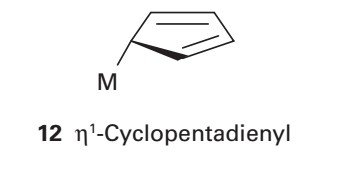
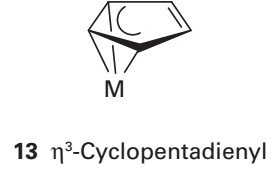
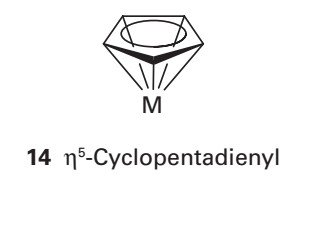
Hapticity (η)
Hapticity describes the number of contiguous atoms in a ligand that are bound to the metal. It is especially important for π-system ligands like cyclopentadienyl.
η1: One atom bound
η3: Three atoms bound
η5: Five atoms bound
Bonding in Carbonyl Complexes
Bonding of CO Ligands
Carbonyl ligands bond to metals via σ donation from the carbon lone pair and π-backbonding from filled metal d-orbitals to the CO π* orbital. This dual interaction stabilizes the complex and affects the CO stretching frequency.
σ Donation: Lone pair on carbon donates to metal
π-Backbonding: Metal d-electrons fill CO π* orbital
Stability: Higher backbonding lowers CO stretching frequency
IR Spectroscopy of Carbonyl Complexes
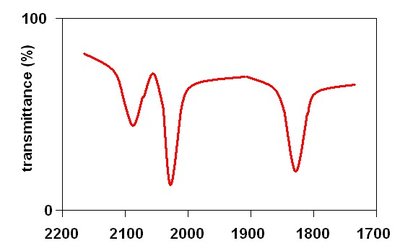
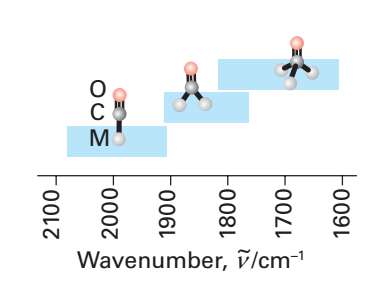
The CO stretching frequency (νCO) is a key diagnostic tool. Terminal carbonyls (triple bond character) have higher frequencies, while bridging carbonyls (double bond character) have lower frequencies.
Terminal CO: 1850–2125 cm-1
Bridging CO: 1700–1860 cm-1
Free CO: 2041 cm-1
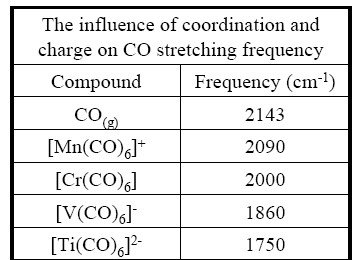
Compound | Frequency (cm-1) |
|---|---|
CO(g) | 2143 |
[Mn(CO)6]+ | 2090 |
[Cr(CO)6] | 2000 |
[V(CO)6]- | 1860 |
[Ti(CO)6]2- | 1750 |
Phosphine Ligands and Steric Effects
Electronic Attributes of Phosphines
Phosphine ligands (PR3) are important in organometallic chemistry. Their σ-donating and π-accepting abilities can be tuned by substituents, affecting backbonding and reactivity.
Ordering: PMe3 < PPh3 < P(OMe)3 < P(OPPh3) < P(NR2)3 < PCl3 < CO ≈ PF3
Greater π-acidity: CO, PF3
Greater σ-donation: PMe3

Cone Angle (Tolman Parameter)
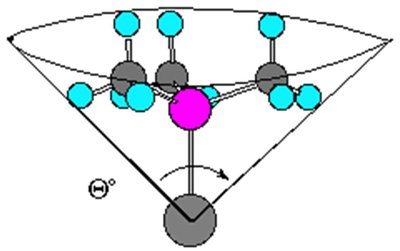
The cone angle quantifies the steric bulk of phosphine ligands, influencing ligand dissociation, association, and catalytic activity. Larger cone angles increase steric hindrance and can promote ligand dissociation.
PH3: 87°
PPh3: 145°
P(t-Bu)3: 182°
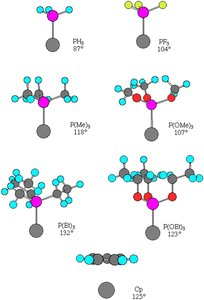
Phosphine Ligand | Cone Angle |
|---|---|
PH3 | 87° |
PF3 | 104° |
P(OMe)3 | 107° |
PMe3 | 118° |
PPh3 | 145° |
P(t-Bu)3 | 182° |
Ligand Types and Bonding Models
Dihydrogen Ligands
Dihydrogen ligands act as neutral two-electron σ donors to the metal center. Back-donation from the metal to the σ* orbital of H2 can occur, affecting the oxidation state and reactivity.
Bonding: 3σ-2e bond
Back-donation: Metal d-electrons to H2 σ* orbital




Alkene and Alkyne Ligands
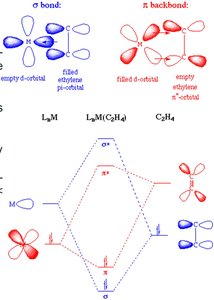
Alkene ligands bind to metals via the Dewar-Chatt-Duncanson model, involving σ donation and π-backbonding. Alkyne ligands are more electropositive and bind more tightly, often displacing alkenes.
Alkene Stability: Tetrasubstituted < trisubstituted < trans-disubstituted < cis-disubstituted < monosubstituted < ethylene
Alkyne Bonding: 2 or 4 electron donor, often non-linear in complexes
Reaction Chemistry of Organometallic Complexes
Ligand Dissociation and Association
Ligand dissociation and association change the electron count by ±2 but do not alter the oxidation state of the metal. Steric factors and ligand stability are important.
Dissociation: Easiest if ligand is stable alone (CO, olefin, phosphine, Cl-)
Association: Adds two electrons to the metal center
Oxidative Addition and Reductive Elimination
Oxidative addition increases the electron count and oxidation state by 2, while reductive elimination is the reverse process. These reactions are central to catalytic cycles.
Oxidative Addition: Formation of new M–X and M–Y bonds, often via concerted or stepwise mechanisms
Reductive Elimination: Coupling and elimination of two ligands, favored by bulky ligands
Insertion and Elimination Reactions
Insertion reactions involve the migration of a σ-bound group to a π-system ligand, reducing the electron count. Elimination is the reverse, increasing the electron count. These processes are key in polymerization and catalytic cycles.
1,1-Insertion: CO, isonitriles, SO2
1,2-Insertion: Olefins, leading to oligomers or polymers
β-Hydride Elimination: Reverse of insertion, common in alkyl complexes
Catalysis: Monsanto Acetic Acid Process
Methanol reacts with CO in the presence of a rhodium catalyst and iodide to produce acetic acid. The cycle involves oxidative addition, CO insertion, and reductive elimination.
Step 1: Oxidative addition of methyl iodide to [Rh(CO)2I2]-
Step 2: CO coordination and insertion
Step 3: Reductive elimination yields acetyl iodide and regenerates the catalyst
Summary Table: Electron Counting Examples
Compound | Ionic Count | Covalent Count |
|---|---|---|
CoII(Cp)2 | 7 + 12 = 19e | 9 + 10 = 19e |
TiIV(Cp)2Cl2 | 0 + 12 + 4 = 16e | 2 + 10 + 4 = 16e |
RhI(PPh3)3Cl | 8 + 6 = 16e | 10 + 6 = 16e |
W0(CO)6 | 6 + 12 = 18e | 6 + 12 = 18e |
Key Equations
Electron Counting (Covalent Model):
IR Stretching Frequency: (terminal) ; $ \nu_{CO} $ (bridging)
Conclusion
Organometallic chemistry is a dynamic field central to modern synthesis, catalysis, and materials science. Understanding electron counting, ligand types, bonding models, and reaction mechanisms is essential for predicting the structure and reactivity of organometallic complexes.
