 Back
BackOrganometallic Compounds: Structure, Reactivity, and Coupling Reactions
Study Guide - Smart Notes
 Tailored notes based on your materials, expanded with key definitions, examples, and context.
Organometallic Compounds
Definition and General Properties
Organometallic compounds are molecules that contain a covalent bond between a carbon atom and a metal. These compounds play a crucial role in synthetic chemistry due to their unique reactivity, which arises from the polarity of the carbon–metal bond.
Organometallic compound: Any compound featuring a direct carbon–metal covalent bond.
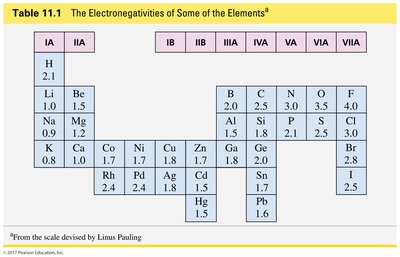
The nature of the carbon–metal bond depends on the relative electronegativity of the elements involved.
Organometallic compounds can act as nucleophiles or bases, depending on the metal and the reaction conditions.
Bond Polarity and Reactivity
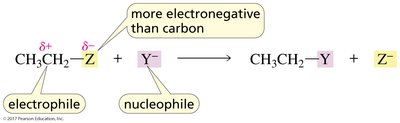
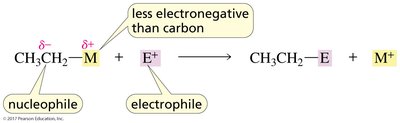
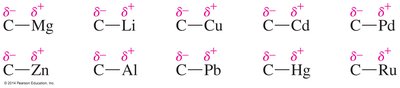
The polarity of the carbon–metal bond determines whether the carbon behaves as a nucleophile or an electrophile. When the metal is less electronegative than carbon, the carbon atom carries a partial negative charge (nucleophilic character).
Electronegativity: The tendency of an atom to attract electrons in a bond.
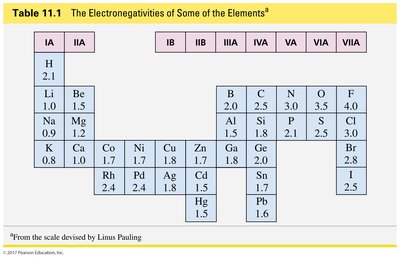
Metals less electronegative than carbon (e.g., Li, Mg) make the carbon nucleophilic.
Metals more electronegative than carbon make the carbon electrophilic.
Electronegativity Table
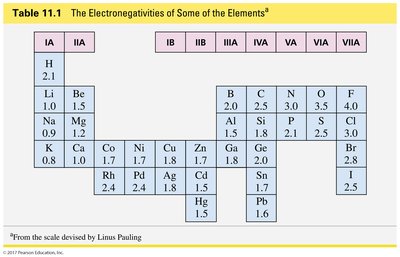
The reactivity of organometallic compounds can be rationalized using electronegativity values. The greater the difference between the metal and carbon, the more ionic the bond and the more reactive the compound.
Types of Organometallic Compounds
Organolithium Compounds
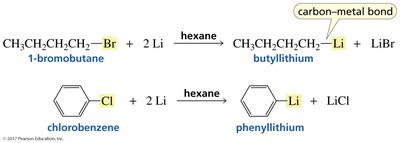
Organolithium compounds contain a carbon–lithium bond. Lithium is monovalent and forms highly reactive organometallics, often used as strong bases and nucleophiles in organic synthesis.
Preparation: Typically synthesized by reacting an alkyl or aryl halide with lithium metal in an aprotic solvent (e.g., hexane).
Reactivity: Highly reactive due to the large electronegativity difference (1.5) between C and Li.
Organomagnesium Compounds (Grignard Reagents)
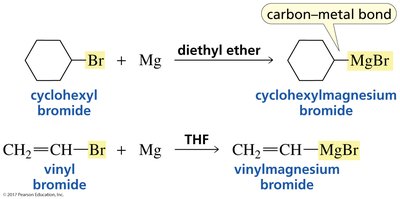
Organomagnesium compounds, known as Grignard reagents, have the general formula RMgX, where R is an alkyl or aryl group and X is a halogen. Magnesium is divalent and forms bonds with both carbon and halogen.
Preparation: Formed by reacting an alkyl or aryl halide with magnesium metal in an ether solvent (e.g., diethyl ether or THF).
Reactivity: Less reactive than organolithium compounds due to a smaller electronegativity difference (1.3).
Bond Polarity in Organometallic Compounds
The polarity of the carbon–metal bond in various organometallic compounds influences their reactivity and the types of reactions they undergo.
Reactivity as Bases and Nucleophiles
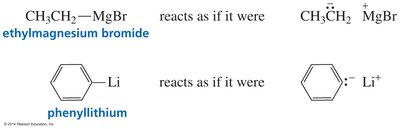
Organolithium and Grignard reagents are strong bases and nucleophiles. They react with even weak acids and are sensitive to moisture.
React with alcohols, alkynes, thiols, carboxylic acids, and water to form alkanes.
As nucleophiles, they add to epoxides and carbonyl compounds (aldehydes, ketones, esters), but not to alkyl halides.
Examples of Reactivity
Organolithium and Grignard reagents react as if the carbon atom bears a negative charge, making them powerful tools for carbon–carbon bond formation.
Organocuprates (Gilman Reagents)
Preparation and Structure
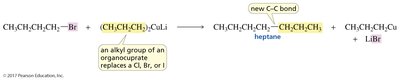
Organocuprates, also known as Gilman reagents, are prepared by reacting organolithium compounds with copper(I) iodide. They are less reactive than Grignard reagents and are used in coupling reactions.
General formula:
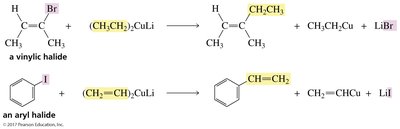
Used to couple alkyl groups with alkyl, aryl, or vinylic halides.

Coupling Reactions
Organocuprates participate in coupling reactions, where an alkyl group from the organocuprate replaces a halogen atom (Cl, Br, or I) on an alkyl, aryl, or vinylic halide, forming a new carbon–carbon bond.
The R group cannot be secondary or tertiary due to side reactions.
Palladium-Catalyzed Coupling Reactions
General Mechanism
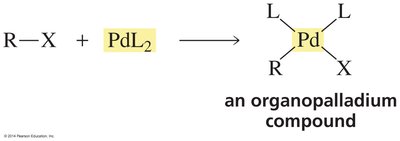
Palladium-catalyzed coupling reactions are powerful methods for forming carbon–carbon bonds, especially between sp2-hybridized carbons. These reactions use a palladium catalyst coordinated with ligands and proceed via a catalytic cycle.
Commonly used for vinylic and aryl halides.
Examples include Suzuki and Heck reactions.

Suzuki Reaction
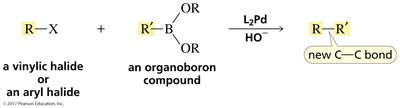
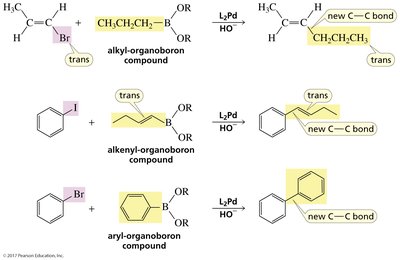
The Suzuki reaction couples a vinylic or aryl halide with an organoboron compound in the presence of a palladium catalyst and base, forming a new C–C bond. It is widely used for constructing biaryl and substituted alkene structures.
Requires a base (e.g., hydroxide) to activate the organoboron compound.
Highly selective and tolerant of various functional groups.

Heck Reaction
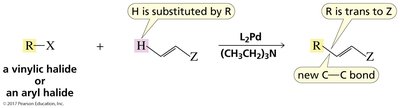
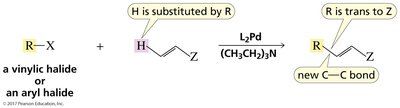
The Heck reaction couples a vinylic or aryl halide with an alkene in the presence of a palladium catalyst and a base, forming a substituted alkene. The reaction is regioselective and often gives trans products.
Best with symmetrical alkenes or those with a resonance-stabilized positive charge.
One of the sp2 carbons should be less hindered for optimal reactivity.
Limitations: Why Only Vinylic or Aryl Halides?
Coupling reactions are generally limited to vinylic or aryl halides because alkyl halides with β-hydrogens undergo elimination rather than coupling, leading to undesired side products.
Summary Table: Common Organometallic Reagents
Reagent | General Formula | Preparation | Reactivity | Common Uses |
|---|---|---|---|---|
Organolithium | RLi | Alkyl/aryl halide + Li | Very reactive, strong base/nucleophile | Deprotonation, nucleophilic addition |
Grignard | RMgX | Alkyl/aryl halide + Mg | Reactive, strong base/nucleophile | Nucleophilic addition to carbonyls |
Organocuprate (Gilman) | (R)2CuLi | RLi + CuI | Moderate reactivity | Coupling with alkyl/aryl/vinylic halides |
Pd-catalyzed (Suzuki, Heck) | Varies | Vinylic/aryl halide + organoboron/alkene | Selective, catalytic | Formation of C–C bonds |
Key Concepts and Applications
Organometallic compounds are essential for forming new carbon–carbon bonds in organic synthesis.
Their reactivity is governed by the polarity of the carbon–metal bond, which is determined by electronegativity differences.
Organolithium and Grignard reagents are strong bases and nucleophiles, while organocuprates are used for selective coupling reactions.
Palladium-catalyzed reactions (Suzuki, Heck) are powerful tools for constructing complex organic molecules.
