 Back
BackPeriodic Properties and Atomic Structure: Study Notes for General Chemistry
Study Guide - Smart Notes
 Tailored notes based on your materials, expanded with key definitions, examples, and context.
Periodic Properties of the Elements
Structure of the Periodic Table
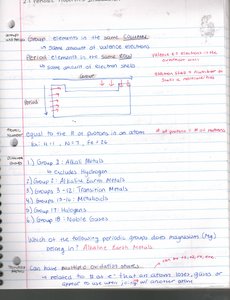
The periodic table organizes elements based on their atomic structure and recurring chemical properties. Elements are arranged in rows called periods and columns called groups.
Groups: Elements in the same column have similar valence electron configurations and chemical properties.
Periods: Elements in the same row have the same number of electron shells.
Group Number: Indicates the number of valence electrons for main group elements.
Period Number: Indicates the number of electron shells.
Classification of Elements
Elements are classified into several groups based on their properties:
Group 1: Alkali Metals
Group 2: Alkaline Earth Metals
Group 3-12: Transition Metals
Group 13-16: Metalloids
Group 17: Halogens
Group 18: Noble Gases
Example: Magnesium (Mg) belongs to the Alkaline Earth Metals (Group 2).
Periodic Properties: Introduction
Oxidation Potential
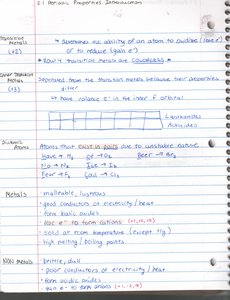
Oxidation potential measures the ability of an atom to lose electrons (oxidize) or gain electrons (reduce). Transition metals often have multiple oxidation states.
Transition Metals
Transition metals are separated from the main group elements and exhibit unique properties, such as variable oxidation states and colored compounds.
Metals vs. Nonmetals
Metals and nonmetals differ in their physical and chemical properties:
Metals: Malleable, lustrous, good conductors of electricity and heat, form basic oxides, and generally have high melting and boiling points.
Nonmetals: Brittle, dull, poor conductors of electricity and heat, form acidic oxides, and generally have low melting and boiling points.
Periodic Properties: Atomic Structure and Trends
Atomic Radius
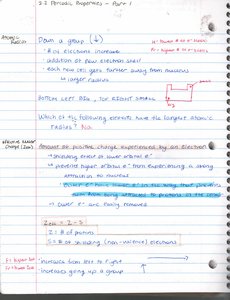
The atomic radius is the distance from the nucleus to the outermost electron shell. It varies across periods and groups:
Down a group: Atomic radius increases due to the addition of electron shells.
Across a period (left to right): Atomic radius decreases as nuclear charge increases, pulling electrons closer to the nucleus.
Effective Nuclear Charge (Zeff)
Effective nuclear charge is the net positive charge experienced by valence electrons. It is calculated as:
Where Z is the atomic number and S is the shielding constant.
Across a period, Zeff increases, making electrons more tightly bound to the nucleus.
Ionization Energy
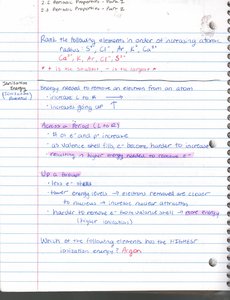
Ionization energy is the energy required to remove an electron from an atom.
Across a period: Ionization energy increases as Zeff increases.
Down a group: Ionization energy decreases as electrons are farther from the nucleus.
Successive Ionization Energies
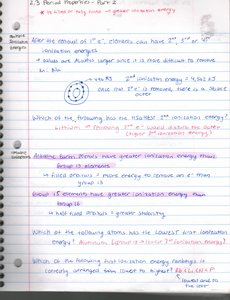
After the removal of one electron, atoms can have second, third, or higher ionization energies. Each successive ionization requires more energy, especially when removing electrons from a stable shell.
Electron Affinity
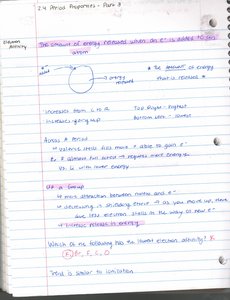
Electron affinity is the amount of energy released when an electron is added to a neutral atom.
Across a period: Electron affinity increases (becomes more negative).
Down a group: Electron affinity decreases.
Electronegativity
Electronegativity is the tendency of an atom to attract electrons in a chemical bond.
Across a period: Electronegativity increases.
Down a group: Electronegativity decreases.
Periodic Trends Summary
Summary of Periodic Trends
The periodic table shows clear trends in atomic properties:
Metallic Character: Increases down a group, decreases across a period.
Atomic Radius: Increases down a group, decreases across a period.
Ionization Energy: Decreases down a group, increases across a period.
Electron Affinity: Decreases down a group, increases across a period.
Electronegativity: Decreases down a group, increases across a period.
Atomic Structure
Structure of an Atom
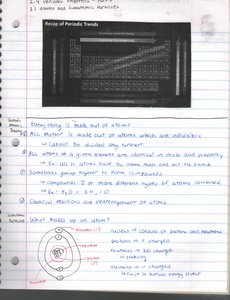
An atom consists of a nucleus (containing protons and neutrons) and electrons orbiting the nucleus. The nucleus is positively charged, while electrons are negatively charged.
Protons: Positively charged, determine atomic number.
Neutrons: Neutral, contribute to atomic mass.
Electrons: Negatively charged, occupy energy levels.
Key Points about Atoms
All matter is made of atoms, which are indivisible.
Atoms of the same element are identical in mass and properties.
Atoms combine in fixed ratios to form compounds.
Chemical reactions involve rearrangement of atoms.
Additional info:
Some diagrams and tables were inferred for clarity and completeness.
Periodic trends and atomic structure are foundational concepts for understanding chemical reactivity and bonding.
