 Back
BackPeriodic Properties of Elements: Effective Nuclear Charge, Atomic and Ionic Radii, Ionization Energy, and Electron Affinity
Study Guide - Smart Notes
 Tailored notes based on your materials, expanded with key definitions, examples, and context.
Periodic Properties of Elements
Introduction
The periodic properties of elements are fundamental to understanding chemical behavior. These properties, including effective nuclear charge, atomic and ionic radii, ionization energy, and electron affinity, are determined by the arrangement of electrons in atoms and their interactions with the nucleus and other electrons.
Effective Nuclear Charge (Zeff)
Definition and Concept
Effective nuclear charge (Zeff) is the net positive charge experienced by an electron in a many-electron atom. It accounts for both the attraction to the nucleus and the repulsion from other electrons. The outer (valence) electrons are shielded from the full nuclear charge by the inner (core) electrons.
Formula: where is the atomic number (number of protons) and is the screening constant (approximate number of core electrons).
Screening Effect: Core electrons repel valence electrons, reducing the full attractive force of the nucleus.
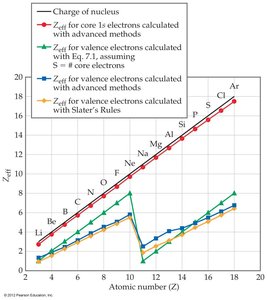
Trends: Zeff increases from left to right across a period due to increasing nuclear charge with relatively constant shielding.
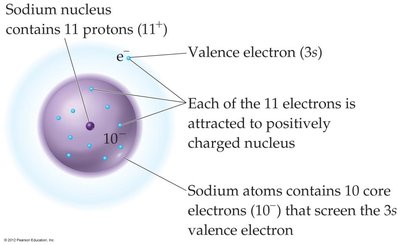
Example: For sodium (Na), , , so for the 3s valence electron.
Analogy: Screening Effect
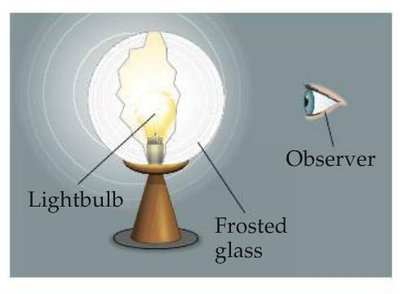
The screening effect can be compared to observing a lightbulb through frosted glass. The frosted glass partially blocks the light, just as core electrons partially block the nuclear charge from reaching the valence electrons.
Trends in Effective Nuclear Charge
Zeff increases across a period (left to right) as the number of protons increases but the number of core electrons remains nearly constant.
Zeff changes less significantly down a group because both Z and S increase.
Sizes of Atoms and Ions
Atomic Radii
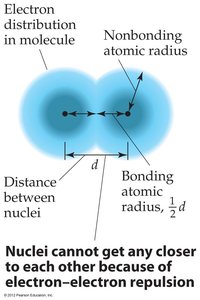
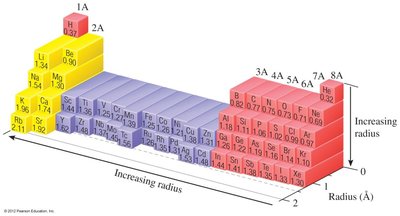
Atoms do not have sharply defined boundaries, but their size can be estimated using the bonding atomic radius, which is half the distance between nuclei of identical atoms bonded together.
Bond Length:
Trends: Atomic radius decreases across a period (left to right) due to increasing Zeff, and increases down a group as the principal quantum number (n) increases.
Ionic Radii
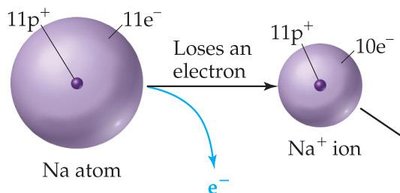
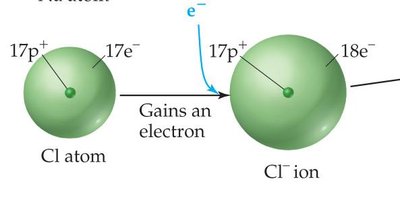
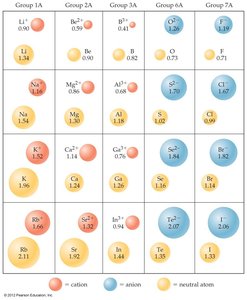
Ionic radius is the radius of an atom's ion. Cations (positively charged ions) are smaller than their parent atoms due to loss of electrons and reduced electron-electron repulsion. Anions (negatively charged ions) are larger than their parent atoms due to increased electron-electron repulsion.
Cations: Smaller than parent atoms.
Anions: Larger than parent atoms.
Isoelectronic Series: A group of ions with the same number of electrons. Within a series, ionic radius decreases as nuclear charge increases.
Ionization Energy
Definition and Trends
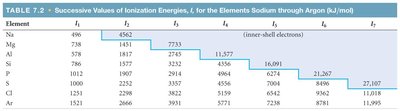
Ionization energy is the minimum energy required to remove an electron from a gaseous atom or ion. Successive ionization energies increase for a given element because each electron is removed from an increasingly positive ion.
First ionization energy (I1): Energy to remove the first electron.
Second ionization energy (I2): Energy to remove the second electron, and so on.
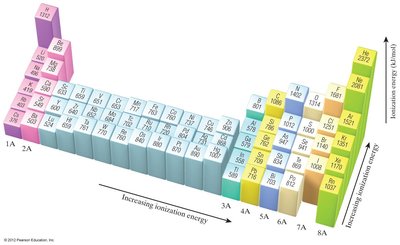
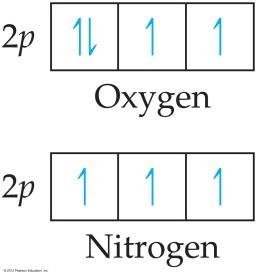
Trends: Ionization energy increases across a period (left to right) and decreases down a group.
There is a sharp increase in ionization energy when an inner-shell (core) electron is removed.
Electron Affinity
Definition and Trends
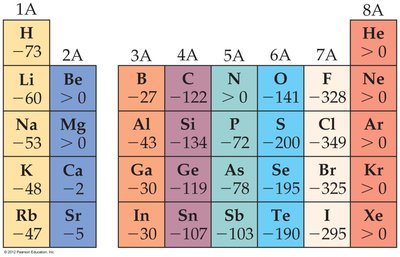
Electron affinity is the energy change when an electron is added to a gaseous atom. A more negative electron affinity indicates a greater tendency to gain an electron.
Trends: Electron affinity generally becomes more negative across a period (left to right) and less negative down a group.
Group 17 elements (halogens) have the most negative electron affinities, while Group 18 (noble gases) have positive or near-zero values due to their stable electron configurations.
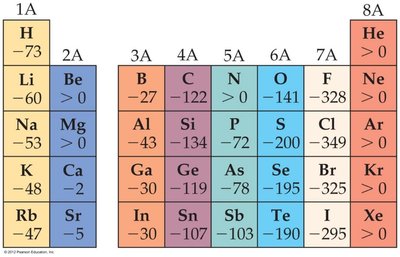
Comparison: Ionization Energy vs. Electron Affinity
Ionization energy measures the ease of losing an electron (energy absorbed).
Electron affinity measures the ease of gaining an electron (energy released).
Example: The electron affinity of chlorine is kJ/mol, indicating energy is released when Cl gains an electron.
Summary Table: Periodic Trends
Property | Across a Period (Left to Right) | Down a Group |
|---|---|---|
Effective Nuclear Charge (Zeff) | Increases | Slightly increases |
Atomic Radius | Decreases | Increases |
Ionic Radius | Decreases for isoelectronic ions | Increases |
Ionization Energy | Increases | Decreases |
Electron Affinity | Becomes more negative | Becomes less negative |
