 Back
Periodic Properties of Elements: Effective Nuclear Charge, Atomic and Ionic Radii, Ionization Energy, and Electron Affinity
Study Guide - Smart Notes
 Tailored notes based on your materials, expanded with key definitions, examples, and context.
Periodic Properties of Elements
Effective Nuclear Charge (Zeff)
The effective nuclear charge is a fundamental concept in understanding how electrons are attracted to the nucleus in multi-electron atoms. It determines many atomic properties, including size, ionization energy, and electron affinity.
Definition: The effective nuclear charge (Zeff) is the net positive charge experienced by an electron in a multi-electron atom. It accounts for both the attraction to the nucleus and the repulsion from other electrons.
Formula: Where Z is the atomic number (number of protons) and S is the screening constant (number of core electrons).
Screening Effect: Inner electrons partially shield outer electrons from the full nuclear charge, reducing the attraction felt by valence electrons.
Trend: Zeff increases from left to right across a period due to increasing nuclear charge and relatively constant shielding.
Example: For sodium (Na), ; for magnesium (Mg), .
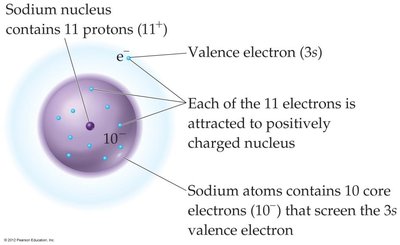
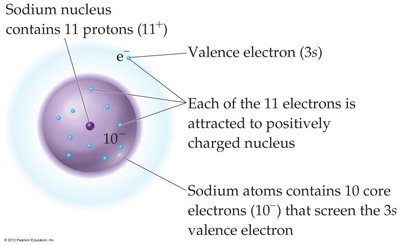
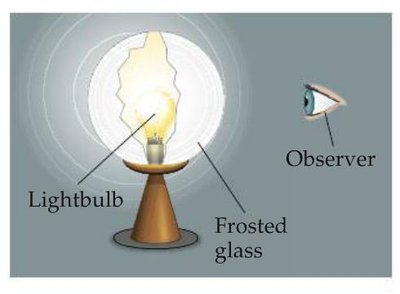
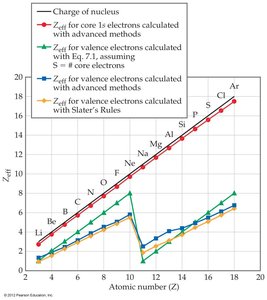
Additional info: The frosted glass analogy illustrates how core electrons 'screen' the nuclear charge, similar to how frosted glass reduces the intensity of light reaching an observer.
Sizes of Atoms and Ions
Atomic and ionic radii are important for understanding chemical bonding and molecular structure. Atoms do not have sharply defined boundaries, but their sizes can be estimated using bonding atomic radii.
Bonding Atomic Radius: Half the distance between nuclei in a molecule. Bond length = radius of atom 1 + radius of atom 2.
Trends:
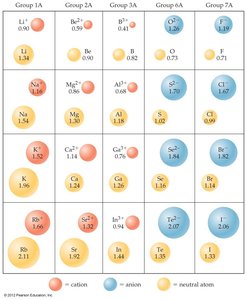
Atomic radius decreases across a period (left to right) due to increasing Zeff.
Atomic radius increases down a group due to increasing principal quantum number (n).
Ionic Radius: Cations are smaller than their parent atoms (loss of electrons reduces repulsion), while anions are larger (gain of electrons increases repulsion).
Isoelectronic Series: Ions with the same number of electrons; radius decreases with increasing nuclear charge.
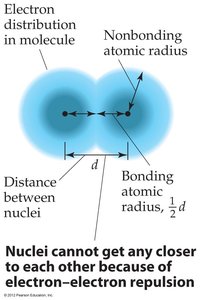
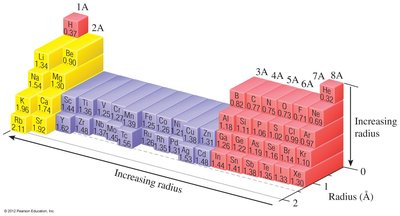
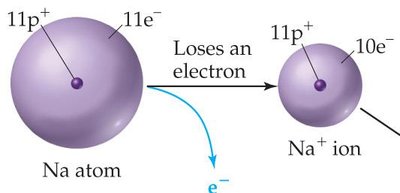
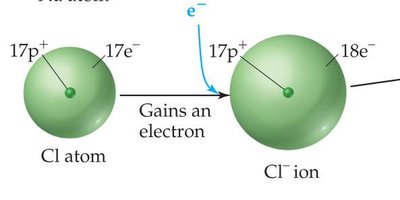
Example: The bond length of C–S is 0.77 Å + 1.02 Å = 1.79 Å.
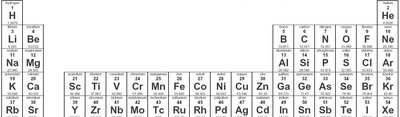
Additional info: The periodic table visualizations reinforce the trends in atomic and ionic radii across periods and groups.
Ionization Energy
Ionization energy is the minimum energy required to remove an electron from a gaseous atom or ion. It is a key indicator of an element's reactivity and chemical behavior.
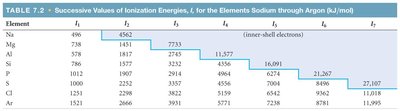
Successive Ionization Energies: Each successive removal of an electron requires more energy: .
Trend: Ionization energy increases across a period (left to right) and decreases down a group.
Sharp Increase: Ionization energy sharply increases when an inner-shell (core) electron is removed.
Example: For sodium: (first ionization energy).
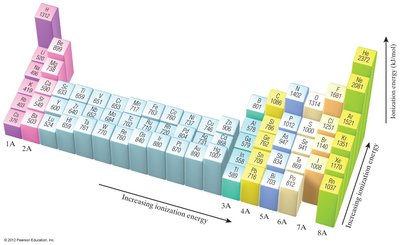
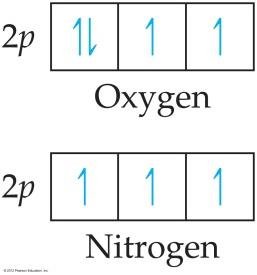
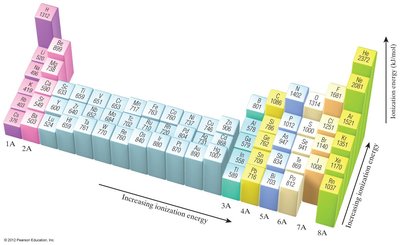
Additional info: The electron configuration diagrams for nitrogen and oxygen explain why nitrogen has a higher ionization energy due to half-filled stability.
Electron Affinity
Electron affinity is the energy change when an electron is added to a gaseous atom. It measures the atom's tendency to gain electrons.
Definition: Electron affinity is negative when energy is released upon electron addition.
Trend: Electron affinity becomes more negative across a period (left to right), but Group 18 elements have positive or near-zero values due to filled shells.
Comparison: Group 1 elements have more negative electron affinities than Group 2 due to their electronic configurations.
Example:
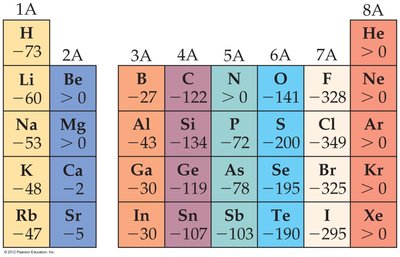
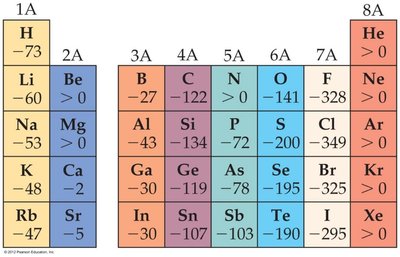
Additional info: Negative electron affinity values indicate favorable electron addition; Group 18 elements resist electron gain due to stable noble gas configurations.
Summary Table: Successive Ionization Energies
The following table compares the successive ionization energies for elements from sodium to argon, highlighting the sharp increase when a core electron is removed.
Element | I1 | I2 | I3 | I4 | I5 | I6 | I7 |
|---|---|---|---|---|---|---|---|
Na | 496 | 4562 | 6912 | 9544 | 13352 | 16600 | 21200 |
Mg | 738 | 1451 | 7733 | 10542 | 13630 | 18020 | 21700 |
Al | 578 | 1817 | 2745 | 11577 | 14842 | 18300 | 23000 |
Si | 786 | 1577 | 3232 | 4366 | 16091 | 19800 | 24500 |
P | 1012 | 1907 | 2914 | 4956 | 6274 | 21267 | 27107 |
S | 1000 | 2252 | 3357 | 4556 | 7004 | 8496 | 27107 |
Cl | 1251 | 2666 | 3859 | 5158 | 6548 | 9400 | 11198 |
Ar | 1521 | 3931 | 5771 | 7238 | 8781 | 11995 | ? |
Additional info: The sharp increase in ionization energy after removal of valence electrons indicates the start of core electron removal.
