 Back
Periodic Properties of the Elements: Atomic Size, Effective Nuclear Charge, and Ionic Properties
Study Guide - Smart Notes
 Tailored notes based on your materials, expanded with key definitions, examples, and context.
Periodic Properties of the Elements
The Explanatory Power of the Quantum-Mechanical Model
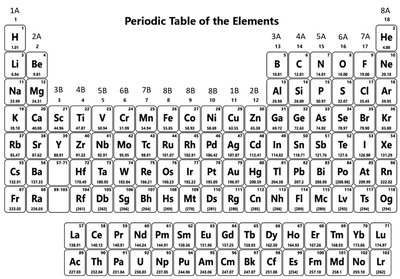
The quantum-mechanical model explains the periodicity of elemental properties based on electron configurations, especially the number of valence electrons. Elements with completely-filled quantum levels (such as noble gases) are chemically inert due to their low electron energy. Elements near noble gases are highly reactive, as they can easily gain or lose electrons to achieve a noble gas configuration.
Alkali metals (Group 1A): Highly reactive, have one electron more than the nearest noble gas.
Halogens (Group 7A): Highly reactive, have one electron less than the nearest noble gas.
Alkaline earth metals (Group 2A): Reactive, have two electrons more than the nearest noble gas.
Noble gases (Group 8A): Inert, due to completely-filled orbitals.
Periodic Trends in Atomic Size and Effective Nuclear Charge
Atomic size is determined by the spatial distribution of electrons. The boundaries of electron orbitals are not definite, so atomic radius is defined in several ways:
Nonbonding (van der Waals) Radius: Half the distance between nuclei of adjacent, non-bonded atoms in a solid.
Bonding (Covalent) Radius: Half the distance between nuclei of two bonded atoms (for nonmetals), or between adjacent atoms in a metal crystal.
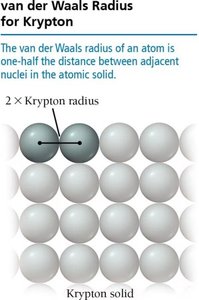
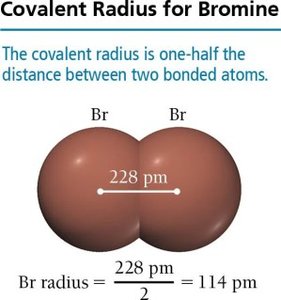
Bond length between two covalently bonded atoms is the sum of their atomic radii. For example, the bond length of I–Cl in ICl is 232 pm, calculated as 133 pm (I) + 99 pm (Cl).
Atomic radius trends:
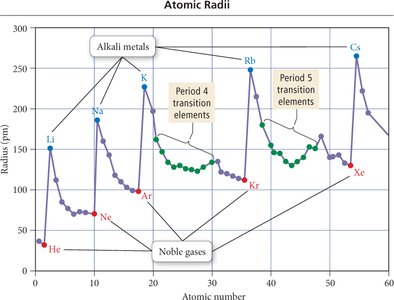
Peaks with each alkali metal, dips with noble gases in a period.
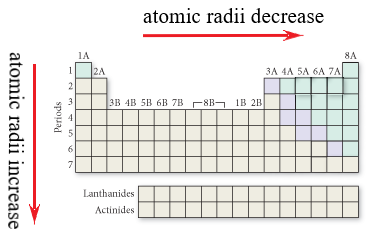
Down a group: Atomic radius increases due to higher principal quantum number (n).
Across a period: Atomic radius decreases due to increased effective nuclear charge (Zeff).
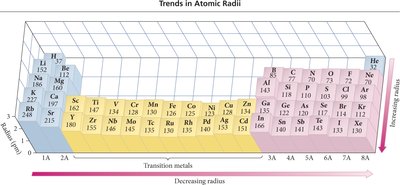
Effective Nuclear Charge (Zeff)
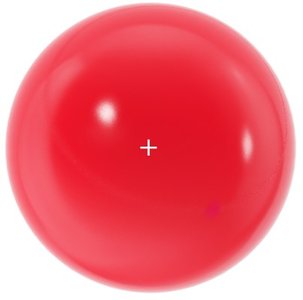
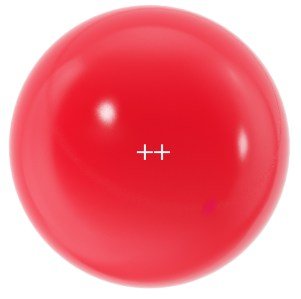
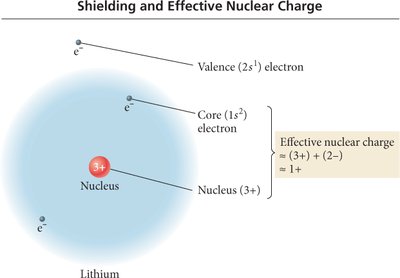
Effective nuclear charge is the net positive charge experienced by an electron in a multi-electron atom. It is calculated as:
Zeff = (actual nuclear charge) – (charge screened by other electrons)
Core electrons shield outer electrons from the full nuclear charge, but outer electrons do not shield each other efficiently. This explains why atomic radius decreases across a period: as Zeff increases, electrons are pulled closer to the nucleus.
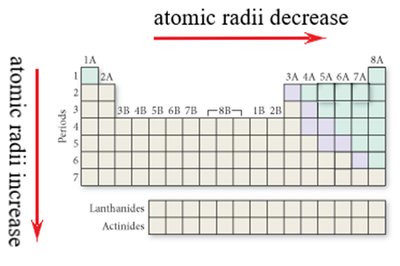
Main group elements:
Down a column: n and size increase, atomic radii increase.
Across a row: Zeff increases, atomic radii decrease.
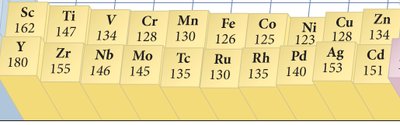
Transition group elements: As we move down a column, size increases. Across a row, atomic radii remain roughly constant (except for the first two elements), because electrons are added to the d orbital at the n–1 level, and the outermost electrons experience similar Zeff.
Examples of Atomic Radius Comparisons
Periodic trends can be used to compare atomic sizes:
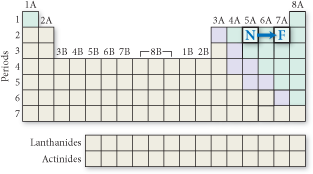
N vs F: F is smaller due to higher Zeff.
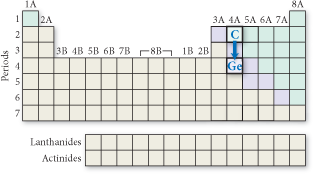
C vs Ge: Ge is larger due to being lower in the group.
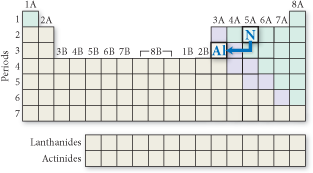
N vs Al: Al is larger due to being further left and lower in the group.
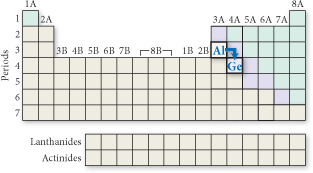
Al vs Ge: Ge is larger due to being lower in the group.
Ions: Electron Configurations, Magnetic Properties, Ionic Radii, and Ionization Energy
When atoms form ions, their electron configurations change:
Cations: Formed by losing electrons; electrons are removed from the highest n orbital first.
Anions: Formed by gaining electrons; electrons are added to the highest n orbital.
For transition metals, electrons are removed from the highest n orbital (usually 4s) before the (n–1)d orbitals.
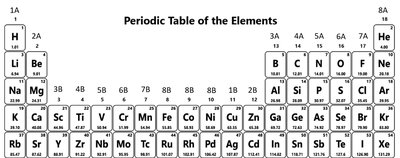
Example: Zn = [Ar] 4s2 3d10; Zn2+ = [Ar] 3d10 (electrons removed from 4s).
Magnetic Properties
Diamagnetic: All electrons are paired; not attracted to a magnetic field.
Paramagnetic: Contains unpaired electrons; attracted to a magnetic field.

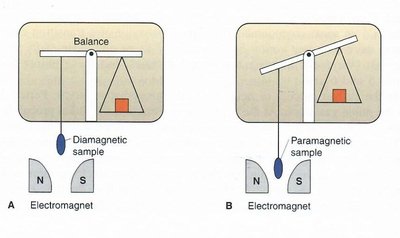
Ionic Radii
Formation of ions affects atomic radius:
Cations: Smaller than their neutral atoms due to loss of outermost electrons.
Anions: Larger than their neutral atoms due to increased electron-electron repulsion.
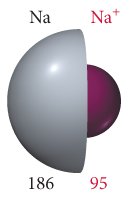
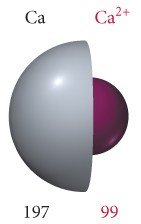
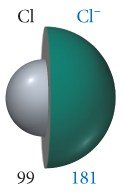
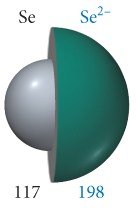
Isoelectronic Species
Atoms and ions with the same number of electrons and identical electron configurations are called isoelectronic. However, their sizes differ due to varying nuclear charges.
Na+ and Ne: Same electron configuration, but Na+ has a higher nuclear charge and is smaller.
Cl− and Ar: Same electron configuration, but Ar has a higher nuclear charge and is smaller.



Practice and Application
Arrange S2−, Cl−, K+, and Ca2+ in order of increasing ionic radii.
Compare the radii of C-12 and C-13 isotopes: C-12 = C-13 (isotopes have nearly identical radii).

Summary Table: Atomic and Ionic Radii Trends
Trend | Direction | Effect |
|---|---|---|
Atomic radius | Down a group | Increases |
Atomic radius | Across a period | Decreases |
Cation radius | Compared to atom | Smaller |
Anion radius | Compared to atom | Larger |
Isoelectronic ions | Higher nuclear charge | Smaller radius |
