 Back
Periodic Properties of the Elements: Electron Configurations and the Periodic Table
Study Guide - Smart Notes
 Tailored notes based on your materials, expanded with key definitions, examples, and context.
Periodic Properties of the Elements
Electron Configurations: How Electrons Occupy Orbitals
Understanding how electrons fill atomic orbitals is fundamental to predicting chemical properties. The arrangement of electrons is governed by quantum numbers and several key principles.
Quantum Numbers: Each electron in an atom is described by four quantum numbers: principal (n), angular momentum (l), magnetic (ml), and spin (ms).
Pauli Exclusion Principle: No two electrons in an atom can have the same set of four quantum numbers. For example, in a hydrogen atom (1s1): - n = 1, l = 0, ml = 0, ms = +½ In a helium atom (1s2): - Spin up electron: n = 1, l = 0, ml = 0, ms = +½ - Spin down electron: n = 1, l = 0, ml = 0, ms = –½
Degeneracy: For hydrogen, all orbitals with the same n are degenerate (same energy). In multi-electron atoms, sublevels (s, p, d, f) of the same n are not degenerate due to electron-electron interactions.
Shielding and Penetration
Electrons in atoms experience varying degrees of attraction to the nucleus due to shielding and penetration effects.
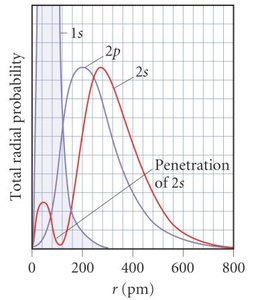
Shielding: Inner electrons partially block the attraction between the nucleus and outer electrons, reducing the effective nuclear charge felt by the latter.
Penetration: Electrons in orbitals that can get closer to the nucleus (e.g., 2s compared to 2p) experience a greater effective nuclear charge. This explains why 2s electrons are lower in energy than 2p electrons in multi-electron atoms.
Example: In lithium (3Li), the 2s1 electron can penetrate the region occupied by the 1s2 electrons, experiencing more of the nuclear charge.
Energy Ordering of Orbitals in Multi-Electron Atoms
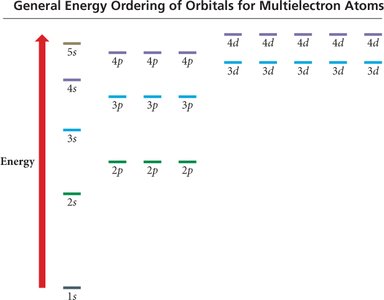
In atoms with more than one electron, the energy of orbitals increases in the order: 1s < 2s < 2p < 3s < 3p < 4s < 3d < 4p < 5s < 4d < 5p < 6s < 4f < 5d < 6p < 7s, etc. This ordering is a result of both shielding and penetration effects.
Sublevel Splitting: For the same principal quantum number n, s < p < d < f in energy due to penetration and shielding.
Hund’s Rule: When filling degenerate orbitals (orbitals of the same energy), electrons fill them singly first, with parallel spins, to maximize total spin multiplicity.
Electron Configurations, Valence Electrons, and the Periodic Table
The periodic table is structured according to the filling of atomic orbitals. Electron configurations determine the chemical properties of elements.
Valence Electrons: Electrons in the outermost principal energy level (highest n value) are called valence electrons. For transition metals, outermost d electrons are also considered valence electrons.
Periodic Trends: As you move down a group, the number of valence electrons remains the same (except for helium).
d-Block Elements: For transition metals, the d orbitals being filled have n equal to the period number minus one (n – 1).
Special Stability: Half-filled and fully filled d subshells confer extra stability (e.g., Mo, Cr, Cu have anomalous configurations).
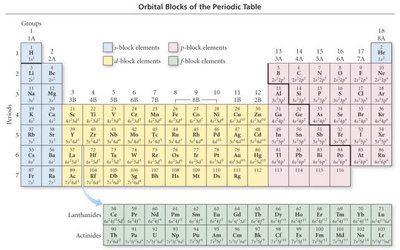
Table: Quantum Numbers for the First Two Electrons
Electron | n | l | ml | ms |
|---|---|---|---|---|
Hydrogen (1s1) | 1 | 0 | 0 | +½ |
Helium (1s2) - Spin up | 1 | 0 | 0 | +½ |
Helium (1s2) - Spin down | 1 | 0 | 0 | –½ |
Key Equations
Quantum Numbers:
Electron Configuration Notation: Example for Carbon:
Additional info: The stability of half-filled and fully filled subshells is due to exchange energy and symmetry. The periodic table's structure reflects the order of orbital filling, which is crucial for understanding chemical reactivity and periodic trends.
