 Back
Periodic Properties of the Elements: Ionization Energy, Electron Affinity, and Metallic Character
Study Guide - Smart Notes
 Tailored notes based on your materials, expanded with key definitions, examples, and context.
Periodic Properties of the Elements
Ionization Energy
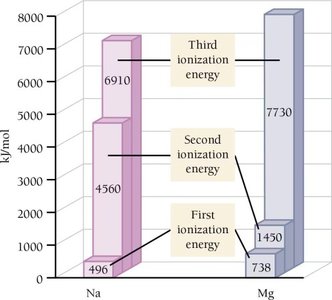
Ionization energy (IE) is the energy required to remove an electron from an atom in the gaseous state. It is always positive, as removing an electron requires energy. The first ionization energy (IE1) refers to the energy needed to remove the first electron, while subsequent ionization energies (IE2, IE3, etc.) refer to the removal of additional electrons.
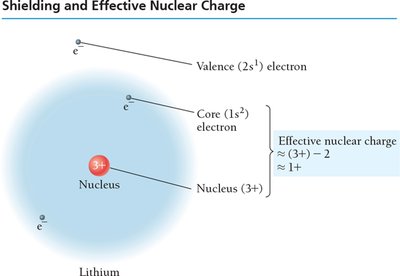
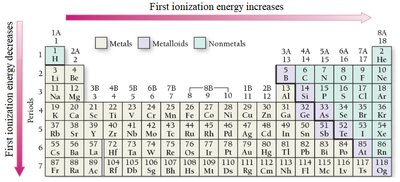
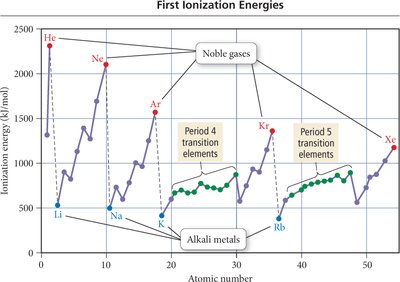
IE1 Trend: Increases from left to right across a period due to increasing effective nuclear charge (Zeff), making electrons harder to remove.
IE1 Trend: Decreases down a group as atomic size increases and electrons are farther from the nucleus.
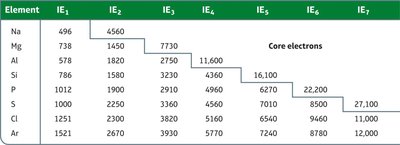
Successive Ionization Energies: Removing a valence electron requires less energy than removing a core electron. Large jumps in ionization energy occur when core electrons are removed.
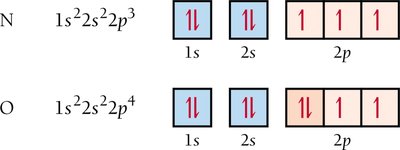
Exceptions: IE1 for B is less than Be due to the transition from s to p block. IE1 for O is less than N due to electron pairing and repulsion in O.
Example: Which element has higher IE1: Al or S? S, because it is further right in the period.
Electron Affinity
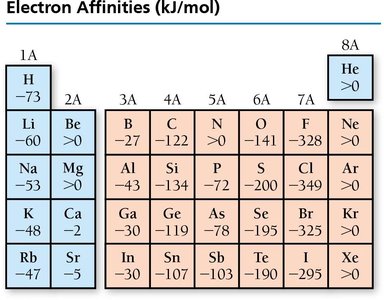
Electron affinity (EA) is the energy change when an atom or ion in the gaseous state gains an electron. EA is usually negative, indicating energy is released when an electron is added.
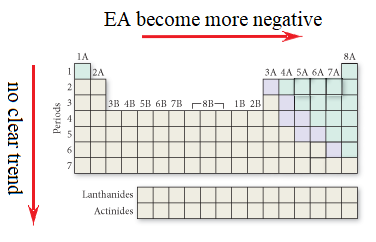
Trend: EA becomes more negative across a period (left to right) for main group elements, due to increasing Zeff.
Trend: No clear trend down a group; EA may become less negative as electrons are added to orbitals farther from the nucleus.
Exceptions: Group 5A elements (e.g., N) have less negative EA due to electron repulsion in half-filled p orbitals.
Example: Cl has a more negative EA than Na because Cl achieves noble gas configuration upon gaining an electron.
Metallic Character
Metallic character describes how readily an element loses electrons. Metals are good conductors, malleable, ductile, and tend to lose electrons. Nonmetals are poor conductors and tend to gain electrons.
Trend: Metallic character decreases across a period (left to right).
Trend: Metallic character increases down a group.
Reason: As ionization energy decreases, metallic character increases.
Example: Arrange Si, Cl, Na, Rb in increasing metallic character: Cl < Si < Na < Rb.
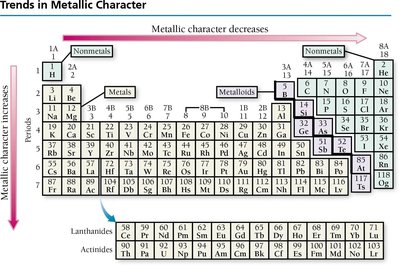
Summary of Periodic Trends
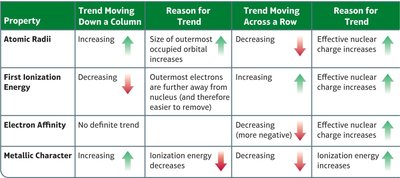
The electronic configuration of elements explains the periodic trends in atomic size, ionization energy, electron affinity, and metallic character. These trends are summarized in the table below:
Property | Trend Down a Column | Reason | Trend Across a Row | Reason |
|---|---|---|---|---|
Atomic Radii | Increasing | Size of outermost occupied orbital increases | Decreasing | Effective nuclear charge increases |
First Ionization Energy | Decreasing | Outermost electrons are further from nucleus | Increasing | Effective nuclear charge increases |
Electron Affinity | No definite trend | --- | Decreasing (more negative) | Effective nuclear charge increases |
Metallic Character | Increasing | Ionization energy decreases | Decreasing | Ionization energy increases |
Key Equations
Ionization Energy:
Electron Affinity:
Effective Nuclear Charge:
Additional info: The notes include exceptions to periodic trends, explanations of electron configurations, and practice questions to reinforce understanding of the concepts.
